Elvis Presley Broke Down in Tears When a Little Girl Played His Song on Her Father’s Old Guitar
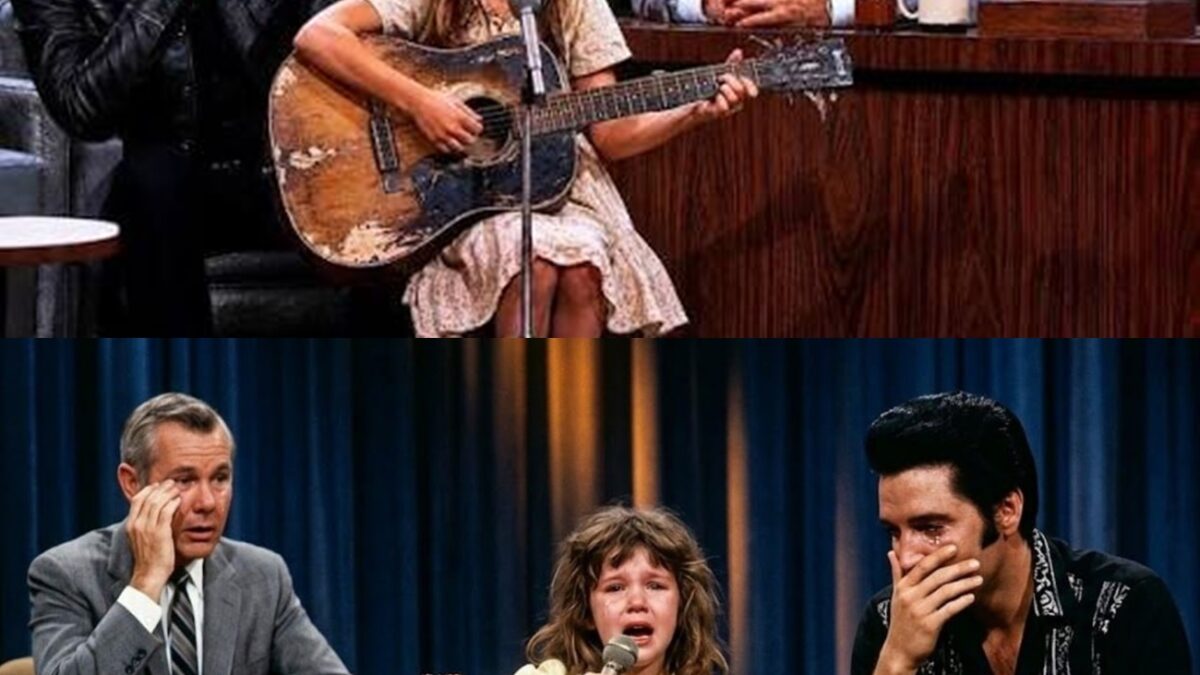
Elvis Presley Broke Down in Tears When a Little Girl Played His Song on Her Father’s Old Guitar
Los Angeles, 1969. The television lights were so bright that they seemed to erase the darkness outside. Thousands of people were watching from their homes that night, expecting exactly what television had promised them. Laughter, music, famous faces, and another unforgettable evening of entertainment. The cameras were ready.
The audience was restless with excitement. The host was rehearsing his opening lines for the final time. And behind a closed dressing room door, Elvis Presley was staring at himself in the mirror. He had learned how to live beneath bright lights. He knew how to smile when cameras appeared.
He knew how to move his shoulders and make an entire audience scream. He knew how to walk onto a stage and instantly become the man America expected him to be. Elvis Presley, the king, the voice, the legend. But that night, something was about to happen that had nothing to do with fame. Because somewhere inside that television studio was a 7-year-old girl holding a battered old guitar.
And within the next few minutes, she would remind Elvis of the one thing he had almost forgotten. Why he had started singing in the first place. Elvis adjusted his black jacket and looked at his reflection. His hair was perfectly styled. Everything about him looked controlled. Then came a knock. Mr. Presley? Elvis turned.
5 minutes. He nodded. Thank you. The producer hesitated. There’s something else. Elvis raised an eyebrow. What is it? There’s a little girl here, 7 years old. Elvis looked confused. A singer? Sort of. What does that mean? The producer smiled nervously. She brought a guitar. Elvis gave a small laugh. Well, that’s not unusual.
The producer looked toward the hallway. You’ll understand when you see it. Then he disappeared. Elvis remained alone for another moment. Something about the man’s expression bothered him. He couldn’t explain why. Then he heard the audience applauding outside. The show had begun. Elvis opened the door and walked toward the studio.
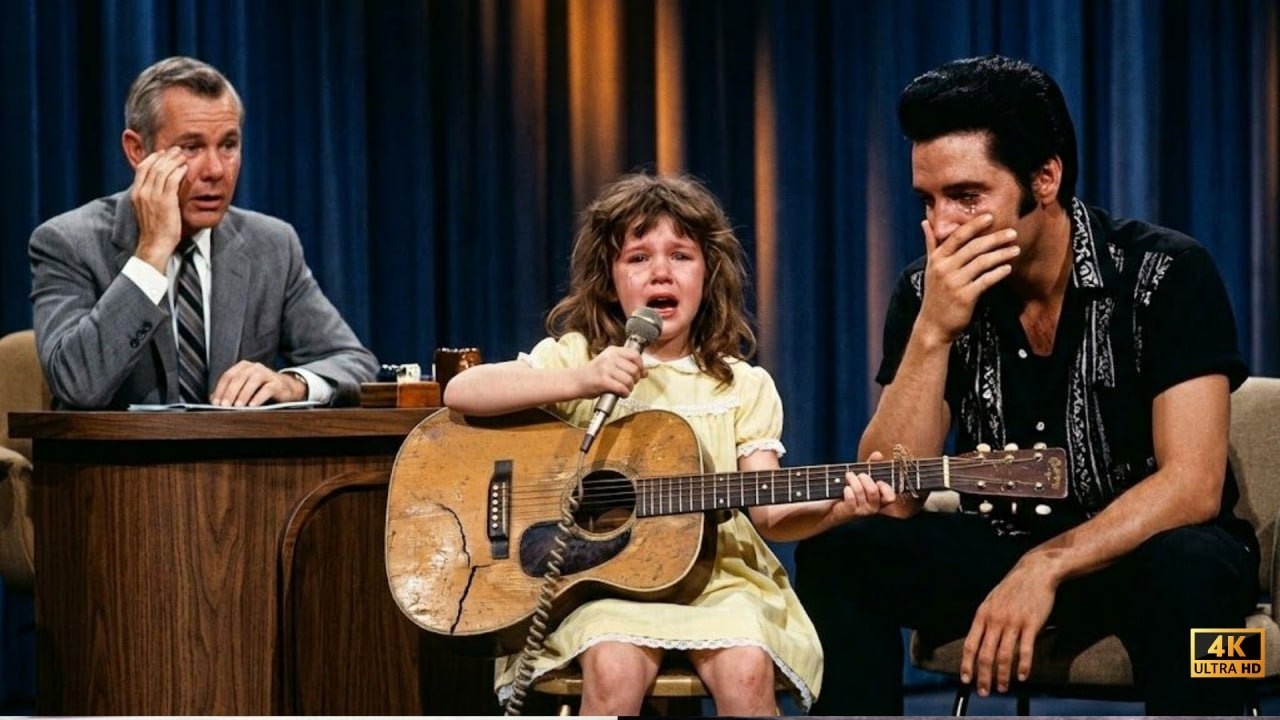
Music filled the hallway. The host was introducing guests. People were laughing. Everything looked normal until Elvis saw her. A little girl sitting near the side of the stage. She wore a simple cream-colored dress. Her brown hair rested over her shoulders. And across her lap was an old acoustic guitar. Elvis stopped.
He stared at the instrument. It looked like it had survived a lifetime. The wood was scratched. The finish was faded. One side had clearly been repaired. The bridge looked worn. Even from several feet away, Elvis could see that the guitar had been loved far more than it had been protected. Then the little girl looked up. Their eyes met.
For a moment, neither said anything. Then she smiled shyly. Elvis smiled back. You play that thing? Yes, sir. Elvis chuckled. Does it play you back? The girl giggled. Sometimes. That answer made Elvis laugh. The nervousness disappeared from her face for just a second. What’s your name? Emily. Well, Emily, Elvis pointed at the guitar.
That’s a mighty old guitar. Emily looked down at it. It belonged to my father. Something changed in Elvis’s expression. Your father? She nodded. He taught me. Elvis looked at her again, more carefully this time. There was something behind those words. Before he could ask what it was, a stage manager called everyone back.
The cameras were rolling. The host turned toward the audience with a smile. And now, we have a very special young guest with us tonight. The audience applauded. Emily walked onto the stage. Her hands were trembling. The host crouched beside her. Are you nervous? Emily nodded. A little. The audience laughed gently.
The host pointed toward the guitar. That’s quite an instrument you brought with you. Emily held it tighter. My father gave it to me. The room became quieter. And what are you going to play? Emily looked toward Elvis. The camera followed her eyes. Elvis was sitting only a few feet away. He leaned forward. Emily whispered, His song.
The audience reacted immediately. The host turned toward Elvis. Well, I think someone just volunteered you for something. Elvis laughed. He looked at Emily. What are you going to play? She answered softly, Love Me Tender. The audience applauded. Elvis’s smile softened. That’s a beautiful song. Emily lowered her eyes toward the guitar.
She placed her fingers around the strings, but there was a problem. The guitar was badly worn. One string looked dangerously weak. The tuning was slightly off. A technician hurried toward the stage. Emily shook her head. I can do it. The technician stopped. Elvis watched her carefully. The technician stepped away.
The studio became silent. Emily took a deep breath. Then she touched the strings. The first chord sounded rough, not polished, not perfect, but honest. Elvis stopped smiling. He listened. Emily continued. Her tiny fingers struggled with the chords. The old guitar buzzed between notes. A few people smiled nervously.
Others leaned forward. But Elvis wasn’t looking at the guitar anymore. He was looking at her hands. Small hands. Shaking hands. Determined hands. And suddenly, something inside him moved. Because those hands reminded him of another time. A time before sold-out shows, before television cameras, before expensive clothes, before millions of people knew his name.
A time when music wasn’t about ratings. It wasn’t about records. It wasn’t about being called a king. It was simply about holding an instrument and hoping someone would listen. Emily reached the first verse. Her voice was quiet, almost fragile. But she didn’t stop. She looked toward Elvis. He didn’t look away.
For a few seconds, the television studio seemed to disappear. There were no cameras, no producers, no celebrities, no audience. There was only a little girl with an old guitar and a man who suddenly remembered the boy he used to be. The boy who had once dreamed that music might take him somewhere. The boy who had once wondered whether anyone would ever hear his voice.
Emily’s fingers slipped. One chord came out wrong. She stopped just for half a second. A few people gasped. Emily looked frightened. She looked at the guitar. Then she looked at Elvis. Elvis didn’t say a word. He simply nodded. Once. Keep going. Emily took a breath and continued. Her voice grew stronger. The trembling disappeared.
By the final lines, she wasn’t looking at the audience anymore. She wasn’t looking at the cameras. She was looking directly at Elvis. And Elvis was looking directly back. The final note faded. Silence. One second. Two. Nobody moved. Then the audience exploded. Applause filled the studio. Emily looked stunned.
She looked toward Elvis as if asking whether she had really done it. Elvis stood. The applause became even louder. He walked toward her. Emily lowered the guitar. Elvis stopped in front of her. You did good. Emily looked up. Really? Elvis nodded. Really good. The host smiled. You seemed pretty moved by that. Elvis didn’t answer immediately.
His eyes moved toward the guitar. Where did you get this? Emily held it closer. It was my father’s. Elvis looked at her. What happened to him? Emily’s smile disappeared. My father passed away last year. The studio became silent again. Elvis slowly knelt down until he was at her eye level. I’m sorry. Emily nodded.
He used to play this for me. Elvis looked at the guitar. Is that why you brought it tonight? Emily nodded. He told me that if I ever got scared she paused. I should play. Elvis swallowed. And were you scared? Emily looked toward the audience. Yes. Then she looked back at him. But I remembered what he said. Elvis looked away. For the first time that evening, the cameras captured something completely different.
The confident entertainer was gone. The king was gone. There was only a man remembering. He remembered his own childhood. He remembered the people who believed in him before the world did. He remembered how music had once been something simple, something sacred. And now, standing in front of him, was a little girl carrying her father’s memory in the form of a battered guitar.
Elvis reached toward it. May I see it? Emily handed it to him. He turned it carefully. He examined every scratch, every repair, every worn section of wood. Then he noticed something carved into the back. A small set of initials. He ran his fingers across them. Your father’s initials? Emily nodded. He put them there.
Elvis stared at the letters for several seconds. Then he handed the guitar back. Emily looked at him. Elvis smiled. Then this isn’t a broken guitar. She looked confused. What is it? A guitar with a history. A soft wave of applause moved through the room. But Elvis wasn’t finished. He turned toward the musicians.
Can we get another microphone? The host raised his eyebrows. What are you planning? Elvis smiled. I think Emily and I have another song to play. The audience erupted. Emily’s eyes became enormous. Me? Elvis nodded. You. The musicians began preparing. The cameras moved closer. The producer backstage stared at the stage in disbelief.
“This wasn’t planned.” he whispered. He was right. Nobody had planned this. Nobody had written it into the script. Nobody had expected Elvis Presley to sit beside a 7-year-old girl and share the stage with her battered guitar. But before the next song began, there was one thing Elvis still didn’t know. He didn’t know the full story behind that guitar.
He didn’t know why Emily’s father had wanted her to bring it there. And he certainly didn’t know that within the next few minutes, a small folded piece of paper would reach his hands. And what he read on that paper would make it almost impossible for Elvis Presley to hold back his tears. Before we continue, tell us something.
If you had been sitting inside that studio in 1969, watching Emily perform on that broken guitar, what would you have felt? Would you have been nervous for her? Would you have cheered? Or would her performance have reminded you of someone you loved? Tell us in the comments where you’re watching from. And if stories like this mean something to you, take a moment to like this video.
Share it with someone who loves classic music, and subscribe. Because the most emotional part of Emily’s story was still waiting. Studio was still buzzing when Elvis sat beside Emily. The applause had barely faded, but the little girl seemed to have forgotten about the audience completely. Her fingers remained wrapped around the old guitar.
Elvis looked at her. You ready? Emily nodded. I think so. Elvis smiled. Don’t think too much. Just play. The musicians began a soft introduction. Emily placed her fingers on the strings. The first chord trembled. Then Elvis began to sing. His voice was calm, warm, almost gentle. And something unexpected happened.
He didn’t overpower her. He didn’t try to turn the moment into an Elvis Presley performance. Instead, he lowered his voice and gave Emily room. Room to breathe. Room to make mistakes. Room to be 7 years old. Emily joined him. At first, her voice was barely above a whisper. But Elvis kept looking at her. Not at the cameras.
Not at the audience. At her. And slowly, the fear began to disappear. Her fingers stopped shaking. Her voice became stronger. The battered guitar still buzzed between some of the chords. One note sounded wrong. Another came late. But Elvis never corrected her. He simply smiled. Keep going. Emily did. By the final verse, something had changed.
She wasn’t the frightened little girl who had walked onto the stage minutes earlier. She was performing. Not perfectly. Not professionally. But honestly. And somehow, that made the entire room listen harder. When the final note faded, there was a moment of silence. Elvis gently placed his hand on the guitar. That’s the sound. The host looked at him.
The sound of what? Elvis stared at Emily. The reason we start singing in the first place. The audience applauded softly. But the host wasn’t finished. He looked at Emily. Your father taught you this song, didn’t he? Emily nodded. Yes. Was he a musician? She shook her head. No. The host smiled. He just loved music? Emily nodded.
He loved it a lot. Elvis smiled. Sometimes that’s all you need. The host paused. Then his expression became more serious. You said your father passed away last year. Emily’s eyes lowered. Yes. How old were you? Six. A quiet murmur moved through the audience. Elvis looked down. Emily continued. He got sick. Her fingers moved slowly across the guitar.
He couldn’t play anymore. Elvis looked at her. So, you played for him? Emily nodded. Every night. The studio became silent. Sometimes he couldn’t talk, she continued. But when I played She smiled through the sadness. He would smile. Elvis didn’t move. Those words seemed to reach somewhere deep inside him. Then Emily reached into the pocket of her dress.
She pulled out a small folded piece of paper. I was supposed to give this to you. Elvis looked surprised. To me? Emily nodded. She handed it over. Elvis took the paper carefully. He unfolded it. There were only a few handwritten lines. His eyes moved across the page. Once, then again. The smile disappeared from his face. The host noticed immediately.
Is everything okay? Elvis folded the paper slightly. Yeah. But his voice was different. The host waited. Elvis looked at Emily. Your father wrote this? Emily nodded. He wrote it before he died. The room became completely still. Elvis looked at the paper again. Then he asked quietly, Why didn’t you tell me earlier? Emily shrugged.
I was scared. Elvis looked at her for several seconds. Then he unfolded the paper once more. The host leaned slightly toward him. What does it say? Elvis didn’t answer immediately. His eyes remained fixed on the handwriting. Finally, he looked up. Her father wrote something for me. The audience waited. Elvis took a slow breath.
Then he read the message aloud. Emily. His voice softened. If you ever get the chance to meet Elvis, don’t ask him for anything. The audience became even quieter. Elvis continued. Just tell him thank you. He stopped. For several seconds, he couldn’t continue. The host looked at him. Thank you for what? Emily answered.
For giving my father something to believe in. Elvis looked at her. Something in his face changed. What did I give him? Emily held the guitar tightly. He loved your music. Elvis lowered his eyes. Emily continued. He used to listen to your records whenever life got hard. Elvis swallowed. He told me that your songs helped him.
A long silence followed. He said that sometimes music made him believe things could get better. Elvis looked toward the floor. For a moment, he seemed almost unable to speak. Because those were the kinds of stories people rarely told celebrities. The world usually told Elvis how successful he was. How famous he was.
How many records he had sold. How many people screamed when he walked onto a stage. But this was different. This was one man’s story. A man Elvis had never met. A man who had listened to his music during the hardest moments of his life. And somehow, without knowing it, Elvis had been there. Not physically. But through a song.
Through a voice coming from a speaker in a small home somewhere in America. Elvis looked at Emily. Your father sounds like a good man. He was. I would have liked to meet him. Emily’s eyes filled with tears. He would have liked you. Elvis smiled. I hope so. The audience applauded gently. Emily wiped her eyes. Elvis looked down at the guitar again.
Then he noticed the scratches. The repaired wood. The worn edges. He slowly ran his fingers across the instrument. Who fixed this? My dad. He fixed it himself? Emily nodded. He couldn’t afford a new one. Elvis smiled sadly. So, he made this one work. Yes. He taught you on it? Yes. Elvis nodded. That explains something.
Emily looked at him. What? Why it sounds the way it does. Emily looked worried. Bad? Elvis laughed softly. No. He pointed at the guitar. Honest. Emily smiled. Elvis continued. Sometimes the things that aren’t perfect tell the best stories. The host looked at him. That sounds like something you learned the hard way.
Elvis looked toward the audience. Maybe. Then he turned back to Emily. He reached toward one of the rings on his hand. He slowly removed it. Emily watched. Elvis placed it on the table. I want you to have this. Emily’s eyes widened. No. The audience laughed softly. Elvis smiled. Yes. But I can’t take that. You can.
It’s expensive. Elvis laughed. That’s not why I’m giving it to you. He pointed toward the guitar. I want you to remember tonight. Emily stared at the ring. Then she looked at him. But I don’t want to forget my father. Elvis’s smile disappeared. You won’t. Emily looked at him. Elvis leaned closer. You don’t need a ring to remember him.
He touched the guitar. Every time you play this, he paused, he’ll be there. Emily began to cry. Elvis placed a gentle hand on her shoulder. And suddenly the audience started crying, too. Even the host looked away for a moment. Nobody had expected the evening to become this emotional. Nobody had expected a little girl with a damaged guitar to uncover something so personal inside Elvis Presley.
The cameras kept rolling. Nobody wanted to interrupt. And then Elvis looked toward the musicians. Do we have somebody who can fix guitars? A technician nodded. Of course. Elvis shook his head. Not somebody who can just fix it. He looked at guitar. Somebody who can fix it without destroying its story. The audience applauded.
Emily looked at him. You’re going to fix it? Elvis nodded. We’re going to take care of it. Emily held the guitar tighter. Can I have it back? Elvis smiled. Of course. When? Soon. She nodded. Then Elvis surprised everyone again. And you’re getting another one. Emily looked confused. Another guitar? Yes. She shook her head.
I already have this one. Elvis smiled. This one belongs to your father. He pointed toward the battered instrument. You should keep it exactly the way it is. Then he looked toward the audience. But you need another guitar to learn on. Emily looked toward the host. Then toward her mother, who was watching from backstage.
Her mother was crying. Emily looked back at Elvis. Why are you doing all this? Elvis didn’t hesitate. Because somebody once believed in me. He paused. And somebody should believe in you. The audience erupted in applause. Emily smiled through tears. But then something unexpected happened. A stagehand hurried toward the host.
He whispered something into his ear. The host’s expression changed. He looked at Elvis. Elvis. Elvis turned. What? We just got a phone call. From who? The host hesitated. Emily’s mother. Emily immediately looked up. Is she okay? The host nodded. She wants to say something. A telephone connection was arranged. A small speaker was brought onto the stage.
The studio became quiet. Then a woman’s trembling voice came through. Hello? Emily’s face lit up. Mom? The audience smiled. Her mother laughed through tears. I can’t believe you’re there. Emily smiled. I played the song. I heard. Emily looked toward Elvis, then back at the speaker. Mom? Yes? I did it. I know, sweetheart.
Her mother’s voice cracked. Your father would have been so proud. Emily lowered her head. Elvis placed a hand gently on her shoulder. Her mother continued. And Elvis? Elvis leaned toward the microphone. Yes, ma’am. Thank you. Elvis looked confused. For what? Her mother took a breath. For making my husband believe that dreams weren’t foolish.
Elvis became still. She continued. He used to tell Emily that one day she would stand on a stage. Elvis looked at Emily. She did. Her mother laughed softly through tears. Yes. Then there was a pause. A pause that seemed to last forever. And then her mother said something that changed the atmosphere completely. He also told me She stopped.
Elvis waited. That if Emily ever met you she should ask you one question. Elvis raised his eyebrows. What question? Her mother answered. Ask Elvis if he still believes in dreams. The room went silent. Elvis looked at Emily. Emily looked back at him. For several seconds he said nothing. Then he smiled. Yes. His voice was quiet.
I still do. He paused. Even when they don’t come true exactly the way you imagined. His eyes moved toward the guitar. Sometimes he smiled faintly. They become something better. The audience erupted in applause. Emily smiled. But Elvis wasn’t finished. He looked directly toward the camera. When I was young, I thought a dream meant becoming famous. He paused.
I thought it meant getting somewhere nobody else had been. He shook his head. Now, I think it’s different. The room listened. A dream is something that keeps you moving when life gives you every reason to stop. Emily listened carefully. Elvis looked at her. Your father understood that. Emily nodded. He did. Elvis smiled.
Then, he was a smart man. The host looked at the guitar. You know, Elvis What? I’ve been doing television for a long time. He looked at Emily. I don’t think I’ve ever seen a performance like that. Elvis nodded. Neither have I. The audience applauded again. Then, Elvis looked toward the musicians. I think we need to do something.
The host smiled. What? Elvis pointed toward Emily. Let’s play another song. Emily’s eyes widened. Another? Elvis nodded. But this time he looked at the guitar. You choose. Emily thought for a moment. Then she whispered the name of one of her father’s favorite songs. Elvis recognized it immediately. His expression changed.
That’s a good one. The musicians began preparing. Emily positioned the guitar. Elvis sat beside her. The cameras moved closer. And the room became quiet. Emily played the first chord. This time, the sound didn’t feel broken. It felt familiar, like an old memory coming back to life. Elvis joined her. Their voices met.
One young, one mature, one carrying grief, one carrying decades of memories, but both were telling the same story. “Keep going.” The song continued. Emily made another mistake. She looked at Elvis. He smiled. “Keep going.” She did. And by the final verse, she was no longer afraid. She was singing for her father, for herself, and perhaps for every person who had ever been told that their dream was too big.
When the final note ended, nobody spoke. Then the audience stood. The applause was enormous. Emily looked around in disbelief. Elvis leaned toward her. “You earned that.” She shook her head. “We both did.” Elvis laughed. “Fair enough.” The host walked toward them. “I don’t think anyone planned this tonight.” Elvis smiled.
“No.” He looked at Emily. “But maybe it was supposed to happen.” The cameras kept rolling. The audience kept applauding. And behind the stage, a producer stood frozen. Because the television program had stopped being a normal entertainment show. It had become something personal, something real, something impossible to script.
But the evening still had one final secret. Because Emily’s mother hadn’t told Elvis everything. There was something else her father had left behind. Something nobody in that studio knew existed. And when that final message was played, Elvis Presley would hear a voice that had already disappeared from the world.
A voice belonging to the man who had taught a little girl how to play. A voice that would say only a few words. But those words would stay with Elvis long after the cameras stopped rolling. The studio was still standing. No one seemed ready to sit down. The applause had become softer, but the emotion in the room had not disappeared.
Emily was still holding her father’s guitar. Elvis stood beside her. One hand resting gently on the little girl’s shoulder. For a moment, everything felt complete. The song had been sung. The story had been told. Her father’s memory had been honored. But then the producer appeared from backstage. He was holding a small cassette recorder.
His face was different. Serious. Almost nervous. He walked toward the host and whispered something. The host listened. Then he looked at Elvis. Elvis. Elvis turned. What is it? The producer held up the recorder. We found something. Emily looked confused. What? The producer glanced at her. Your mother sent this. Emily’s face changed.
My mother? The producer nodded. She asked us to play it only if you were here. Elvis looked at the recorder. What is it? The producer took a breath. Your father’s voice. The entire studio became silent. Emily stopped moving. For a moment, she looked as though she had forgotten how to breathe. My father’s? Yes. Elvis looked at her.
Do you want to hear it? Emily’s eyes filled with tears. She nodded. Slowly. The producer placed the recorder on a small table. The cameras moved closer. The audience became completely still. Nobody knew what they were about to hear. The producer pressed play. Static filled the speakers. A faint crackle. Then silence.
And finally, a man’s voice. Weak. Tired. But warm. Emily. The little girl covered her mouth. Her eyes widened. She hadn’t heard that voice in a long time. Her father’s voice. The voice that had once called her downstairs for breakfast. The voice that had once told her to hold the guitar correctly. The voice that had once laughed when she played the wrong chord.
The voice that had disappeared from her life. Until now. Emily. The recording continued. If you’re hearing this, the man’s voice paused. Then I guess you finally got brave enough. Emily began crying. Elvis looked away for a moment. The recording continued. I know you get scared. A small laugh came through the speaker.
I know you think you’re not good enough. Emily shook her head. Her tears were falling freely now. But you are. The audience was silent. You don’t have to be perfect. The voice continued. You just have to keep playing. Emily pressed the guitar against her chest. Her father continued. And if one day you get the chance to meet Elvis Presley, the room became completely still.
Elvis looked toward the speaker. The man’s voice became softer. Tell him I said thank you. Elvis lowered his head. The recording continued. His music helped me through some days I didn’t think I would survive. Elvis closed his eyes. The words hit him harder than anything else that night. The man’s voice continued.
I don’t know if he’ll remember this. A pause. But I want him to know that somewhere out there the recording crackled. His songs helped a father stay hopeful long enough to watch his little girl grow. Emily was crying now. Her shoulders shook. Elvis placed his hand on her back. The recording continued. And if I don’t get to see her become the woman I know she’ll be the man’s voice broke.
Then I need her to know something. The studio was frozen. I’ll be listening. The recording ended. Static, then silence. No applause. No music. No movement. Nothing. Emily slowly bent forward. Elvis caught her before she fell. He pulled her gently toward him. She cried against his jacket. Elvis closed his eyes. For several seconds he said nothing.
Then he whispered Your father was there. Emily looked up. What? Elvis touched the guitar. He was there. He pointed toward the recorder. He’s here. Emily wiped her eyes. But I miss him. I know. I want him back. Elvis’s face softened. I know. Emily looked at him. Do you miss people, too? Elvis didn’t answer immediately.
He looked toward the empty stage, then he nodded. Yes. Who? Elvis smiled sadly. A lot of people. He paused. More than I can name. Emily studied his face. Does it get easier? Elvis took a slow breath. No. She looked disappointed. Then he continued. But you learn how to carry it. Emily looked at the guitar. Like this? Elvis nodded.
Exactly like this. The audience began crying quietly. The host wiped his eyes. Elvis looked toward the camera. Then he said something that nobody expected. That’s what music does. The room listened. It doesn’t make the pain disappear. He looked at Emily. It teaches you how to carry it without letting it destroy you. The audience applauded softly.
Elvis sat beside Emily. He picked up the guitar. He examined it again. Then he noticed something he hadn’t seen before. A small piece of tape beneath the body. He carefully peeled it back. Underneath was a handwritten date. And beneath the date were two words. Elvis stared at them. Emily leaned closer. What does it say? Elvis didn’t answer.
The host stepped closer. What is it? Elvis looked at Emily. It says He paused. Your first song. Emily looked confused. What does that mean? Elvis turned the guitar slightly. Your father marked the day you played your first song. Emily smiled through tears. I was four. Elvis looked surprised. Four? She nodded. He said I was terrible.
The audience laughed. Elvis smiled. Sounds like a good father. Emily laughed. He said I hit every wrong note. Elvis nodded. Then, he was definitely honest. The laughter grew. For the first time since the recording, Emily smiled. And Elvis seemed relieved. He wanted her to laugh because he understood something important.
Grief could take over a room, but sometimes laughter was how you opened the window. He handed the guitar back. Your father left you something more important than this guitar. Emily looked at him. What? A reason to keep playing. She nodded. Elvis smiled. And now you have another one. What? Me? Emily laughed. You? Yes. He pointed at himself.
You’ve got a new problem. She smiled. What problem? You have to get better. The audience laughed. Emily laughed, too. Elvis continued. Because someday he pointed toward the guitar. I’m going to hear you play again. Emily’s eyes widened. Really? Really. The host looked surprised. You’re making plans now? Elvis smiled.
I’m making promises. The audience applauded. Emily reached for his hand. Thank you. Elvis squeezed it. You’re welcome. Then the host asked the question everyone had been thinking. Elvis, after everything you’ve heard tonight, he paused. What does this little girl remind you of? Elvis looked at Emily. His answer came slowly.
Me. The room went silent. When I was young, he continued, I had no idea where music would take me. He smiled. I didn’t have much. He looked toward the guitar. But I had a dream. He turned toward Emily. And somebody believed in me. Emily listened. That matters. Elvis’s voice became quieter. Sometimes one person believing in you is enough to keep you going.
He looked toward the audience. And sometimes he paused. You don’t even realize you’ve become that person for someone else. The host nodded. That sounds like what happened with Emily’s father. Elvis smiled. Maybe. Then he looked toward the camera. And maybe that’s why we’re here tonight. The musicians began playing softly in the background.
Elvis turned to Emily. Do you want to sing one more? Emily smiled. One more? One more. What song? Elvis thought for a moment. Then he looked at the old guitar. Your father’s favorite. Emily nodded. She knew exactly which one. She placed her fingers on the strings. The musicians waited. Elvis sat beside her. The lights became softer.
The audience quieted. Emily began. One chord, then another. Her voice came softly. But this time, there was no fear. She wasn’t singing to impress anyone. She wasn’t singing for television. She wasn’t even singing for Elvis. She was singing for the man who had taught her that music could keep a person alive when everything else seemed to be falling apart.
Elvis joined her. Their voices blended. The little girl’s voice trembled once. Elvis looked at her. She continued. The audience listened. And somewhere behind the cameras, Emily’s mother watched from a monitor. She covered her mouth because she could almost imagine her husband sitting beside her, listening, smiling.
The song reached its final verse. Emily looked toward the empty seat where her father might have been. Then she closed her eyes. She sang the final note. It lingered, then disappeared. Silence. Elvis looked at her. He smiled. You did it. Emily opened her eyes. He heard it? Elvis nodded. I think he did. The audience stood.
The applause was enormous. Emily held the guitar against her chest. Elvis placed his arm around her. For several seconds, they simply stood there. A legendary singer, a little girl, and a battered guitar between them. The cameras captured the image. Nobody knew yet that it would become one of the most emotional moments of the entire program.
But before the night ended, Elvis had one more thing to say. He walked toward the microphone. The applause slowly faded. He looked directly into the camera, and his voice became serious. People ask me all the time why I sing. He paused. Tonight, he looked toward Emily. I remembered. He touched his chest. I sing because somewhere somebody is listening.
The room became silent. And maybe they need the song more than I will ever know. Emily looked up at him. Elvis smiled. So, if you’re out there, he looked directly into the camera. If you’re scared, if you’re hurting, if you think you’re not good enough, he paused. Keep playing. The audience began applauding. Elvis continued, “Keep singing.
” The applause grew. “Keep believing.” Then he looked toward Emily. “Because you never know who might be listening.” The studio erupted. Emily hugged her guitar. And Elvis looked down at her. He knew the night was coming to an end, but he also knew something else. This little girl had walked into the studio carrying her father’s broken guitar.
She was going to leave carrying something different. Hope. And perhaps Elvis was leaving with something, too. A reminder. That after all the fame, all the money, all the screaming crowds, the greatest gift a singer could ever receive was knowing that his voice had helped another human being survive. The cameras slowly pulled back.
The lights dimmed. The audience continued applauding. But backstage, something unexpected was waiting. Emily’s mother had arrived. And when she finally walked onto the stage and saw her daughter standing beside Elvis, she didn’t say a word. She simply ran toward her. Emily dropped the guitar into the safe hands of a technician.
Then she ran into her mother’s arms. They held each other. Elvis stepped away. He gave them their moment. But as he watched, he noticed Emily’s mother holding something in her hand. A small photograph. She walked toward him. “Mr. Presley.” Elvis turned. “Yes?” She handed him the photograph. “This was my husband.
” Elvis took it. He looked down. A young man smiling beside the same guitar Emily had carried onto the stage. Elvis stared at the photograph. Then he turned it over. There was writing on the back. One final sentence. Elvis read it. His expression changed completely. Because the sentence wasn’t addressed to Emily.
It wasn’t addressed to her mother. It was addressed to him. And what it said would stay with Elvis Presley for the rest of his life. Elvis stared at the photograph. For several seconds, he didn’t move. The picture showed a young man standing beside the same battered guitar Emily had carried onto the stage.
He was smiling. Not the smile of someone posing for a photograph. It was the relaxed smile of a father who had no idea that one day his little girl would carry that guitar into a television studio and change the way a room remembered music. Elvis slowly turned the photograph over. There were only a few handwritten words.
He read them once. Then again. >> [clears throat] >> His eyes became wet. The message was simple. If she ever meets you, remind her that the dream was never about becoming famous. It was about becoming brave. Elvis lowered the photograph. Emily’s mother watched him carefully. What does it say? Elvis looked toward Emily.
The little girl was standing several feet away, still holding the guitar. He smiled. Something beautiful. Emily’s mother nodded. He wrote that the week before he died. Elvis looked down at the photograph again. He knew? He knew he didn’t have much time. Elvis took a slow breath. And he still thought about her future.
Her mother nodded. He always did. Elvis looked toward Emily. She was watching them. Can I tell her? Her mother smiled. That would mean everything. Elvis walked over. Emily looked up. What did it say? Elvis knelt beside her. He held the photograph carefully. Your father left you a message. Emily’s eyes widened. What? Elvis looked directly into her eyes.
He said your dream was never about becoming famous. Emily listened. He said it was about becoming brave. She became quiet. Then she looked at her guitar. I think he knew I was scared. Elvis smiled. I think he knew you better than anybody. Emily looked at him. Was he brave? Elvis didn’t hesitate. Yes. How do you know? Elvis looked at the photograph.
Because he was thinking about you when he was afraid. Emily didn’t understand completely. Elvis continued. That is what brave people do. He placed the photograph in her hands. They don’t stop being afraid. They just keep going because someone they love needs them to. Emily held the picture against her chest. Then she began crying again.
Elvis put his arm around her. Her mother joined them. For a moment, the three of them stood together under the television lights. The cameras continued rolling. But nobody cared anymore. This wasn’t television. This was a family saying goodbye to someone who wasn’t there. And somehow Elvis had become part of that goodbye.
The host approached slowly. He looked at Elvis. Are we still on? Elvis smiled. Yeah. The host looked toward the cameras. Then I think people watching at home should see this. The camera moved closer. Elvis turned toward it. For once, there was no performance in his eyes. He spoke directly to the audience. There are things you can buy.
He paused. Cars, big houses, beautiful clothes, records. He looked down. But none of those things can replace a person. The studio became silent. You can become famous. You can become rich. You can have thousands of people screaming your name. He looked toward Emily. And still, his voice softened. You can miss one person more than all the world can understand.
The audience listened. So, if there’s somebody you love, he paused. Tell them. If there’s somebody you miss, he took a breath. Remember them. And if somebody once believed in you, he looked at Emily. Don’t waste that belief. The audience began applauding. Elvis stepped away from the microphone. Emily looked at him.
Can I ask you something? Sure. Do you still have dreams? Elvis smiled. Of course. What are they? He thought for a moment. To keep making music. Emily smiled. That’s it? No? He looked at her. To make music that matters. She nodded. Then she asked, Does this matter? Elvis looked at the guitar, then at her. Yes. A pause.
Very much. Emily smiled. Then I’ll keep playing. Elvis laughed softly. Good. He stood. Then he turned toward the musicians. Can we play one last song? The host smiled. One last? Elvis nodded. This one is for Emily’s father. The musicians took their places. Studio lights dimmed. Emily sat beside Elvis. She held the guitar.
Elvis looked at her. You ready? She nodded. Yes. The music began. Slow, gentle, almost like a lullaby. Emily played the first chords. Elvis began singing. His voice was quieter than usual. There was no showmanship, no dramatic movement, no attempt to impress. Just a man singing for a father he had never met. Emily joined him.
Her voice was stronger now. The little girl who had walked onto the stage trembling was gone. In her place was someone who had discovered something that night. She could carry her grief without letting it silence her. The song continued. At one point, Emily looked toward the empty seat where her father would have been.
She smiled. Then she kept playing. Elvis noticed. He smiled, too. The final note arrived. Emily played it slowly. Elvis let the last word disappear into the silence. The music stopped. Nobody moved. Then Elvis whispered, “For him.” Emily nodded. “For dad.” The audience stood. The applause lasted and lasted and lasted.
Emily’s mother cried. The musicians wiped their eyes. Even members of the production crew were openly emotional. But Elvis didn’t look at the audience. He looked at Emily. And he knew something. This little girl would remember tonight for the rest of her life. Not because she had met Elvis Presley. Not because she had appeared on television.
Not because thousands of people had applauded. She would remember because she had walked onto that stage carrying a piece of her father and walked away carrying his message. Be brave. Keep playing. Keep believing. The cameras slowly pulled back. The host delivered the final words of the program. But before the broadcast ended, Elvis stepped toward the microphone one last time.
I want to say something. The host nodded. Elvis looked directly into the camera. To the father who gave his daughter this guitar. He paused. I never met you. The room became silent. But tonight I feel like I did. He looked toward Emily. You raised a good girl. Emily’s mother covered her mouth. Elvis continued. And if you’re listening somewhere he smiled.
She played beautifully. Emily began crying. The audience applauded. Elvis stepped away. Then something unexpected happened. Emily ran toward him. She wrapped both arms around his waist. Elvis looked surprised. Then he hugged her. The audience erupted. He whispered something into her ear. Nobody could hear it. But Emily nodded.
Later, when someone asked her what Elvis had said she would remember the words perfectly. He had told her never let anybody tell you your dream is too small. Then he added and never let anybody tell you you’re too young to make a difference. Emily smiled. I won’t. Elvis released her. He looked at the old guitar one last time. Take care of that.
I will. And play it. I will. Even when you’re scared. Emily nodded. Especially then. Elvis smiled. That’s my girl. The cameras slowly faded. The broadcast ended. But the story didn’t. Because the following morning, something unexpected happened. People across the country began talking about the little girl with the old guitar.
Letters arrived at the television studio. Phone calls came from strangers. People wanted to know who Emily was. They wanted to know about her father. They wanted to know whether she would continue singing. And most importantly, they wanted to know what happened to the guitar. Elvis had kept his promise. The instrument was carefully repaired.
But he gave strict instructions. Don’t make it look new. The technician asked why. Elvis answered, “Because every scratch means something.” The guitar was repaired without removing the scars. The damaged wood remained visible. The old marks stayed. The history stayed. And when Emily finally received it back, she held it against her chest.
She smiled. Her father’s guitar was still his guitar. Just stronger. Like her. But Elvis didn’t stop there. He arranged for Emily to receive a new guitar as well. Not because the old one wasn’t good enough. But because he wanted her to have an instrument she could grow with. He included a handwritten note. Emily opened it.
There were only a few words. For the songs you haven’t written yet. She kept that note. For years, she kept the guitar. But the greatest gift Elvis had given her wasn’t an instrument. It wasn’t a ring. It wasn’t a television appearance. It was permission. Permission to keep dreaming. Permission to be afraid.
Permission to fail. Permission to keep going anyway. Years later, people would remember Elvis Presley for his voice, for his performances, for the crowds, for the fame, for the legendary moments that made history. But somewhere inside that enormous legacy was one small night. A little girl, an old guitar, a father’s final message, and a singer who suddenly remembered why music mattered.
Because music isn’t always about fame. Sometimes it is about memory. Sometimes it is about survival. Sometimes a song becomes the only bridge between someone who is still here and someone who is gone. And sometimes a stranger you’ve never met can become part of your life simply because they heard your voice.
That night, Elvis Presley didn’t just meet a little girl. He met the memory of her father. And in return, Emily reminded Elvis of something he had almost forgotten. Before the world called him the king, he was simply a young man with a dream. A young man who wanted somebody to listen. A young man who wanted his voice to matter.
And now, decades later, his voice had mattered to a father he had never met. That was the part that stayed with him. Not the applause, not the cameras, not the television ratings, the message. His music helped a father stay hopeful long enough to watch his little girl grow. Those words changed something inside Elvis.
Because fame can make you feel as though your work belongs to the world. But sometimes, you don’t realize that your work belongs to one person, one family, one child, one night, one moment when someone desperately needs to hear the exact song you happen to record years earlier. And that is why the little girl with the broken guitar became unforgettable.
She didn’t walk onto that stage to become famous. She walked onto that stage because her father had asked her to be brave. And she was. She didn’t sing because she wanted applause. She sang because she wanted her father to hear her. And somehow he did. Perhaps not in the way she imagined, but through the memory he left behind, through the guitar he placed in her hands, through the words he recorded before he was gone, and through the music that connected her to a singer who had never even known his name.
Years later, whenever Emily played that old guitar, she would still see the scratches, still feel the worn wood beneath her fingers, still remember the studio lights, still remember Elvis looking at her and saying, “Keep going.” And she did. Because that was the promise. Not to Elvis, not to television, not to the audience, to her father.
Keep playing. Keep singing. Keep believing. And somewhere beyond the applause, beyond the cameras, beyond the years, the little girl who once stood trembling beneath the television lights became exactly what her father had hoped she would become. Not famous, not perfect, brave. And perhaps that was the real miracle of that night.
Elvis thought he was helping a little girl find her voice, but she reminded him of his own. The King walked onto that stage believing he was already the one who had something to give. He walked away realizing he had received something, too. A reminder that every song has a destination. Sometimes that destination is a stadium.
Sometimes it’s a radio. Sometimes it’s a lonely room. And sometimes it’s the heart of a father who simply needs one more reason to believe tomorrow is worth reaching. That night Elvis gave Emily a guitar. He gave her courage. He gave her a promise. But Emily gave Elvis something he could never buy. She gave him proof that his music had mattered.
Not to millions, not to history, but to one human being. And sometimes one is enough. So, if you’re watching this story right now, remember Emily. Remember the old guitar. Remember her father’s message. And remember what Elvis said. Keep playing. Maybe there’s something in your own life you’ve been afraid to continue.
Maybe a dream you’ve put away. Maybe a song you stopped singing. Maybe a person whose memory still hurts. Maybe you’re waiting until you’re no longer afraid. But perhaps courage doesn’t mean waiting for fear to disappear. Perhaps courage means picking up the guitar while your hands are still shaking and playing anyway.
Because you never know who might be listening. And you never know whose life your voice might change. The cameras went dark that night. The audience went home. The stage was emptied. The old guitar was carried away, but the message remained. A father had given his daughter a dream. A daughter had carried it onto a stage.
And a legendary singer had reminded her not to let fear take it away. That was the night Elvis Presley discovered something more powerful than fame. He discovered that sometimes the smallest voice can remind even a king why he started singing.