“Show Us What You’ve Got, Mr. Page” — Guitar Teacher Didn’t Know She Was Talking to JIMMY PAGE
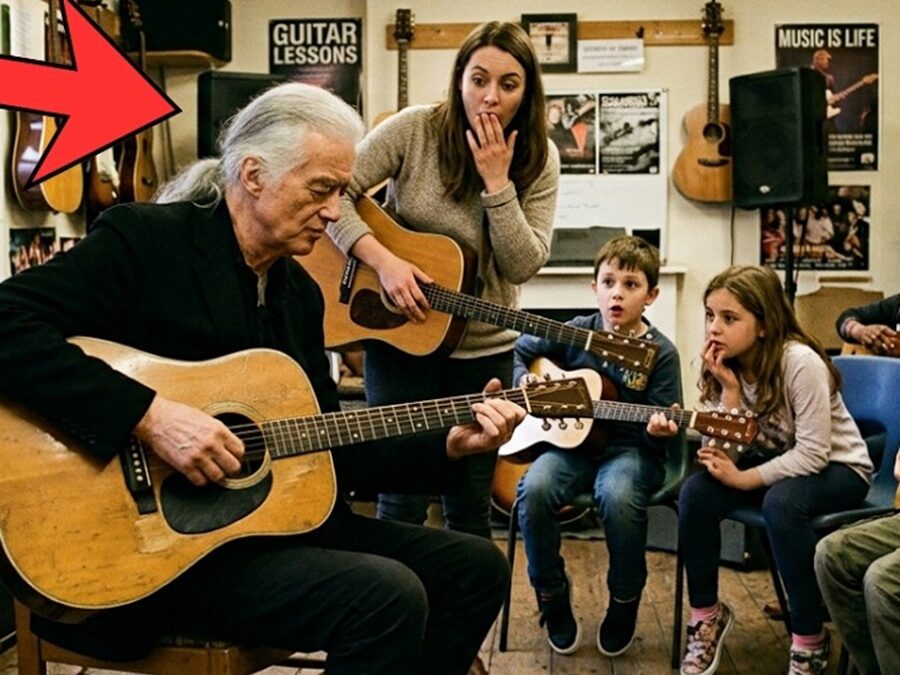
“Show Us What You’ve Got, Mr. Page” — Guitar Teacher Didn’t Know She Was Talking to JIMMY PAGE
Show us what you’ve got, Mr. Paige. The guitar teacher didn’t know she was talking to Jimmy Paige. Kingsway Music Studio in Holborn, in September 2018, was the kind of place that formed part of the practical infrastructure of music education in London. A space adapted on the ground floor, equipped with soundproofing and instrument storage, with a reception where parents registered the entry and exit of their children, and which smelled of the specific combination of resin, wood and the ambient heat of electronic devices that
characterizes the rooms where guitars are the main business. It wasn’t a glamorous place. It was functional, and its function was fulfilled with the consistency necessary for parents to trust it and for children to return week after week. Emma Clark had been teaching there for two years, and before that at Melody House in Islington, and before that at a community music program in Leeds.
In total, he had been teaching guitar for five years since finishing his degree at the Leeds Conservatorium , enough time to develop the specific combination of patience and method required for good instrumental teaching, and short enough for each small step forward of a student to be genuinely satisfying to him , rather than just professionally noting it.
She was 26 years old and good at her job, in the way that people who truly love what they teach are. Not only technically, but with a dedication to learning that was transmitted to the students, in the same way that dedication is always communicated through the quality of attention paid and the genuine interest in whether the lesson had been understood.
She had been teaching at Kingsway for two years and knew her students as only weekly contact with children allows. It is not the deep knowledge of a parent, but the specific knowledge of someone who has seen the same person struggle with the same problem for several weeks and has found, or not, the approach that solves it.
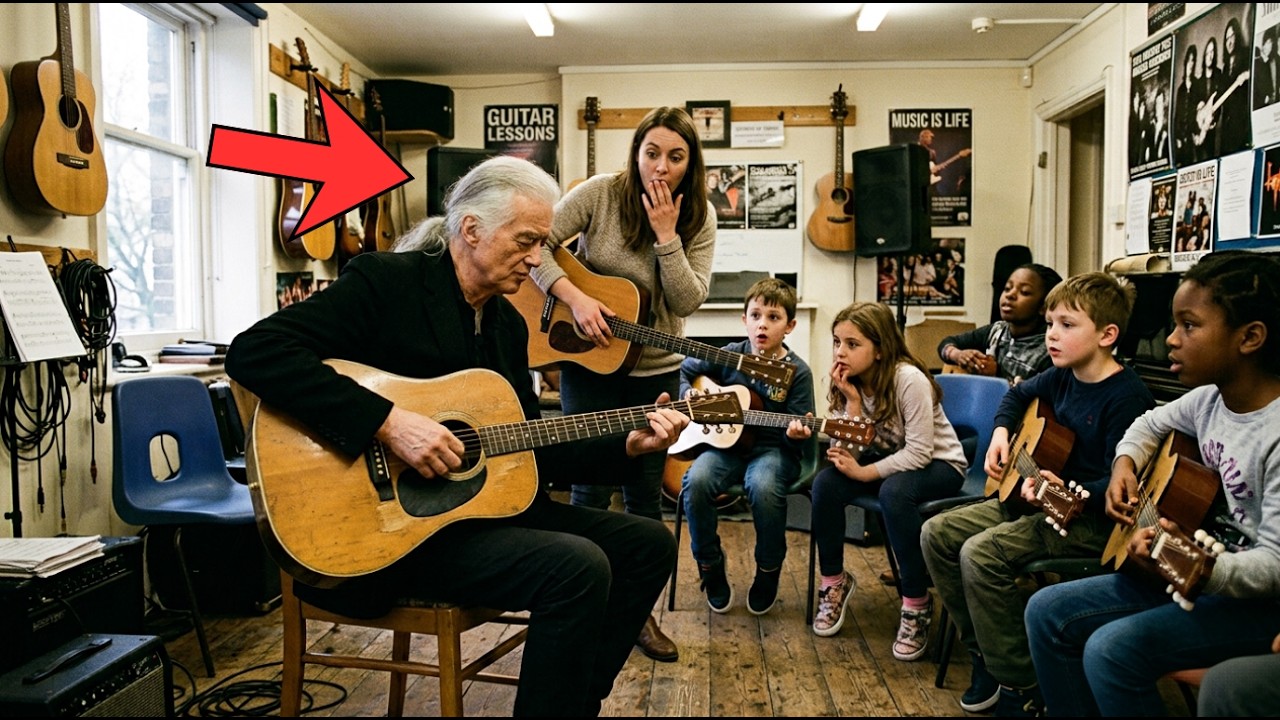
I knew that Callum was struggling with the chord changes and that patience was the only solution. I knew that a girl named Priya had perfect pitch and I did n’t know it yet. I knew Sophie had good instincts and the specific difficulty of a child who understood music intellectually before her hands reached that level of understanding.
His Tuesday afternoon class was from 3:15 to 4, and consisted of six children between the ages of 8 and 12 . And today’s lesson was the E minor pentatonic scale in first position, which was where I always got to with beginners after the initial work with chords. Because the pentatonic scale was where rock guitar truly lived .
And because showing children that what they heard on the radio and what they learned in the studio were connected by the same five notes was one of the surest ways to make them want to practice. I had been explaining this for four minutes when the door opened. A man entered. He was in his seventies, wearing jeans and a jacket that showed signs of prolonged use without having been replaced.
With gray hair longer than most men his age wear it, and with that specific quality of stillness in his movements that people develop when they have spent a long time feeling comfortable in their own body. She was holding the hand of Sophie, 9, one of Emma’s best students ; The type of student who had practiced what was asked of her and who listened when you spoke instead of waiting for you to finish to do something else. Mr.
Paige, Emma said, making the natural assumption, please take a seat in the back. We’ll finish in about 40 minutes. “Of course,” the man said. His voice was calm and had a quality that she couldn’t immediately identify. There was something beneath his kindness that suggested he was capable of much more than kindness required.
She sat down in the plastic chair at the back of the room, the chair she kept specifically for parents and grandparents who sometimes arrived early or who preferred to watch rather than wait outside. She folded her hands in her lap and looked at the class with the serene attention of someone who feels completely comfortable being present without participating.
Emma went back to the lesson. The E minor pentatonic scale in first position consists of five notes arranged in a pattern that begins on the sixth string at the 12th fret or on the open sixth string, or wherever the musician’s skill and the tone of the song place it. And it’s the basic structure of most of what’s been played on electric guitar since the late 1950s.
Teaching it to eight-year-olds requires some patience with small finger mechanics and the development of motor coordination. And Emma had developed that patience over 5 years until it became something genuine, not feigned . She walked around the classroom, attending to each child’s particular difficulties, making the adjustments and suggestions that the afternoon required.
Sophie was doing well with the scale itself, but she had problems with the left-hand position , a specific difficulty with the wrist angle that produced dull notes on the bass strings. Emma explained, demonstrated, and watched Sophie try again; It was still sounding muffled. “Imagine you’re holding a small ball,” Emma said. Your hand makes a C shape.
Sophie tried it, still muted. The wrist should move slightly forward. Sophie tried. Better, but not right. From the back of the room, a calm voice. Can? Emma turned around . The man in the back chair looked at her with a completely courteous and deferential expression, without the presumption that characterizes parents who interfere in classes. Mr.
Paige, I appreciate it, Emma said, but I’ve been teaching for five years and I think I’ve got it …Of course. I apologize . He settled back into his seat. Emma went back to Sophie. She tried two more approaches, neither of which produced the clear tone she was looking for. “Very well,” he said, looking back at the man.
If you have a suggestion, he stood up and crossed the room with the same calmness with which he had entered. He crouched down next to Sophie’s chair, getting down to her level, the way people do when they actually pay attention to someone instead of just pretending to. Sophie, you ‘re not holding the mast. You’re pushing against it, but the rope should come towards you, not the other way around.
It’s a pull, not a push. Sophie adjusted her wrist. He hit the note. It sounded clear, with all the low strings vibrating, without a trace of muting. “Oh,” Sophie said. “Yes,” the man said. Emma watched Sophie’s hand with the focused attention of someone cataloging a teaching technique that had just worked where their own approach had failed.
” Pull instead of push,” she said. I have n’t tried to describe it that way. Sometimes, saying the same thing differently opens a door, the man said. He returned to his chair. Emma finished the lesson. The children put their small guitars back in their cases with that mixture of care and carelessness that characterizes children who handle objects whose value they do not yet fully understand.
And several of them approached the wall of instruments to look at the guitars on display . As Emma took her notes from the session, she was aware, in that peripheral way in which one is aware of things that are not the focus of one’s current attention. that the man at the back of the room was looking at the guitars on the wall with a different kind of attention than the casual interest of a grandfather waiting for his granddaughter.
I was looking at a specific acoustic guitar mounted at the end of the row with the attention of someone reading something. “Mr. Paige,” she said as she approached. Do you play a little? He said his granddaughter Sophie, does she look like you? “She’s just like herself,” he said. I only pick it up sometimes. Emma looked at him.
There was something about the way he said things, the way he used economics. Sufficient precision in each sentence. That was interesting. “Well, since she obviously knows how to play the guitar, and since we only have a few minutes left,” she said, feeling generous and a little proud of the open-mindedness she was demonstrating.
Sometimes it helps children to see an adult play. Would you be willing to teach us a few things? She pointed to the demonstration guitar, an acoustic Yamaha she used for her class. A solid instrument in the way that instruments at this price were solid, reliable, and honest without being extraordinary. Show us what you can do, Mr. Paige.
The man sitting in the plastic chair at the back of the classroom was Jimmy Page. This was a fact that Emma Clark did not know because she was 26 years old, and her main relationship with Led Zeppelin had been through their recordings, which she knew extensively and loved; And her secondary relationship with Jimmy Page had been through the poster on her bedroom wall, which depicted him in the mid-70s at a stage of his life that was some 40 years and the full weight of the following decades away from how he looked in September 2018. 18. She was a
musician. She had a degree in music. I had the poster on the wall. I hadn’t recognized him. Jimmy Page looked at the Yamaha demo guitar for a moment. I had played guitars of all quality and price levels that the instrument market contained. From vintage instruments that represented the upper limit of what money could buy to backstage guitars from 1970s concerts that had been taken because something broke.
And he had discovered throughout that experience that what came out of an instrument was determined more by what was put into the performance than by what was put into the manufacture . He took the Yamaha. He checked the tuning. This took approximately 8 seconds, involving small adjustments to two strings, which he made with the economy of someone for whom this process is as automatic as breathing.
Then he played the opening riff of Whole Lotta Love. The riff has four notes. It starts with the sixth string open and goes through two fretted notes and returns. And in its basic form, it can be played by someone with a few months of guitar practice. in the hands of Jimmy Page on a 150-pound Yamaha acoustic in a studio in Holborn.
It sounded like the record, not similar to the record. Like the record, the specific quality of the tone, the timing, and the relationship between the notes that had made it the record . Present now in a room with six children and a guitar teacher who was in the process of going through, in about 3 seconds, several stages of understanding in rapid succession.
The first stage was: it’s really good. The second stage was: he’s very good, better than a grandfather who played in a band should be. The third stage was: I know this riff. I know this riff very well. I know this riff from an album I’ve listened to hundreds of times. The fourth stage was: the reason I know this riff is.
The fifth stage arrived without words, which is how the greatest recognitions usually arrive. Jimmy finished the riff, placed the guitar on his knee, and looked at Emma with the expression of someone who has been watching a recognition happen in another person and is waiting for it to be completed before speaking.
Emma’s mouth was open. The six children watched her with the slightly worried interest of children observing an adult behaving unexpectedly. Sophie started laughing. “That’s my uncle Jimmy,” Sophie said, not addressing anyone in particular. “He plays the guitar.” Emma looked at Sophie. He looked at the man holding the Yamaha on his knee.
He looked at Sophie again. “Uncle?” she said. He sometimes picks me up when my mom can’t . His name is Jimmy Page. Yes. And I just told him to show me what he’s got. Sophie considered this. He showed it to you, didn’t he? Emma sat down in the nearest chair, which happened to be the chair at the back of the room where Jimmy had been sitting.
She sat on it with the specific quality of someone whose legs have made a decision independently of their owner. He looked at Jimmy Page, who was still holding the Yamaha with the relaxed familiarity of someone for whom holding a guitar is his natural state. ” You’re Jimmy Page,” he said. “Yes, I have your poster on my wall.
I’m a little older than that poster. I know all of Led Zeppelin’s albums. I’ve listened to Physical Graffiti probably 300 times. I learned to play guitar with your records.” He paused. I didn’t recognize you. There is quite a difference between 1975 and now. Jimmy said, “I told you to show us what you’ve got.” She said it again, as if repetition could make it more understandable. I told that to Jimmy Page.
” And I showed it to you,” he said. It seemed like the reasonable answer. Emma briefly covered her face with her hand. The children watched the exchange with the mild fascination of those who see something they do n’t quite understand, but which is clearly important to the adults around them. Mr. Paige, s
he said, could you…I mean, since you’re here and the children are still here, would you be willing to tell me what you’re working on? Jimmy said: My minor pentatonic, first position. the connection between the scale and the real music they might know. He nodded once. She moved from the back of the room to the center of the study, sat on the floor in the space where the children had been sitting in the circle that Emma used for group work, and looked at the six children with the calmness of someone who has been in rooms with many people and feels completely comfortable in the
current one. Who knows what a pentatonic scale is? He asked. Silence. Then, Sophie’s hand. Emma just told us. Good. Emma is right that it’s important. Can anyone tell me why? Silence. Jimmy looked at Emma. You tell him. Emma said from the back. Because every rock solo you’ve ever heard uses it.
Every rock solo I’ve ever played uses it. Jimmy said, the same five notes. Let me show you what you can do. He played the scale. not as an exercise, not as a demonstration of fingering, but as music. The five notes arranged in an ascending and descending pattern with the timing and phrasing of someone who has played them tens of thousands of times and has found in that repetition not boredom, but depth.
The children listened. That’s the scale, he said. Now listen. He rearranged the same five notes in a different sequence and played it with a different rhythm. Does anyone recognize that? Sophie’s hand. Stairway to Heaven. The guitar solo from Stairway to Heaven. The same five notes, different order , different rhythm, different feeling.
He played it again, then switched to something else. That’s Whole Lotta Love. The same five notes. The children were silent, in the way children are silent when something has clicked in their understanding. When the gap between what they were doing and why it matters has closed. Emma has been teaching them the right thing.
Jimmy said, “The scale is the foundation. But the scale isn’t the music. The music is what you decide to do with it. The feelings you put into it, the story you tell.” He played a simple melodic phrase . This is the scale turned into music. There’s something about her. A feeling. Can you hear it? Several children nodded.
That feeling comes from you. The technique, the scale, the finger position. That’s the vehicle. You are what’s inside. He returned to the position of Sophie’s wrist. The problem that had been the original reason for his intervention. You already fixed it, but let me show you why it matters. He demonstrated the muffled sound, the position of the hand that produced it, then the corrected position, the throw instead of the push, the clear tone that resulted.
The scale sounds like a scale when the notes are muted . It sounds like music when they are clear. Emma was showing you how to get clear notes. I’m showing you why clear notes matter. He played the scale again clearly, each note fully realized. Listen to the difference between that and the turned-off version. The children nodded.
Same notes, same fingers, different angle of pressure. That’s what technique is for. It is not an end in itself. It’s what allows you to clearly say what you ‘re trying to say. He looked at Emma, who was still in the background with her phone. Everything Emma has been teaching them. This is why Emma, in the background, was taking notes with the focused efficiency of someone who has found a pedagogical approach and wants to remember it accurately.
She had been a good teacher before that afternoon and would be even better after it, not because Jimmy Paige had taught her things she didn’t know, but because she had observed a different approach to her own that pointed to the same place. And the two approaches together were more comprehensive than either one separately.
When the session ended and the parents arrived to pick up the children, Jimmy got up and returned the Yamaha to its stand. Emma crossed the room. Mr. Paige, he said, and then stopped. I don’t know what to call it in this situation. Jimmy is fine. Jimmy, I owe you an apology . Because? Because I didn’t recognize you.
For treating you like a grandfather who might know a few chords. That’s who I am, Jimmy said. In this context, I am Sophie’s uncle, here to pick her up . You treated me accordingly. I told you to show us what you’ve got. And I showed it to you, you asked a reasonable question. I gave you a reasonable answer. He stared at her.
You are a good teacher, Emma. I watched you for 40 minutes before all that happened. You were doing well. Emma looked at him. How do you know? Because they are here. He said, “Children don’t keep going back to something they don’t want.” They came back to you. That’s no small feat. She remained silent for a moment.
“Can I ask you something? Would you consider it the next time you pick up Sophie? Would you? I’ll be here next week.” He said, ” Sophie’s mom works on Tuesdays. I’ll sit in the back. I won’t interrupt unless you ask me to. I might ask you. That’s fine.” Emma hesitated. So, could you…could you sign my guitar? My home guitar, I mean , not the one from school.
Bring it next week. He helped Sophie put her small guitar into the case with the ease of someone who has stored many guitars in many cases over many years. Checking that the instrument was properly positioned and the closures secure before handing it over, which is how someone treats instruments when the care is genuine and not just a gesture.
They left the studio together, while Sophie told him something about her week at school. Jimmy listened with that specific quality of attention that he dedicated to things, which was total . For the next nine weeks, Jimmy Paige picked Sophie up from Kingsway Music Studio almost every Tuesday that her mother worked, which was most of the week.
And he would sit in the plastic chair at the back of the room and watch Emma Clark teach guitar to six children. And he was, in his opinion, like someone who has spent 60 years in music, watching others create it and teach it, watching someone do it well. The children improved. Sophie’s wrist position was corrected by the third week.
A boy named Callum, who had been struggling with chord changes, found something in the fifth week that produced a visible breakthrough in real time; His face changed when muscle memory kicked in for the transition from G to D, and both chords sounded clean for the first time .
Emma took them from the pentatonic scale to their first song for week eight. A simplified version of a melody that they could play from beginning to end without stopping. And the specific satisfaction of playing something recognizable from beginning to end was visible on every face in the room . On the final Tuesday, Emma brought her guitar from home.
It was an acoustic guitar she had bought in her second year at the Leeds Conservatoire, a Martin she chose because she intended to play it for the rest of her life and had played it for the next 8 years. It showed evidence of those 8 years in the small scratches, the worn finish on the edge of the mouth, and the overall quality of an instrument that has been used rather than displayed.
Jimmy signed it. He signed it inside his body through his mouth, in the specific place where he used to sign instruments when they were going to be played and not hung on a wall. Then he turned it over and wrote something on the back of the headstock, where it would be visible every time she picked up the guitar. He gave it back to her.
She turned it over to read what he had written to Emma. Thank you for asking me to show you what I have. You already knew that. You just needed someone to watch. JP Emma Clark has that guitar. He plays it in every lesson he teaches because it’s his best guitar and because using it matters.
When you pick it up, read the back of the tuning pegs before you begin. He’s been doing it for 6 years and hasn’t gotten used to it, which means he’s finally come to understand the point. Jimmy Page has not mentioned the Tuesday lessons at Kingsway Music Studio in any interview or public context. Sophie’s mother knows the story because Sophie told it to her at length on Tuesday nights after each session, and Sophie’s mother has confirmed that it happened, in the straightforward way of someone confirming an unusual but not unbelievable fact. Emma
has told the story. At first she resisted because the central element of the story, that she had told Jimmy Page to show her what he had, was something she found difficult to describe without it sounding like the most embarrassing moment of her professional life. Over time, he has come to understand that it was something else.
That the question was the right question and that the answer was exactly what the question deserved , and that the nine weeks at the back of the room were worth more to his education than he has yet been able to fully measure. Show us what you’ve got, Mr. Page, he showed it to them. What he showed her wasn’t just a lot of love on a 150-pound Yamaha.
It was 40 minutes of observing, nine weeks of returning, and a phrase on the back of a tuning peg. You already knew that.