Bullies Pushed an Old CEO — Until a Black Single Dad Stepped In They Had No Idea He Was a SEAL – Ty
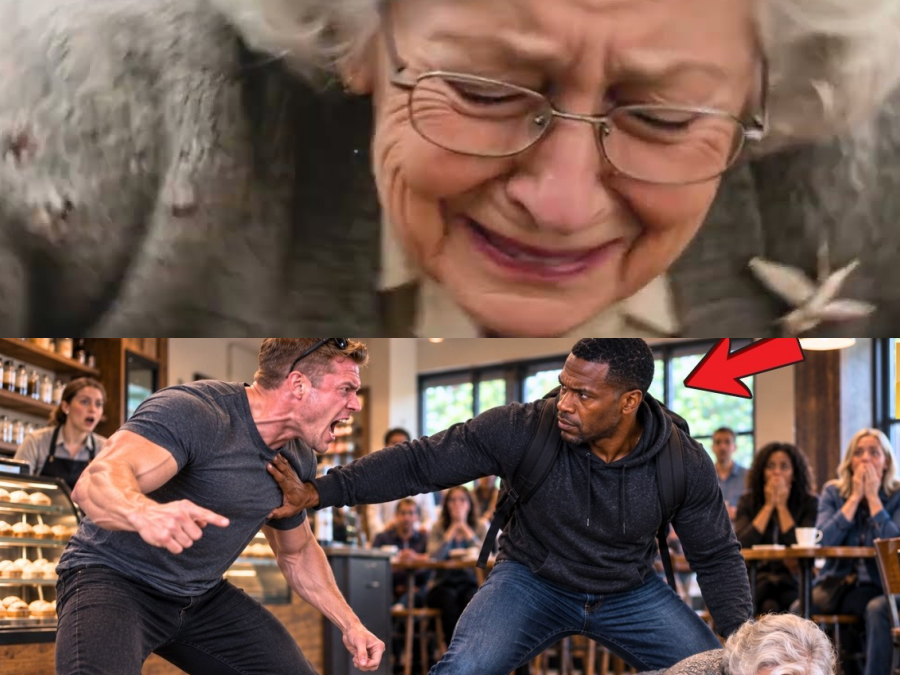
Bullies Pushed an Old CEO — Until a Black Single Dad Stepped In They Had No Idea He Was a SEAL
MOVE IT, LADY. SOME OF US HAVE PLACES TO BE. >> The old woman turned around. I’m sorry. I’ll be quicker next time. Nah, you’re good. Then he drove his shoulder into her. Her cane hit the floor. She went down hard. Coffee everywhere. And the little silver bird on her sweater came loose and skittered across the tile.
Whoa. You okay there? 30 people lifted their phones. Not one lifted her. Ma’am, I think this is yours. Nobody in that room knew who she was, and nobody knew what the man kneeling beside her used to be. The Marlo coffee on Bennett Street filled up early on Saturdays. By 9, the line reached the door.
The espresso machine hissed without stopping, and the whole front of the shop glowed where the sun came through the tall windows. It smelled like dark roast and warm butter. Somebody had put on quiet music that nobody was listening to. Eleanor Caldwell came in at 9:40 the way she always did. She was 74 years old. She wore a gray cardigan with a pled elbow, flat brown shoes, and a pair of glasses she kept pushing up with one knuckle.
In her right hand, she carried a wooden cane with a worn brass tip. Pinned near her collar was a small silver bird, no bigger than a thumbnail, with one tiny stone for an eye. Nobody in the shop looked at her twice. That was the point. She had been coming to this corner for 20 years, long before the building above it was renovated and long before the coffee shop changed its name.
She always ordered the same thing. Black coffee, large, no room. She always sat at the same table by the window, the second one from the corner, where the sun landed on the wood by 10:00. She and her husband had sat at that table every Saturday for 17 years. Harold had been gone 3 years now. She still ordered the coffee.
She still took the same chair, the one facing the door, because that had been hers, and she had never once considered taking his. The brooch had been a gift from him. He had given it to her the year the company finally stopped losing money, and he had made a joke about it that she still remembered and had never repeated to anyone.
She waited in line like everyone else. She did not like being helped. When a young barista once tried to carry her cup to the table for her, Elellaner had thanked her politely and then carried the cup herself, and the girl had learned not to offer again. Four people ahead of her in the same line, a man named Marcus Reed was reading the pastry case. Marcus was 38.
He wore a plain dark hoodie, jeans, and running shoes that had seen a lot of miles. A small backpack hung off one shoulder. His hands were down at his sides, loose, and he stood the way some men stand without knowing it, [music] weight even, shoulders quiet, taking up no more space than he needed.
He was trying to decide between a croissant and one of the chocolate things because his daughter had said she wanted a croissant, but she had also said last week that croissants were boring. Immani was 8. She sat two tables back with a spiral notebook open in front of her and a plastic case of colored pencils drawing something she had not let him see yet.
Saturday mornings were theirs. They had a routine. Pastry, then the library, then the park if it wasn’t raining. She looked up at him across the room. Marcus lifted two fingers at her, then held up the croissant tongs and raised an eyebrow. She gave him a thumbs up. He put the croissant on the tray. A moment later, she got up and came over to stand beside him in line, leaning against his hip the way kids do.
Daddy, why do those ladies keep looking at us? Marcus did not turn around to check which ladies she meant. He had already noticed. He had noticed before she had the same way he noticed the exits and the guy near the condiment bar who kept checking his phone and the fact that the door stuck slightly on the second swing.
Go finish your drawing. She went back to her table. Marcus moved up one place in line. Behind him, three young men came in together and the room got a little louder. There were three of them, all somewhere in their 20s. The tallest one was named Trent, though nobody in the shop knew that yet. He wore a gym shirt a size too small and had his sunglasses pushed up on his head.
The second one, Cody, was shorter and thicker through the shoulders and laughed at everything Trent said about a half second before it was funny. The third one hung back near the door with his hands in his pockets and watched the other two more than he watched anything else. They had been up all night.
That was not obvious from looking at them, but it was obvious from listening to them. They were loud in the specific way of people who have decided the room belongs to them. Man, this line, who runs this place? Cody thought that was hilarious. Eleanor moved up to the counter. The barista, a young woman named Cassie, with a name tag she had decorated herself, smiled at her the way you smile at somebody you see every week. Morning, Miss Eleanor.
Good morning. Large black, please. She set her cane against the counter’s edge so she could open her wallet. Her hands were not fast anymore. She knew that. She had made her peace with it around the time she turned 70, which was also around the time she stopped going to board meetings in person and started letting other people run the company she had built. She counted out her bills.
She always paid cash. It took a few seconds longer than a card would have. Behind her, Trent sighed theatrically. Come on. Eleanor did not turn around. She finished counting, handed the money across, and thanked Cassie by name. Marcus, three people back, turned his head about 10°. Just enough. It was 9:44 in the morning.
The sun had reached the second table from the corner. Everything in the room was still completely ordinary. It stayed that way for another 11 seconds. Cassie slid the cup across. Eleanor put her wallet away, took the cup in her left hand, and reached for the cane with her right.
Ma’am, you want a sleeve? No, thank you. It cools faster without. Trent stepped up to the counter before she had fully turned, close enough that she had to shift her weight to get out of his way. Finally, Eleanor looked at it. She had spent 50 years in rooms full of men who talked like that, and she had learned a long time ago that the best thing you could do with them was decline to be interesting.
“Excuse me,” she said and started toward her table. “You know they have delivery, right, for people who can’t move.” Cody again. Eleanor kept walking. Her table was nine steps away. She had counted them once years ago for no reason at all, and the number had stuck. Seriously, my grandmother’s 90 and she’s faster than that.
At some point, you got to just stay home. A woman at the condiment bar looked down at her lid. Two men at the long table by the wall stopped talking and did not look up. Nobody said anything. Eleanor got to step four. Ma’am, I’m talking to you. She stopped. She should not have, and she knew it even as she did it, but 74 years of manners are hard to put down.
I’m sorry if I kept you waiting. I’ll be quicker next time. It was a small thing to say. It cost her something to say it. And it landed exactly the way things like that land in front of a certain kind of man, which is to say, it landed like blood in water. Nah, you’re good, Trent said and started toward the pickup end of the counter.
What happened next took less than a second and would be argued about for weeks. He came past her on her right side. the side with the cane, moving fast and cutting the angle tighter than he needed to. His shoulder caught hers. It was not a punch. It was not even strictly speaking a shove with a fist.
It was the kind of contact a man makes when he wants to knock somebody sideways and still be able to say he didn’t do anything. But Eleanor Caldwell weighed 118 lb and balanced on a wooden cane, and she went down. The cane skidded across the tile and struck the base of the trash can with a flat wooden crack that everyone in the shop heard.
The cup left her hand. Coffee went across the front of her cardigan and across the floor in a long dark fan. Her glasses slid up her forehead and came off entirely. Her hip hit the tile first, then her elbow, then her shoulder. The room went completely silent. There is a particular quality to silence in a crowded space.
It is not the absence of sound. It is 30 people all deciding at the same moment not to be the one who moves. Trent stopped, looked back, and laughed once, short and surprised. Whoa, you okay there? Cody was already laughing. It was a high, unsteady sound, the laugh of someone who is not sure what just happened and has decided to be on the winning side of it anyway. And then the phones came up.
Not one, not two, from the long table by the wall, from the window seats, from the line, from the man at the condiment bar who had been checking his phone anyway and now simply turned it sideways. Six, seven, eight of them. Black rectangles lifting all around the room at chest height, framing a 74year-old woman on the floor of a coffee shop.
Nobody put a hand out. Nobody came around the counter. Nobody said, “Stop.” Eleanor did not cry. She did not call out. She did not look up at any of them. She pushed herself onto one hip and then she began to move her hand across the wet tile in slow, flat sweeps. She was not reaching for her cane.
The cane was 6 ft away and she could see it. She was not reaching for her glasses, which were near her knee. She was looking for the brooch. It had come off when she landed. The pin had given the way a 50-year-old clasp will, and the little silver bird had gone out of the neckline of her cardigan, and skittered somewhere under the edge of the trash can, or into the spilled coffee or beneath somebody’s chair.
And Eleanor Caldwell, who had built a company worth more than every person in that room would earn in their lifetimes combined, was on her hands and knees on a wet floor patting the tile for a piece of silver the size of her thumbnail while eight phones filmed her. Cassie came around the end of the counter and then stopped because the three men were between her and Eleanor and she was 19.
Hey, hey, you can’t. She fell. People fall. Two tables away, Immani Reed had stopped drawing. Her pencil was still in her hand. And four people back in a line that had not moved, Marcus Reed set his tray down on the counter. He did not move right away. For about two full seconds, Marcus stood where he was.
And in those two seconds, he ran the whole thing forward the way he had been trained to years ago in a different life in rooms and streets that had nothing to do with a coffee shop on Bennett Street. He saw the geometry. Three men, one of them wound up, two of them following, an old woman on the floor between them and the door.
A counter to his left with a 19-year-old behind it who had already frozen once. 30 odd civilians, all of them seated, none of them moving, and every single one of them holding a camera. And he saw the other thing, the thing that had nothing to do with training. He saw what it would look like. A black man, 6’1, in a dark hoodie, crossing a crowded room fast toward three white guys in their 20s with an elderly white woman on the floor in the middle of it.
He knew precisely how that frame read. He knew how it would read to the people filming it and to the people who would watch it later without the 40 seconds that came before and to whoever walked through that door in the next few minutes wearing a uniform and needing to decide quickly who the problem was. He had spent his whole adult life doing math like that.
He had done it in uniform and he had done it out of it. And the truth was he had done it more carefully out of it. That was one side. The other side was sitting two tables back with a colored pencil in her hand, watching the room and waiting to find out what happened next. If he stayed where he was, his daughter would learn something this morning.
She would learn it cleanly and permanently, the way children learn things you didn’t mean to teach them. She would learn that when a person gets knocked down, a room full of adults picks up their phones. She would learn that her father was one of them. Marcus picked up his tray and set it on the counter. Watch that for me. Then he crossed the floor.
He did not run. He did not go at the three men at all. He angled wide around Trent’s left, kept his hands open and visible at about waist height, and went past all three of them like they were furniture. The first thing he did was crouch and pick up the cane. The second thing he did was put his hand flat on the floor near the trash can, run it once along the base, and come up with a small silver bird.
He looked at it for half a second. Then he went the rest of the way to Eleanor, and he did not touch her. He went down on one knee about 2 ft away at an angle where she could see him coming. And he set the cane on the floor within her reach, and he held the brooch out on his open palm. Ma’am, I think this is yours.
Eleanor stopped sweeping the tile. She looked at his hand. She was breathing hard and her hip was screaming at her and she had not put her glasses back on. So what she saw first was just a shape and a hand and something small and bright on it. Then she got the glasses up onto her face and she saw the bird. Her fingers closed around it.
She held it against the middle of her chest over the coffee stain and for a moment she did not say anything at all. Ma’am, can I help you up? I’m going to need to take your arm. Is that all right? He asked it loudly. Loud enough to reach the back wall. Loud enough that every phone in the room recorded a man asking permission before he touched her.
Eleanor got her voice back. Yes, thank you. He took her left forearm in both hands, braced her elbow, and told her to take her time and push with her good leg. She got a foot under herself. He came up with her slow, keeping her weight over her own feet. And when she was standing, he did not let go until she had the cane and had tested it.
Cassie appeared beside them with a chair. Marcus turned it and Eleanor sat down. Is anything broken? Can you move your fingers on that hand? I’m all right. Move them anyway, please. She moved them. He nodded once. Only then did Marcus straighten up and turn around and look at the three men who had been standing there the whole time watching him. The room was still silent.
Every phone was still up. That’s enough. Trent tilted his head. Who are you? Nobody special. He said it flatly with no edge on it at all. The way a man reads a street sign out loud. It seemed to confuse Trent more than an insult would have. Trent came a few steps closer, taking his time, and looked Marcus over from the shoes up.
He did it slowly, and he did it for the benefit of the room. And when he got to the top, he made a small sound through his nose. Yeah, okay. Here’s a thought. Mind your own business. Cody drifted up on Trent’s right, half a step behind, arms out from his sides, the way men stand when they want to look wider than they are. The third one stayed by the door and did not come any closer. “This is a nice place.
Everybody’s having a nice morning. Nobody needs whatever this is.” He gestured vaguely at Marcus, at all of him, at the hoodie and the backpack and the fact of him. “You don’t even belong in here.” Somewhere behind Marcus, a phone shifted angle. He heard the chair leg scraped that went with it. He did not answer.
He did not react to it in his face or his shoulders or his hands. He had heard some version of that sentence in an airport in Virginia, in a rental car line in Colorado, in a hardware store nine blocks from the house he owned. And he had long since stopped spending anything on it in public. He turned around, crouched down beside Eleanor’s chair, and looked at her wrist.
“Ma’am, when you went down, did you catch yourself on that hand, or did you land on the elbow?” Eleanor blinked at him. It took her a second to understand that he had simply stopped participating in the other conversation. The elbow, I think, then the hand. Can you turn it over for me? Palm up, palm down. She did it. It hurt.
And she let it show, which she almost never did. That’s not broken. It’s going to be ugly tomorrow. Keep it elevated when you’re sitting. You sound like a doctor. I’m not. He looked at her hip instead. the side she had landed on and did not touch it. Can you put weight on that leg? Don’t stand up. Just press your foot into the floor. She pressed. Yes. Good.
He glanced toward the counter. Can somebody get her a cup of water and a towel? Cassie was already moving. Behind him, Trent had not gotten what he wanted, and Marcus could feel him deciding what to do about that. There is a sound a room makes when a man is about to escalate, and it is mostly the sound of other people getting quieter.
Hey, I’m talking to you. I know that was in its way the worst thing he could have done. He understood that. He had made a choice about it. A man like Trent could survive being argued with. What he could not survive was being treated as a minor feature of the morning. Look at me when I’m talking to you.
Marcus stood up and turned around. He kept his hands low and open. He kept about 6 ft of floor between them. I’m listening, but I’m not going to argue with you. She’s 70some years old and she just hit the floor. That’s the thing I’m dealing with right now. Nobody pushed anybody. All right. You calling me a liar? I said, “All right.
” Trent looked around the room and this was the moment Marcus had been waiting for because it was the moment Trent went shopping for allies. 30 people, eight phones, two men at the long table by the wall who had gone back to studying the grain of the wood. A woman by the window with her hand over her mouth. Cassie, 19, behind the counter with a stack of paper towels.
And nobody, not one single person in the entire shop opening their mouth. Marcus understood the arithmetic of that better than anyone in the room. The three men were not the obstacle. Three men he could account for. The obstacle was the 30 people who had already decided without saying a word to each other that whatever this was, it was happening between the loud guy and the black guy and that the safest possible position was to hold the phone steady and stay out of it. He could not make them speak.
He could not make them come forward. He could not, if this went wrong in the next 90 seconds, count on a single one of them to say what they had seen. So he did the only thing he could do, which was to give them nothing to misinterpret. He stepped back, not away exactly. He moved so that he was standing between Eleanor’s chair and the three men with his hands at his waist, palms visible, [music] feet square.
He put himself in a posture that would read the same way from every angle in the room. Nobody has to escalate this. Get your coffee. I’ll stay over here. We’re done. You hear this guy? What Trent said next, he said to the whole room. He turned around in a slow half circle with his arms open, taking in the tables and the windows and the line, and he raised his voice so it would carry to the back wall. Okay, everybody.
Everybody’s filming. Good. He pointed at Marcus without looking at him. You all got this guy on video, right? because I want everybody to see this. Lady falls down, she trips, whatever. She’s old and this guy comes flying across the room at us. Ask yourselves who the problem is here. Go ahead, look at him and ask yourselves.
And something happened then that Marcus had known would happen and had braced for and which hit him anyway. The phones moved. Not all of them, but four or five of them turned smoothly the way a field of sunflowers turns and came off Trent and Cody and the spilled coffee and the old woman in the chair and settled on him. Eleanor saw it, too.
She was sitting with a wad of paper towels pressed to the front of her cardigan and her glasses crooked and her hand closed around a silver bird, and she watched a room full of adults change the subject of their own footage. She started to push herself up out of the chair. Ma’am, please sit down. They are lying. I know. Please sit down.
She sat, not because she agreed, but because her hip would not hold her. Marcus turned to face the room. It was the first time he had addressed anyone in it besides Eleanor and the three men. [music] And when he spoke, his voice was exactly the same as it had been for the last two minutes, which was somehow more unsettling than shouting would have been. My name is Marcus Reed.
I live on Eldridge, 11 blocks from here. I come to this place most Saturdays. There are at least six cameras in this room, and every one of them saw the same 40 seconds I did. He looked at Trent. So, I’m not worried about what people are going to believe. I’m worried about what happens in the next 2 minutes.
Then walk away. I can’t do that. Why not? And Marcus said the thing he had come there to say, the thing that had actually moved his feet across the floor in the first place. Because my daughter is watching. The words went across the room and changed the temperature of it. Trent’s face did something complicated.
Cody stopped grinning and looked over his shoulder, hunting for the kid and could not find her because she had not moved and she was small and she was sitting very still behind a notebook. Marcus did not point her out. He would not do that. She’s eight. She’s been sitting in this room for the last 3 minutes and I need you to understand what she just watched because I don’t think anybody in here has thought about it yet.
He looked at the tables. He looked at the long one by the wall and the two men there finally looked back. She watched a woman get knocked down on a floor. She watched 30 grown adults decide that the right response to that was to hold up a phone. Not one person in this room got out of a chair. His voice stayed level. That’s the first thing she learned this morning. Nobody said anything.
Somebody’s cup went down on a table too hard. And here’s the second thing. I don’t want my daughter growing up believing that shoving a 74 year old woman onto a tile floor is something that just happens. But I want that a whole lot less than I want her growing up believing that the one person who walked over to help is the one everybody turned the camera on.
The room got very quiet. Four of the phones came down. Not all of them, but four. The woman by the window took hers down and put it face down on the table and pressed her hand flat on top of it as though it might get away from her. At a small table near the register, a young woman in a denim jacket, 22 years old, named Hannah Brooks, did not put her phone down.
She had started filming 11 seconds before Eleanor fell because she had been recording a voice memo for her sister about the line and had switched to video when the shouting started. She was still recording. She was going to keep recording. She had not yet understood what she had, and she was too frightened to say so out loud.
Trent had lost the room, and he knew it. That was the problem. Men like Trent do not recover from losing a room by going quiet. They recover the only way they know how, which is by making something physical happen because a physical thing has a winner. You don’t talk about my daughter, which made no sense, and which told Marcus exactly where this was going.
Cody laughed again, and this time it came out wrong, thin, and too late. Marcus felt the whole shape of the next 30 seconds arrive in his chest like a change in air pressure. Okay. Okay. Trent closed the distance and put both hands on Marcus’ chest. It was not much of a shove. It rocked him back a few inches, no more, but it was the first contact, and everyone in the room understood that a line had been crossed.
trying to be a hero. Marcus took one step back. He did not set his feet. He did not lower his center of gravity. Did not turn his body sideways. Did not do any of the things that 12 years of training had made as natural to him as breathing. He did the opposite. He raised both hands to shoulder height, palms out, fingers spread, elbows loose.
It is a posture that costs a man something. It gives away every advantage he has. It means that whatever happens next, he will be absorbing it rather than preventing it. There is no version of that stance that helps you win. There is only one thing it is good for, and that is being filmed. Please stop. Say it again. Please stop.
Trent shoved him a second time harder, both hands high on the sternum. Marcus’ heel found the leg of a chair, and he had to take a longer step to keep from going backward into it. His hands stayed up. Eleanor Caldwell could not stand this. She had spent 51 years in boardrooms. She had been the only woman at conference tables where men explained her own balance sheet to her.
She had fired a chief financial officer at 68 and negotiated a plant closure in a parking lot in the rain. And she had never once in her life been the person who sat quietly while something wrong happened 4 ft away. She got her cane under her, planted it, and pushed herself up out of the chair. “He hasn’t done anything. He hasn’t touched anyone.
Look at his hands. Look at them.” Modi turned and put his palm on her shoulder and pushed her back down into the chair. It was not violent. It was casual, which was worse. He did it the way you would close a cabinet door that had drifted open without even fully looking at her, and the chair rocked back on two legs and came down.
Eleanor made a small sound, and Marcus felt it come up through him. It came up fast and hot from somewhere under the ribs, and it wanted very badly to be let out, and it knew exactly what to do. That was the thing nobody understood about men like him. The training had not taken it away. The training had made it efficient. Everything in his body knew with total clarity and no effort at all how to end this in under 4 seconds and how to make sure none of the three of them got up quickly afterward.
He stood there with his hands in the air and did not do any of it because he was doing a different calculation and he had been doing it the entire time and it went like this. If any of these men ends up on the floor, it does not matter who started it. It does not matter that she is 74.
It does not matter that six phones recorded the shove. The clip that will travel is the 4 seconds where I am moving and he is falling and every frame before that will be gone. It does not matter that I am right. There are people in this world who are permitted to be wrong once in public and get a second look. I am not one of them.
I learned that when I was 14 and I have never once been allowed to forget it. So he kept his hands up. You’re going to get hurt. I don’t want anybody to get hurt, including you. You think you could? I think this ends now. And everybody goes home. Across the room, Cassie had the shop phone against her ear, turned toward the wall, talking fast and low.
Above them, on the second floor of the building, in a small office with four monitors, a security supervisor named Dale Witmore was already standing up and reaching for his radio. Marcus heard the door to the stairwell bang. He knew what that sound was. He had about 11 seconds. 11 seconds to get his hands down, get his back to a wall, get himself into a shape that would read correctly to two men who were about to come through a door into a situation they had not seen the beginning of.
He started to move toward the window, away from Trent, toward open floor where he could stand still and be obviously alone. and Trent, who had exactly as long as Marcus did and did not know it, reached out and grabbed a fistful of the front of his hoodie and twisted it up under his throat. What Marcus did took less than a second. He did not punch.
He did not throw anybody. He brought one hand up, put his thumb into the soft place at the base of Trent’s wrist, rotated the joint the way a man turns a doorork knob, and stepped in and around at the same time, so that Trent’s own grip peeled off his shirt, and his arm folded up against his chest, and his balance went out over his toes.
Trent went two steps sideways, hit the edge of a table with his hip, and stayed up. Marcus let go instantly. He put his hands back in the air. I don’t want to hurt you. That was all of it. That was the entire contact. Under one second, no strike, nobody down, and Marcus had released him before Trent had even finished stumbling.
The stairwell door came open at that exact moment. Two men came through it. Dale Whitmore in front, a younger guard named Owen behind him. And what they saw when they cleared the doorway was this. A young man staggering sideways off a table, holding his wrist. An elderly woman sitting crooked in a chair with coffee down the front of her sweater, her glasses knocked sideways, one hand pressed to her chest, and one man standing alone in the middle of the cleared floor, 6’1, dark hoodie, hands up.
They did not see the 40 seconds before it. They did not see the shoulder at the counter or the cane skidding across the tile or the brooch in Marcus’s open palm. They had been upstairs. They had gotten one sentence over a phone line from a 19-year-old, and the sentence had been, “There’s a fight.” Dale Whitmore was 51 years old, 22 years in this building, a decent man with a bad back, who had never once in his career gotten anything seriously wrong.
He took in the room in under a second, and he made the read that his eyes handed him. Sir, hands behind your back. I’m not resisting. Hands behind your back now. I’m not resisting. My hands are up. I’m going to turn around slowly. He turned around slowly. They took him at the counter. They put him chest first against the pickup end of it, took his backpack off his shoulder, and brought his arms down behind him one at a time.
Owen had a knee braced against the base of the counter, and both hands on Marcus’s forearm, pulling harder than he needed to because he was 26 and his heart was going, and he had never done this before outside of training. Marcus did not tense up. He did not pull. He let them position him because he knew what happened to men who did not.
His cheek was against the cold metal edge of the counter. His backpack was on the floor with the strap under someone’s shoe. The croissant he had bought for his daughter was in a paper bag 4 ft away on a tray where Cassie was holding it. He attacked us. You saw it. He came across the room at us. He put hands on me.
He pushed that old lady down, too. That’s how it started. We were trying to help her. There it was. Marcus closed his eyes for one second and then opened them. Is that right? 30 people, eight phones, six of which had recorded the entire thing, one of which was still recording at that moment from a small table near the register.
Nobody answered. I don’t know. I just got here. It happened really fast. A woman said she hadn’t been watching. The two men at the long table by the wall looked at their hands. Somebody call the police. Marcus heard three separate people start dialing. The phones came back up. All of them. Every single one.
Whitmore’s radio crackled. Owen kept his weight on Marcus’s arm. Sir, what’s your name? Marcus Reed. You got ID? Left front pocket. I’m not going to reach for it. Eleanor Caldwell was trying to stand up and could not. Her hip had locked and her cane had gone under the table when Cody pushed her down and she could not reach it and she was making a sound that was not quite a word and nobody was looking at her.
And then a small figure came around the end of the second table. Immani Reed had been sitting very still for 4 minutes with a colored pencil in her hand. She had her notebook clutched against her chest with both arms. She had come forward three steps to the place where the tables ended and the open floor began.
And she had stopped there. She did not cry out. She did not run to him. She just stood at the edge of it, 8 years old, holding her drawing, looking at her father held down against a coffee counter with his arms behind his back in front of 30 adults and their cameras. Marcus saw her. Everything in him went still, not calm, still the way water goes still before it turns over.
He did not speak to the guards. He did not tell them who he was. He did not say the word navy, and he did not say the other word, the one that would have changed the whole room in a second, because he knew exactly how it would sound coming out of the mouth of a man being restrained. And he knew that some men get believed when they say a thing like that, and some men get laughed at.
and he had a fairly good idea which he would be. He turned his head as far as he could against the counter so that she could see his face. Look at me, baby. I’m okay. Don’t be scared. Eleanor Caldwell heard him say it. She had spent 74 years on this earth. She had buried a husband and a sister. She had sat in a hospital corridor in 1978 at 3:00 in the morning, and she had signed a document in 1991 that put 400 people out of work.
and she had lain awake about it for 20 [music] years. She had never in her life heard anything like a man telling his daughter not to be scared while two people held his arms behind his back for something he did not do. She stopped trying to reach her cane. She put her right hand on the seat of the chair and her left hand flat on the table and she pushed herself up onto her feet without it.
Her hips screamed. Her elbow gave out halfway. And she caught herself on the edge of the table. And the whole thing skidded [music] 4 in with a shriek of metal on tile that turned every head in the room. She stood up. 74 years old, 118 lb, coffee down the front of her cardigan, no cane, glasses crooked on her face, and she did not wait for anyone to help her, and nobody did.
Then she used the voice. It was not a loud voice exactly. It had not been loud in 50 years. It was something else. Something that came from five decades of walking into rooms full of men who had already decided what was going to happen and telling them what was going to happen instead. Let that man go. The whole shop turned.
Ma’am, I need you to sit down. Let him go right now. Ma’am, he picked me up off your floor. She pointed at the tile, at the long, dark smear of coffee and the paper towels lying in it. That is my coffee. That is where I landed. I was on the ground for a full minute in the middle of this room, and not one of you moved.
And that man came out of your line and got down on his knees and asked my permission before he touched me. Take your hands off of him. Mitmore’s grip did not change, but his weight did. Owen looked at his supervisor. Ma’am, I’ve got two individuals saying those two individuals put me on this floor. That’s not You came past me on my right side.
You put your shoulder into me at the counter after I apologized to you for being slow. I apologize to you. I have made a great many mistakes in my life, young man, but I have never once in 74 years had to apologize for existing at the front of a line. and I did it this morning and you knocked me down anyway.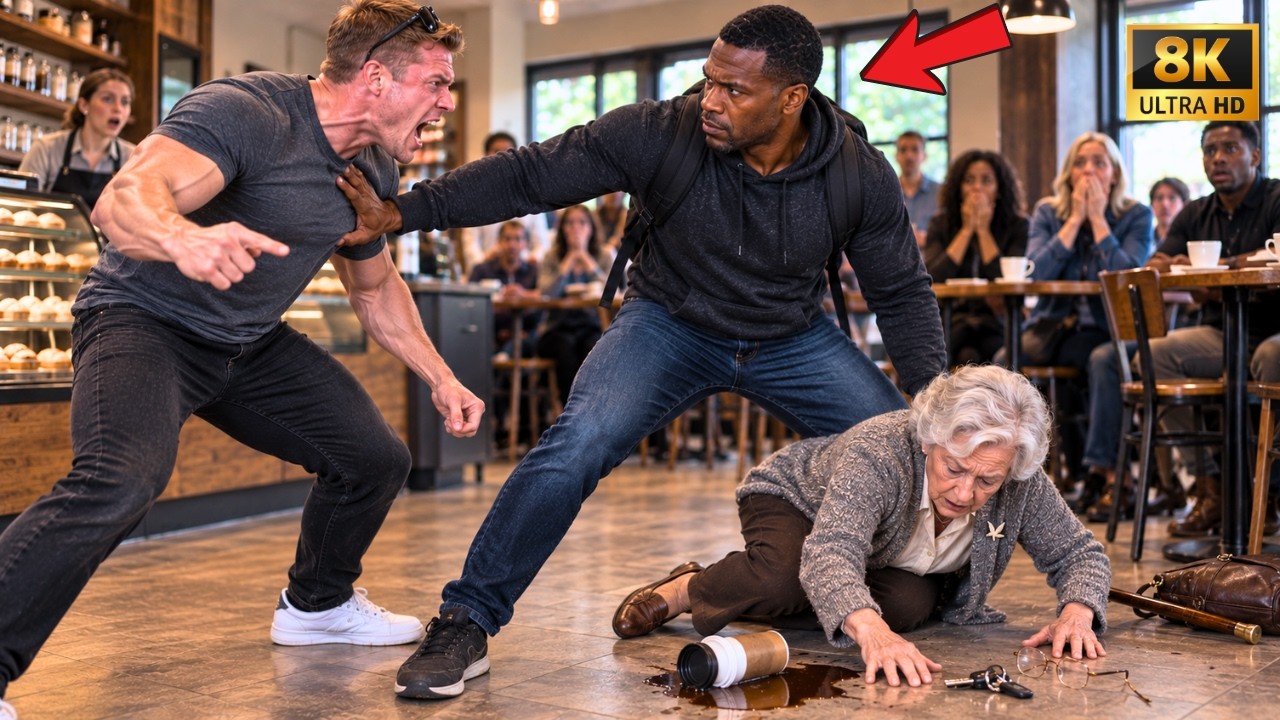
Nobody moved. Eleanor reached into the pocket of her cardigan and took out a phone. Her hands were shaking badly enough that it took her two tries. She put it to her ear. Margaret, it’s Eleanor. No, listen to me. I’m at the Bennett Street store. Yes, that one. She listened again. I need you to get Bill Hoffman on the phone and I need building security supervisor to receive a call in the next 90 seconds and I need somebody to preserve the camera footage from this location from 9:30 this morning forward before anybody touches anything. She
looked directly at Dale Whitmore while she said the next part. This is Eleanor Caldwell. I’m the founder. I’m standing in one of our own stores. She lowered the phone. The silence [music] that followed was a different kind of silence than before. Cassie, 19, behind the counter, had gone completely white.
She had been handing this woman a large black coffee every Saturday for 14 months. She had called her Miss Eleanor. There was a photograph in the back hallway by the time clock next to the health inspection certificate of a woman cutting a ribbon in front of a warehouse in 1984, and Cassie had walked past it 400 times without ever once looking at the face.
Whitmore’s radio went off in his hand. He did not answer it. Ma’am, are you telling me? I am telling you that you are holding the only person in this building who did anything [music] right this morning. And that was when Hannah Brooks stood up. She was 22. She had a denim jacket and a half-finished latte and a phone that had been recording continuously for 9 minutes and 40 seconds.
She had been sitting 11 ft from the counter when it started. She had filmed the whole thing. She had filmed the shoulder, the fall, the cane, the phones going up, the brooch, the crouch, the raised hands, the wrist, all of it. And she had not said one single word. She walked to the counter with the phone held out in front of her in both hands like something hot. I have it.
I have all of it from before she fell. It’s It’s 9 minutes. You can see everything. He never touched anybody until that guy grabbed his shirt and then he let go right away. It’s all on here. Whitmore looked at the phone. He looked at Marcus, still against the counter, still not resisting, still with his head turned so his daughter could see his face. Owen, let him up.
They let him up. Marcus straightened and rolled his shoulders once. He did not look at the guards. He did not ask for an apology. And he did not wait to be given one. He walked past all of them, past Whitmore and past Trent and past the phones. And he went down on one knee in front of his daughter and put both arms around her.
The next 20 minutes belonged to other people. Two officers came in and watched four minutes of Hannah Brooks’s video standing at the end of the counter and then went outside with Trent and Cody and the third one who had spent the entire morning near the door and who when asked what he had seen told them the truth immediately and in detail. Names were taken.
Eleanor declined an ambulance twice and accepted an ice pack on the third offer. Dale Whitmore apologized to Marcus three times. Marcus accepted the first one, told him to preserve the store footage, and did not discuss it again. By the time the shop had emptied out to a dozen people, Elellaner was back in a chair by the window at the second table from the corner with her cardigan hung over the radiator and an ice pack on her elbow and the silver bird sitting in front of her on the table because the clasp was broken and there was nowhere to pin it.
Marcus came over with two cups. Fresh one, large, black, no room. That’s what you had. How do you know that? I was four people behind you. He sat. His daughter had gone back to her table and her notebook. Eleanor turned the cup around twice without drinking from it. What do you do for a living, Mr. Reed? Right now, I’m a full-time father.
That isn’t an answer. It’s the true one. He drank some of his coffee. I do contract work, logistics and safety consulting mostly for the port 3 days a week. And before that, he did not answer immediately. Before that, because I watched what you did to that young man’s wrist, and I have been watching people for a very long time, and that was not something a man learns at the port.
Marcus set the cup down. I was in the Navy 12 years doing what? I was a seal. Eleanor sat back in her chair. She thought about the three men. She thought about the tall one with his hands on Marcus’s chest, shoving him twice, and the shorter one grinning half a second early, and the wrist that had folded like a piece of paper and then been let go inside of a second.
You could have put all three of them on the floor. Yes, ma’am. In how long? I’d rather not answer that. I would rather you did. 4 seconds, maybe five because of the tables. Then why didn’t you? And Marcus gave her the real answer. Because she had asked it straight and because she was 74 and had coffee on her sweater and had stood up without a cane for him in front of 30 people.
Because the training isn’t what people think it is. Everybody assumes they taught us how to fight. They didn’t really. Fighting’s the easy part. What they spent 12 years teaching me was control. Anybody can lose their temper. Anybody. It takes nothing at all. The hard thing is staying calm when you’ve got every single reason in the world not to be.
That is a very generous way to describe this morning. It isn’t generous. He turned the cup on the table. There’s a second part. Go on. Some people get to be wrong once in public with people watching in a room full of cameras. They get to make one mistake and have somebody go back and look at the beginning of the tape. He looked at her.
I’m not one of those people. I’ve known that since I was 14 years old. My mother sat me down and explained it and I was angry about it for about 10 years and then I stopped being angry about it because being angry about it didn’t change it. Eleanor did not say anything. So when that man had my shirt in his fist, I wasn’t making a moral decision.
I want to be honest with you about that. I was doing math. If he goes down, the only 4 seconds anybody ever sees is the 4 seconds where I’m moving. Everything before that disappears. It doesn’t matter that I’m right. You were right. I was right and they put me against the counter anyway. That’s not a complaint. That’s just the arithmetic I live in.
Eleanor picked up the little silver bird and closed her hand around it. She was thinking about the order of things. That was what she could not get past. He had come across that floor and the first thing he had done was pick up the cane, and the second thing he had done was put his hand on a filthy wet floor and find a brooch the size of a thumbnail.
And only then had he come to her. And he had done all of that before he said one word to the three men. Nobody had told him the brooch mattered. He had simply seen a woman on the ground reaching for something instead of for her cane and understood. Mr. Reed, do you know what I was doing on the floor? Looking for that? Do you know why? No, ma’am.
It wasn’t my business. My husband gave it to me in 1979. He’s been dead 3 years. I sit at this table because we sat at this table. Marcus nodded once and did not say any of the things people usually say. Excuse me. Immani had come over with her notebook. She turned it around and held it up.
And on the page were three people standing in a row. A girl with a notebook, a tall man, and an old woman with a cane. That’s you. Because you looked sad, and my dad picked you up. Eleanor Caldwell had been called Madame Chairman for 19 years. She had been given an honorary doctorate, a key to a city, and a plaque with her name misspelled on it.
She had shaken hands with two governors. [music] She had sat at the head of a table in a building with her own name on the outside of it and watched men twice her size decide in real time to agree with her. None of it had ever once made her feel the way she felt looking at a crayon drawing held up by an 8-year-old in a coffee shop because the drawing had gotten it right.
There was no company in it and no title in it and no building with a name on it. There was just a woman who had been on the ground and the man who came over. May I keep this? 3 weeks later, she found him. It was not difficult. She had a name, a street, and a company with a research department, and she used all three.
And then she had Margaret call and set up a meeting. And Marcus assumed for the first four minutes of it that he was being offered money to go away quietly. He was not. I want to start something and I want you to run it. Young people 14 to 18, six sites to start. I will pay for all of it and I will put my name nowhere near it.
Teaching what? That’s what I’m asking you. Marcus thought about it and then he gave her one condition. I won’t teach kids how to fight then what? How to walk away from something that isn’t worth it. [music] How to stand between a person and the thing that’s coming at them without putting hands on anybody. [music] how to hold on to your temper when somebody is working very hard to take it from you.
[music] He looked at her and how to treat people with dignity even when nobody is giving you any, especially then. That’s the whole thing really. That’s the only part that’s hard. Eleanor put out her hand and they shook on it. The program opened the following spring in a converted warehouse 11 blocks from Bennett Street.
By the end of the second year, there were 400 kids in it with a waiting list. Marcus never told any of them about the Navy. It came out eventually, the way things do, and when a 15-year-old finally asked him straight out whether it was true, he said yes and then [music] changed the subject so smoothly that the kid did not notice for 10 minutes.
He never asked anybody to call him sir. He never once told the story of the coffee shop. People tried to make him a hero about it for a while. A local station wanted him on a morning segment. Somebody put the video on the internet where it did what those videos do. And for about nine days, strangers wrote things about him.
Every time it came up, Marcus said the same sentence and then he stopped talking. I just wanted my daughter to see the right thing. Eleanor had the drawing framed. She hung it in her office on the 22nd floor on the wall beside the window directly next to a heavy brass plaque naming her executive of the year for 1996.
Visitors always looked at the plaque first and the drawing second. And then they always looked at the drawing again. She had the brooch repaired. It cost $40 and took a week. And on Saturday morning, she still went to the Marlo coffee on Bennett Street at 9:40 and sat at the second table from the corner where the sun landed on the wood by 10:00.
She still ordered a large black no room. Cassie still made it, but she did not sit alone anymore. Most weeks there were three cups on that table and a notebook and a paper bag with a croissant in it. Do not decide who a person is from their age or their clothes or their skin. The woman on the floor may have built the building you are standing in.
The man everyone turned the cameras on may be the only one in the room who moved. And you do not need power to change what happens next. Most of the time, all it takes is one person willing to stand up and say, “That’s