K9 Blocked Every Doctor—Until a Radiology Tech’s Bracelet Revealed Her Hidden Military Bond – Ty
K9 Blocked Every Doctor—Until a Radiology Tech’s Bracelet Revealed Her Hidden Military Bond
The ambulance bay doors at Cascadia Regional Medical Center blew open at 4:47 in the afternoon, and the man on the gurnie was still bleeding through two field dressings someone had applied to his right side with a hand that clearly knew what it was doing. Three paramedics pushed the gurnie fast. Two trauma nurses ran to meet it, and every single one of them stopped within 6 ft of the patient.
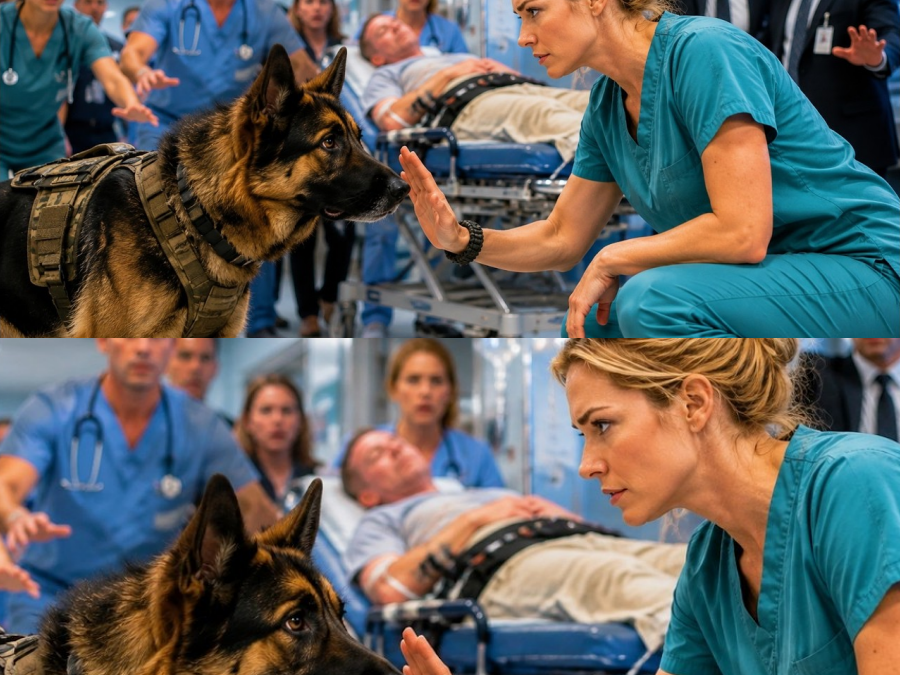
Not because of the blood, not because of the dressings or the oxygen mask or the IV line already running. Because of the dog. The Labrador was black, about 80 pounds, wearing a full tactical vest with a military working dog patch stitched on the side, and it was positioned with its body low and parallel across the width of the gurnie, moving with it the way water moves around a stone, without disruption, without aggression, and without any intention of allowing a single hand near the man beneath it.
The dog wasn’t growling. It wasn’t barking. Its eyes just moved, tracking every person who moved toward them, and that calm was more alarming than noise would have been. The trauma team had been in motion. Now they weren’t. Get animal control on the phone, someone said. That’s going to be 40 minutes minimum at shift change. Then get the handler.
This animal has to have a handler. One of the paramedics, a heavy set man who had clearly been standing too close to the dog for comfort for the past 12 minutes, shook his head. Came in on a federal transport vehicle. Dog was already on scene when we got there. No handler on site, no leash, just the patient and the dog and a field kit.
Cali Briard was at the far end of the hallway with a portable X-ray unit and a tablet she hadn’t finished logging yet. She had been until 90 seconds ago thinking about whether she had time to grab coffee before the evening shift supervisor started asking where she was. She was a radiologic technologist and she had been on her feet for 9 hours and the coffee machine on the second floor made a better cup than the one in the break room.
And that had been the full scope of her concerns until the bay doors blew open and everything in the corridor rearranged itself around something she hadn’t expected to see. She watched the dog. Not the patient, not the blood, not the controlled chaos of a trauma team that couldn’t get within reach of their own patient. She watched the dog.
The Labrador’s body language was specific in a way that most people in the hallway probably weren’t reading correctly. It wasn’t aggressive. It was guarding. The weight distribution was wrong for an attack posture. The hind quarters were too settled, the head too low, the eyes too steady.
This was a dog that had been trained to do exactly this, to mark a perimeter and hold it. Not because it intended violence, but because violence was what it was protecting against. Callie had seen this posture before. in a different state, in a different building, standing outside a kennel unit attached to a military installation she had visited twice in her life and thought about considerably more than that.
She set the tablet on the portable X-ray unit. She walked toward the gurnie. Ma’am, one of the trauma nurses put out a hand. Stay back, the dog. Callie didn’t stop, but she slowed down and she changed the way she was moving. She dropped her shoulders. She tilted her head slightly down and to the left, taking her direct gaze off the dog’s eyes without losing her awareness of its position.
She let her arms hang loose at her sides, palms slightly forward. She kept her pace deliberate and unhurried. She got within 10 ft of the gurnie and stopped. The dog’s head turned. It looked at her, not the evaluating sweep it had been giving everyone else. This was different, specific. It held on her for two full seconds, and Callie held perfectly still and breathed through her nose and didn’t speak and didn’t move.
She brought her right hand up slowly, palm out, fingers together, and held it for one second in a position that meant nothing to anyone else in the hallway. The Labrador blinked, its weight shifted back. The low posture eased by maybe 3 in, and it stepped back from the side of the gurnie. Not far, but enough.
Behind her, someone exhaled like they had been holding their breath for a long time. Callie was already moving toward the patient. The dog tracked her with its eyes, but did not block her. She reached the gurnie’s edge, put two fingers to the patient’s neck, and looked at the trauma attending, a lean man named Dr.
Margolus, who had been the closest thing to frustrated she had ever seen a doctor look. “He’s tachi cartic,” she said. “Rates around 115, maybe 120. His color’s wrong and his breathing is too fast and too shallow for the volume of the bleed. You need to move him now. Dr. Margolus looked at her for exactly 1 second.
Then he looked at the dog, which had not moved from its new position back, but watching. Then he moved. The trauma team reformed around the gurnie. The dog repositioned alongside it, fluid and precise, but it didn’t block them. It watched. It permitted. And when they pushed the gurnie toward trauma too, the dog went with them and nobody argued about it.
Callie kept her hand near the patients wrist as they moved. She had no clinical standing to do this. She was a radiologic technologist. Her job was imaging, but the dog was watching her and the dog was the reason the trauma team could work. And she was not going to do anything to break what had been established in the last 4 minutes.
His name, one of the paramedics, told Dr. Margolus in a low voice was Flynnstead. That was all they had. If you’ve stayed this far, don’t leave. Stay until the end. Like this and drop a comment with your city. I want to see how far this story travels. Flynn Stead did not regain consciousness during the first hour of assessment and treatment.
The wound was a gunshot right lateral thorax. And while it had avoided the major vessels by a margin that Margolus later described as uncomfortable, it had done real damage. Blood products went in. Fluids followed. The O was called. Through all of it, the Labrador. Someone had finally gotten close enough to read the tag on his tactical collar.
The name stamped in block letters. Charge. Repositioned to the foot of the bed and settled into a low, watchful posture that communicated the same thing his earlier behavior had. He was still working. He was always working. Callie stayed in trauma 2 longer than her assignment required. She told herself it was the documentation.
Portable X-rays required technical notes and she hadn’t finished her log. She told herself a lot of things. The truth was simpler. She didn’t want to leave Sarge alone in a room full of strangers. She understood that this was not rational. Sarge was a military working dog. He didn’t need her presence for emotional support.
But there was something in the way he had looked at her in the corridor. something in the specific quality of recognition in those dark amber eyes that had settled in her chest and wasn’t moving. She was charting in the corner of the room when the footsteps came down the hallway. Wrong cadence. Two deliberate souls with a harder profile than standard hospital footwear.
She turned before the door fully opened. Two people, both in dark civilian clothes with credentials already displayed. The taller one, a woman in her late 30s with closecropped hair and the specific kind of eye contact that was professionally designed to communicate authority, spoke first. Cali Briard. Yes. Special agent Nara Polllet, OSI.
She held the badge just long enough. The man you just helped stabilize works for us. We need to ask you some questions. The family consultation room off the main corridor was furnished with uncomfortable chairs and a box of tissues and nothing useful on the walls. Callie sat with her hands in her lap and answered questions in the order they were asked.
She had learned a long time ago that this was the correct approach under pressure, systematic without embellishment. Plet’s partner was a younger agent named Yates, who took notes on a tablet and had the habit of not looking up when she answered, only looking when she stopped. She found this mildly irritating, which she chose to interpret as a sign she was managing her nerves adequately.
“You were the first medical staff to successfully make contact with the patient,” Plet said. Sarge made that possible. About that, Plet paused. Sarge is a retired military working dog assigned to Ste as a service animal following Ste’s medical separation from active duty 18 months ago. In that time, according to everyone who knows him, Sarge has not permitted physical contact from a stranger without a direct introduction from Steed himself.
Today was the first exception on record. She let that sit for a moment. Do you have any prior connection to military working dog programs or to Flynnstead personally? I’ve never met Flynnstead before today. And Sarge? Callie was quiet for a moment. Not Sarge specifically. Plet’s eyes sharpened by a fraction. Can you tell me about that bracelet? Callie looked down at her left wrist, where the sleeve of her scrubs had pushed back.
The paracord bracelet was dark green and tan, woven in a specific pattern that looked decorative, unless you knew what you were looking at. Most people didn’t. She had worn it for so long that she sometimes forgot it was there. My brother made it, she said. Plet waited. Colon Briard. He was an army dog handler attached to a unit that worked with the 160th out of Fort Campbell.
He made this for me about 6 years ago. She turned her wrist so the weave faced up. The knot pattern is a handler’s signal. It’s a tactile ID used in the field in low visibility conditions. The handlers in his unit used variations of it as quick recognition markers for the dogs. The dogs were trained to associate the pattern with a specific scent from the handler’s hands.
Worn against skin over time, it absorbs and holds the scent signature. She paused. Sarge would have been exposed to these patterns during training, possibly during operations. He would have encountered them on handlers, on friends of handlers, on people in the unit’s immediate orbit. When he registered my wrist in that hallway, he recognized a friendly signature.
Plet said, “Combin with the approach signals I used, the body language my brother taught me the basics when I visited his unit twice over four years. She looked at Plet. I never expected to use any of it. Plet wrote something down. Yates looked up for the first time. Where is your brother now? Plet said. Callie’s hands folded in her lap, a reflex she recognized and didn’t change.
Fort Louis VA. He’s been there 11 months. Spinal injury during his last deployment. She paused. He’s not going back to the unit. He knows that he’s been working through what that means. Plet looked at her with something that wasn’t quite sympathy, but was in that neighborhood. Does he know Flynnstead? The room was very still.
Steed was Colin’s commanding officer for three of the four years Colin was in the unit. Callie said he’s the one who made the call that got Colin out of the field when the injury happened. He’s the reason my brother is alive. Neither agent spoke. I didn’t know Steed was the patient, Callie said. Not until after. I only knew him by name and by what Colin told me.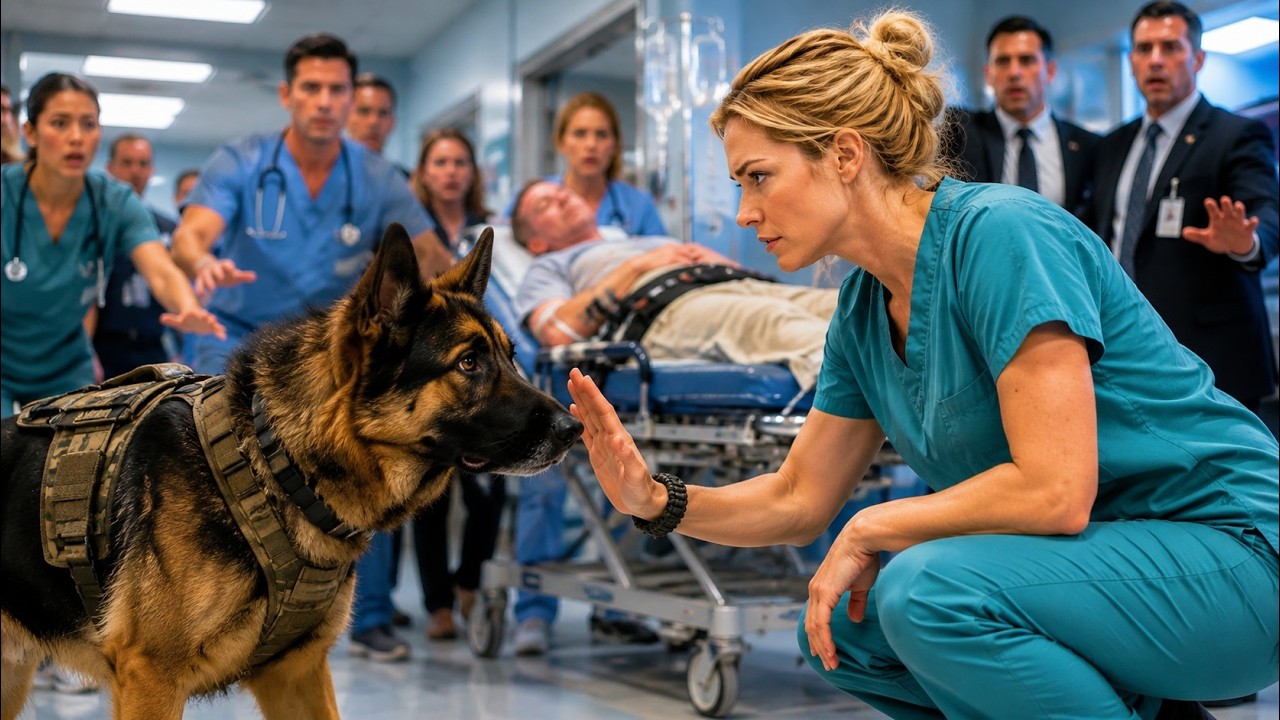
I wouldn’t have recognized his face. But Sarge recognized you,” Plet said. Apparently, the consultation room had a clock on the wall that was 4 minutes slow. Callie had clocked this in the first 30 seconds and had been tracking the real time against it since. She was at hour 10 and 20 minutes of her shift and calculating whether the vending machine on the second floor had anything left worth eating.
When the door opened again and Plet sat back down with a folder she set on the table between them but didn’t immediately open. Flynnstead was shot in a location and manner that rules out random incident. Plet said the field dressing on his wound was applied by someone with significant tactical medical training. This was a planned operation against a specific individual and it was reactive.
Someone became aware that Ste was close to identifying a source inside his own unit and moved to remove the problem before he could. He’s been keeping records, Callie said, and then stopped because she hadn’t actually known that until the words came out. She was extrapolating the way she always extrapolated from the facts available.
Someone who’s noticed a leak in their unit for over a year, who filed a report and was told they were misreading the data, they keep their own records. That’s what you do when you don’t trust the official system to hold on to it. Plet’s expression didn’t change. We don’t know the location of those records. Does he? He’s not conscious enough to tell us yet.
Callie looked at the folder. What do you need from me? What Plet needed was both simpler and more complicated than Callie expected. Simpler because the immediate ask was clear. Steed’s file had logged Callie’s name from her initial contact in the trauma bay. And changing that nursing assignment now would create a documentation discrepancy in systems that Plet had reason to believe were being monitored.
Keeping the assignment intact would maintain a cover that OSI needed intact. Callie had already been on shift 11 hours. Plet was asking her to stay. More complicated because while Cali had been in the consultation room, two things had happened that Plet now laid out with the careful precision of someone delivering information that had implications she was still calculating.
First, a contracted IT technician named Clark Hessel, who serviced Cascadia Regional’s medical records vendor system, had accessed the inpatient floors admission log three times since Ste’s arrival. The timestamps were irregular. Normal maintenance protocols ran during off hours, targeted specific system functions, and were logged in advance.
These accesses were clustered, short in duration, and aimed at one record. Second, a gray SUV had parked in the hospital’s east structure and had not moved in 2 hours. Callie had noticed the SUV herself. From the breakroom window, when she’d gotten coffee 40 minutes ago, she’d registered it. Third level, east corner, direct sight line to the ambulance bay entrance and filed it the way she filed things she didn’t have context for yet.
When she described it, Plet’s expression shifted by a fraction. How long ago? When I got coffee, maybe 70 minutes. Yates was already on the radio. They moved Stead to a room on the fourth floor, north wing. The transfer was not clinically ideal. Margoli said so plainly, but Plet made the argument and Margolius accepted it.
Cali managed the monitoring leads and the IV lines during the move alongside a floor nurse named Jinny, who absorbed every element of the situation with the composed efficiency of someone who had been working night shifts at a military adjacent hospital for 8 years and had stopped being surprised by federal agents around hour 3 of year 1.
Sarge came with them. Nobody suggested otherwise. Callie was checking Ste’s oxygen saturation in the new room when he spoke for the first time. Where’s Sarge? Not quite a question, flat and deliberate. Foot of the bed, she said. He’s been there the whole time. Steed opened his eyes. He tracked the ceiling, then the room, then her, with the systematic method of a man who had developed a protocol for waking up in unfamiliar places because the alternative had cost too much.
“You’re not a nurse,” he said. Radiologic technologist Calli Briard. Something moved across his face. Briard Colon’s my sister. He was quiet for a moment that felt longer than it was. I didn’t know he had family and medicine. He doesn’t talk about me much. I’m not a comfortable subject. She adjusted the pulse oximter on his finger.
You’d have to ask him why. How is he? She looked at him directly. He held the look without flinching. Some days are better than others, she said. He’s at Fort Lewis. He’s doing the work. I should have gone to see him. He would have told you not to make the trip. She paused. He would have said he was fine.
Steed didn’t argue with this. The silence between them had the quality of two people who understood the same person from different angles and had arrived independently at compatible conclusions. “The records I’ve been keeping,” he said. Then she waited. Cloud stored, encrypted. There’s an access sequence, six steps, not the standard four.
Most people try four and stop there. He was watching her with the same dark, evaluating calm she’d first seen when he opened his eyes. If something goes sideways before Plet gets there. Tell me the sequence, Callie said. He did. She memorized it the way she memorized things that mattered in the same layered method she used for imaging protocols and medication interactions she’d cataloged over years of sitting in VA rooms and watching and learning and not having a clinical credential for any of it. She didn’t write it down. Writing it
down created a different kind of problem and she understood this without being told. You reported the leak, she said, and they dismissed it. Ste looked at the ceiling twice. So you kept building the case alone. Someone inside my unit has been feeding our operational schedule to a foreign network for over a year.
Deployment windows, fitness profiles, medical assessments, the kind of information that tells an outside actor exactly when and where the unit is most exposed. He stopped. The tightness around his mouth had nothing to do with pain medication and everything to do with something older and harder to treat.
In 3 weeks, my unit has a rotation. This network has been positioning around that window for months. If I’m out of the picture before the records surface, there’s nothing to stop it. Callie thought about this the way she thought about imaging anomalies, tracing the mechanism, following the path, identifying where the failure originated.
She thought about a man who had filed reports and been told he was misreading data, who had responded not by accepting the dismissal, but by quietly systematically continuing to build a case while working alongside the person he suspected, maintaining the appearance of normaly for 14 months. She recognized the architecture of it. She had lived a smaller version of it in different rooms for different reasons.
Sarge knew, she said. Stead was quiet for a moment. He stopped being comfortable around my exo about 13 months ago. I noticed. I didn’t know what to do with it yet. He turned his head toward her. A dog doesn’t have politics. He doesn’t have a career to protect. He just reads what’s actually in the room.
Who is it? Major Southerntherland. His voice was level, past bitter, into something that had been processed and set down in a place where it could be carried without being constantly handled. 12 years. He was at my sister’s wedding. I’ve eaten dinner at his house. She didn’t say anything. There was nothing useful to say.
The afternoon moved the way long shifts moved once the adrenaline had been metabolized. Not fast, not slow, but with a granular awareness of each individual hour that made each one feel longer than the clock suggested. Cali monitored Ste’s vitals with the attention of someone doing twice the clinical work she was officially logging.
She reviewed Jinnie’s chart notes. She checked the IV site twice without announcing it. At 2:40 in the afternoon, Plet came to the doorway and delivered information with the specific controlled register of someone managing urgency without amplifying it. Yates had pulled the vendor systems full access log.
Clark Hessel had run two queries since Steed’s admission. The first flagged the inpatient floor’s active admissions list. The second pulled the nursing staff roster for the fourth floor. Callie’s name was the anomaly in the second query, flagged for extended hours, visible to anyone mapping who had ongoing contact with the patient. The gray SUV had left the east structure, tracked to an address 4 mi east of the hospital. Someone was there.
Someone had been watching. They know I’m here. Callie said they knew 40 minutes ago. Plet said, we’ve been managing the cover since then. A pause. There’s a second access point. Someone ran a remote query through a third-party vendor terminal at 1:30. Someone inside this building with administrative level credentials. Callie thought about the supply coordinator’s office at the end of the south corridor.
It had a vendor terminal with that access level. She had used it herself 2 months ago to pull a billing discrepancy in a patient’s imaging orders. The supply coordinator had called in sick that morning. The office would have been empty all day. She told Plet. Plet had her radio out before Cali finished the sentence.
20 minutes later, a man in green administrative scrubs went out a second floor window and across the service courtyard and through the east service gate before Plet’s ground unit cut him off at the maintenance junction. His name was Clark Hessle. He was in custody. He was talking before they finished processing him because he was scared enough to talk fast and had been given just enough information to do his part in the network and not enough to feel comfortable about what happened to people who got caught in it.
The threat arrived on Callie’s phone at 5:17 in the evening from an unknown number, three words, back away now. She read them. She thought about every room she had ever made herself smaller to fit into. Every time a radiologist had talked over her, every time an administrator had told her the anomaly she’d flagged was already being handled, every time she had been the person who noticed the thing and watched the notation go somewhere else, she thought about the specific language of the text. Back away, not a threat of
injury, the language of someone hoping she would decide the exposure wasn’t worth it. That she would become the person who hadn’t really seen anything important. She forwarded the text to Plet, put her phone in her pocket, and went back to the fourth floor. The voice memo from Plet arrived at 6:03 in the morning.
Callie had been in an on call room for 2 hours, horizontal, which wasn’t sleeping, but was the next closest thing when the message appeared. She put in her earbuds and pressed play. Plet’s voice was clipped, controlled, the background sound of a vehicle interior underneath it. Cali, the civilian contact above Southerntherland. We’ve had surveillance on a building two blocks east of the hospital for 48 hours.
Phone metadata from Hessel’s device puts that location monitoring the hospital’s east service entrance specifically. The same entrance Hessel used. It feeds directly to the freight elevator which goes to every floor. We’re executing warrants simultaneously at 0600 Zid Southerntherland at Fort Lewis. Civilian contact at the northern location.
But if the timing on either end triggered a contingency, whoever’s positioned near the hospital has a window before everything closes. We’re 8 minutes out. Get Ste out of that room now. Callie was moving before the memo finished. She pushed into Ste’s room. He was already halfsitting up, reading her face with the assessment protocol she’d watched him use.
Every time new information entered the room. Warrants executing, she said. Someone was positioned two blocks east monitoring this building. They know the service entrance layout. Plet is 8 minutes out. He was already moving toward the edge of the bed. She didn’t comment on what it cost him. She got her shoulder under his arm and took the IV pole in her other hand and they moved the way people moved when the clinical ideal and the operational reality were in direct conflict.
Not gracefully, not by protocol, but forward. the supply room two doors down, locked from the inside. She knew it because she had used it twice before. Once to give a patients family a private phone call, once to wait out a situation in the hallway that wasn’t hers to manage. She got stead inside. She got the IV pole through without catching it on the frame.
She pulled the door closed and turned the lock and pressed her back against the shelving in the dark. Sarge was already there. She hadn’t seen him follow them, but he was there at the door. nose at the gap beneath it entirely still. 8 minutes, Ste said quietly. Maybe 6 now. He didn’t say anything about the supply room.
She didn’t say anything about the IV site she was checking by touch in the dark. They had established an efficient economy of silence over the past 14 hours that served them both. Then Serge’s ears moved, both of them rotating forward and left toward the freight elevator at the end of the corridor. She put her hand on Ste’s arm. He’d already felt it.
The elevator mechanism was audible in the quiet of early morning. Not loud, but present. The specific low sound of a car in motion. A shift in air pressure that preceded the sound of a heavy door opening. Then footsteps. One person moving carefully, hugging the wall rather than the center of the corridor.
The pace of someone with a destination and enough training to think about angles. A door opened. a room being checked, then another closer. Sarge turned his head toward her. In the dark, she could see the amber gleam of his eyes, and she read in them the thing she’d first seen in that ambulance bay corridor.
Not fear, not aggression, but a heightened, focused readiness. The specific quality of an animal that had identified a threat and was waiting on instruction. She put two fingers lightly on his back. He stilled further. The footsteps stopped outside their door. a pause, the listening kind, the calculating kind. She controlled her breathing and made it slow and shallow.
Stead had gone entirely still beside her, the way of someone trained to reduce his physical presence to near nothing while remaining completely alert. The handle moved, it turned. It met the locked resistance and stopped. Another pause longer. Then the footsteps moved past, continuing down the corridor toward Steed’s original room, which still had his name on the door placard.
She let a breath out through her nose. Steed’s hand found her wrist in the dark, not gripping, just contact, the involuntary acknowledgement of two people who had just shared 30 seconds of genuine uncertainty about what happened next. From the far end of the corridor, a stairwell door, multiple sets of footsteps, commands that were sharp and non-negotiable.
The controlled efficiency of a federal takedown in a confined space, a sound that might have been a shoulder hitting a wall. Then Pit’s voice close and clear through the door. Clear. His name was Edwin G. 58 years old, retired defense intelligence, transitioned to private consulting 8 years ago.
The phone recovered from his jacket during the arrest contained 941 days of communication with a network that included Southerntherland, two additional military personnel, three civilian contractors, and six international numbers that OSI’s digital forensics team would spend the next 4 days tracing to their sources. Callie learned most of this from Yates in the third floor breakroom at 8 in the morning while she ate something from the vending machine that she couldn’t taste and didn’t try to.
Yates delivered information the same way he took notes efficiently without editorializing, looking at his tablet rather than at her. For the first time, she found this reassuring rather than irritating. Precision was more useful than warmth in the current situation. Sutherland was taken at Fort Lewis at 6:03 a.m. 47 seconds after the warrant executed.
He was in the officer’s mess. The simultaneity with G’s arrest at the hospital had been deliberate. Plet had timed them specifically to eliminate any window for communication between the two. Hessle was cooperating fully. He had been recruited 6 weeks prior, given exactly enough information to do his part and not enough to understand the larger network.
He knew the phone number. He knew the payment method. He didn’t know why. The encrypted drive, when instead gave Plet the access sequence, opened a record that 14 months of careful, systematic documentation had built into something irrefutable. 42 time-stamped instances of intelligence discrepancy consistent with prior disclosure. Recorded conversations.
A voice identifiable on analysis naming a civilian contact above Southerntherland. Edwin Galt by name in his own voice naming the operation. Plet came to the room at 8:30 with the expression of someone who had expected to find a useful record and found a complete one. It’s comprehensive. She said, I know what’s in it. Ste said.
You have the civilian contact on recording naming himself, naming the network, naming the 3-week window. She sat down, which Callie had not seen her do in the 18 hours since she’d first walked into the trauma bay corridor. You’ve been carrying this for 14 months. I needed it to be complete before I moved on it. I’d already reported it twice through channels and been told I was overreading the data.
His voice was even the specific register of someone who had processed the anger a long time ago and was now operating from whatever was on the other side of it. If I surfaced incomplete records a third time and they disappeared again, there was nothing left to try. Plet was quiet for a moment. Southerntherland, how long did you know him? 12 years.
When did you first suspect him? 14 months ago. Small things first. Intel that was slightly old. Timing that was fractionally wrong. Nothing you could prove. Nothing you could take to anyone without sounding paranoid. He paused and then Sarge stopped going near him. About 13 months ago, I noticed I started keeping records. The room was quiet.
Plet looked at Ste for a long moment, and then the way she had done once before in the consultation room, when the professional register had shifted briefly into something else, she said, “The people in your unit, when this becomes official, they’re going to need time. I know the ones who trusted him. They’re going to need to be angry first.
Let them be, Callie said. Both of them looked at her. Let them be angry for as long as it takes. That’s not the part that needs to be managed. The part that needs managing comes after. Plet looked at her for a moment. Then she stood, picked up her folder, and left in the direction of what would clearly be a very long day of subsequent steps.
The formal commenation came through Plet 4 days later. A sealed envelope, OSI letterhead, private and classified. Callie’s name, the timeline, her specific contributions to an 8-month investigation documented at the federal level. Not public, not visible without clearance, but real and permanent in the way that official records were real and permanent regardless of who could read them.
She read it once, standing at the breakroom window on the fourth floor, where she could see the east parking structure and the space where the gray SUV had been. She folded it carefully, put it in her jacket pocket, and went back to Ste’s room, where she had two more hours of monitoring to finish before Jinny took over and she could finally go home.
Colin came 5 weeks later. He drove himself from Fort Lewis in the handcontrolled vehicle he had been teaching himself to navigate, which he’d mentioned only once in a text with the studied casualness of someone who had worked very hard on something, and was determined not to make it into a larger event than it was.
He pulled into the hospital lot at 11:15 on a Tuesday and didn’t tell Cali he was coming until he was already in the lobby. She found him near the window that looked out over the parking lot. He had the posture she watched him develop over the past year, the deliberate stillness of someone who had learned to ration movement, to make each decision about how to hold his body intentional rather than automatic.
He looked better than 3 months ago. He looked like someone who had been doing the work steadily and without announcement. He looked at her and didn’t speak for a moment. Then you could have told me. You would have said you were fine. I would have come anyway. I know, she said. But I wanted it to be over first.
I wanted to be able to tell you all of it. He was quiet, working through something. He’s recovering. He’s going to be okay. She paused. He’s asked about you more than once. Colin looked at the floor and then back at her, and she recognized the expression on his face. It was the one she had seen 11 months ago in his hospital room.
The first time the pain had broken through the wall he’d been maintaining. And he’d looked at her like she’d caught him at something. The specific look of someone who had been managing something very heavy and had just been offered permission to put it down. I should have gone to see him, he said. He knows why you didn’t.
She kept her voice level. And you’ve been doing everything right, Colin. Everything that needed doing. That’s not nothing. He didn’t answer. She had asked Plet for one favor. Plet had agreed without being asked twice. Sarge came out of the elevator with a handler who stopped at the lobby entrance and unclipped the leash and let the dog move forward on his own.
Sarge crossed the lobby and went directly to Colin. It happened fast and slow at the same time, the way things happened when you had been braced for something, and then found that bracing hadn’t been enough preparation. Sarge pressed his head against Colin’s leg, and Colin’s hand came down and found the dog’s ears, and for a moment, neither of them moved, and there was nothing in the lobby that mattered more than what was happening in that small space between a man and a dog who had been separated by events that neither of them had controlled. Callie watched her
brother’s face. She had seen him angry. She had seen him in pain he refused to name. She had seen him in the specific exhaustion of someone rebuilding something that had been taken apart at a fundamental level. She had not seen him look the way he looked in that moment. Not broken, not relieved exactly, but something that was both and neither.
the expression of a person who had walked back into a room they’d believed they’d had to leave permanently and discovered it had been waiting. After a moment, Colin looked up at her. She watched him work through the older brother reflex. The argument about why she hadn’t told him sooner, the question of why she hadn’t called, and she watched him set it down. The bracelet, he said. Yes.
I thought you’d lose it in about 2 weeks. I’ve worn it for 6 years. He looked at her for a long moment, then at Sarge, who had not moved from his position, then back at her. I didn’t know, he said, not an accusation. The flat acknowledgement of someone recalculating what his sister actually was in relationship to what he’d assumed.
I thought I was giving you something to hold on to. You were. She held his look. You were also giving me something to use. Turns out those were the same thing. Colin was quiet. Something moved through his face. Not the argument anymore. Something else. Something that had no clean name, but that she recognized because she had been watching his face for 31 years.
The program, he said finally. Military trauma coordination. You’ve been running that for 2 months and you didn’t tell me. I was waiting until I had something to show for it. He looked at her steadily and now now I have something to show for it. He almost smiled. It didn’t make it all the way, but it came closer than anything she had seen from him in 11 months.
And she filed that away as a positive indicator in a way that had nothing to do with her professional training and everything to do with the fact that he was her brother and she had been watching him very carefully for a long time. Sarge straightened, stepped back to Colin’s side, and sat. His work, whatever he had decided it was, appeared to be complete.
The training module took eight more weeks to finish. It covered civilian military handoff protocols for emergency department admissions, K9 integration procedures for trauma staff who had no prior exposure, and the specific gap that existed when wounded service members came through civilian hospital systems without adequate contextual briefing for the people receiving them.
The gap that had existed in that ambulance bay at 4:47 in the afternoon. the gap that had required a radiologic technologist to step out of her assigned lane and into a situation she had no official standing in. Carrying six years of proximity to someone else’s world, wearing a bracelet she had been told was a keepsake. It was detailed work, granular.
Nothing about it was dramatic. It was the architecture underneath the drama, the thing you built in the quiet time, so that the next time the bay doors blew open and the situation demanded someone to move, the person who moved had more to work with than instinct alone. She believed in the architecture. She had always believed in it.
She had been constructing it for years in the space of her own capabilities in hospital rooms and VA waiting rooms and two visits to a kennel unit in Tennessee without a credential for it or a room that officially acknowledged she was doing it. Now she had both. Ste came by 3 months after everything closed. He stood in the doorway of her office with Sarge beside him looking at the whiteboard and said, “Is that the K9 integration section draft 4? It keeps needing revision.
It should keep needing revision.” He looked at it for a moment. Colon said you’re presenting at the M hat conference. He talks to you now. We’ve been talking for a while. He looked at her. I should have called him sooner when he was first at Lewis. He would have said he was fine. I know. I would have gone anyway. She turned back to the whiteboard.
The K9 section still has gaps. I have direct experience with one incident which is not the same as expertise. I could review it. Ste said. I was going to ask you two. Sarge crossed the office without ceremony and settled beside her chair with the unhurried decision-making of an animal that had assessed the situation and reached a conclusion.
She reached down and rested her hand briefly on his head. Outside the window, the morning light came in at an angle that made the whiteboard almost too bright to read. She picked up a marker and thought about the next section, the one that covered the specific silence that could open up in a trauma bay when the situation exceeded everyone’s training and how to close that silence before someone had to close it alone.
She had been in that silence. She had been the one who moved. She started writing.