They Attacked the Wrong Woman at the Gun Store — It Was the Last Mistake They Ever Made – Ty
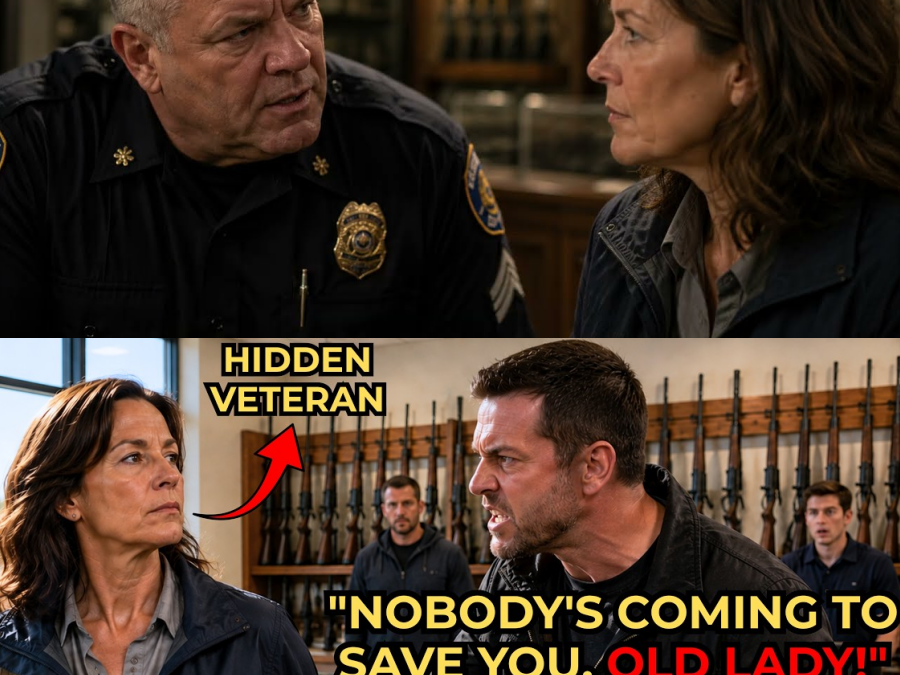
They Attacked the Wrong Woman at the Gun Store — It Was the Last Mistake They Ever Made
Three men jumped her the moment she stepped inside the gun store. One of them grabbing her by the arm hard enough to leave a bruise. “This one’s ours.” he said, loud enough for the whole street to hear. She didn’t scream. She didn’t run. 20 seconds later, all three of them were on the floor and not one of them could explain what had just happened.
But the real shock came an hour later when police pulled the men’s records and discovered they’d been planning something considerably worse than a random attack. And the only reason anyone found out in time was because they’d made the mistake of picking the wrong woman to grab first. Fenwick Arms sat on a quiet commercial strip in a mid-size suburb.
The kind of gun shop that had operated for 11 years without a single incident more serious than a shoplifted box of ammunition. Rifles hung along the back wall in careful rows. Handguns sat under glass along the front counter. And a small radio played quietly behind the register. The ordinary soundtrack of an unremarkable Wednesday afternoon.
It was a quiet afternoon, the store nearly empty, when Odalis Marquette pushed through the front door on her way to pick up a scope sheet ordered the week before. She was in her mid-50s, unremarkable in appearance, wearing a plain windbreaker and carrying a small canvas bag. The kind of ordinary customer who drew no particular attention on any ordinary day.
Three men were already inside when she entered, positioned near the ammunition wall in a way that a more suspicious observer might have recognized as deliberate rather than casual. The clerk on duty, a young man named Perry, had noticed something off about their behavior in the 10 minutes before Odalis arrived.
Though he hadn’t yet decided what to do about the vague unease sitting in his stomach. The moment the door chimed behind Odalis, the largest of the three men crossed the store in four quick strides and grabbed her by the upper arm. His grip hard enough to leave a mark that would still be visible the following day. “This one’s ours,” he said to his companions, loud enough for the whole street to hear through the glass storefront.
“Grab the other bag.” Perry froze behind the counter, his hand hovering uselessly near a phone he hadn’t yet managed to pick up. Odalis didn’t scream. She didn’t struggle against the grip in any way that looked, in that first half second, like resistance at all. She simply looked down at the hand on her arm, then up at the man’s face with an expression that had nothing to do with fear.
What happened next took less time than it took Perry to finish dialing 911. Odalis’s free hand found the man’s wrist, and in a single fluid motion that redirected his own forward momentum against him, she broke his grip and put him on the ground with a technique that looked, to Perry’s untrained eye, less like a struggle and more like something demonstrated in a controlled training environment.
Her movements carried no wasted energy, no telegraphed windup, the specific economical violence of someone whose body had internalized the sequence so completely that conscious thought had largely stepped aside to let trained reflex handle the situation instead. The second man lunged toward her from the side, and she pivoted into him before he’d fully closed the distance.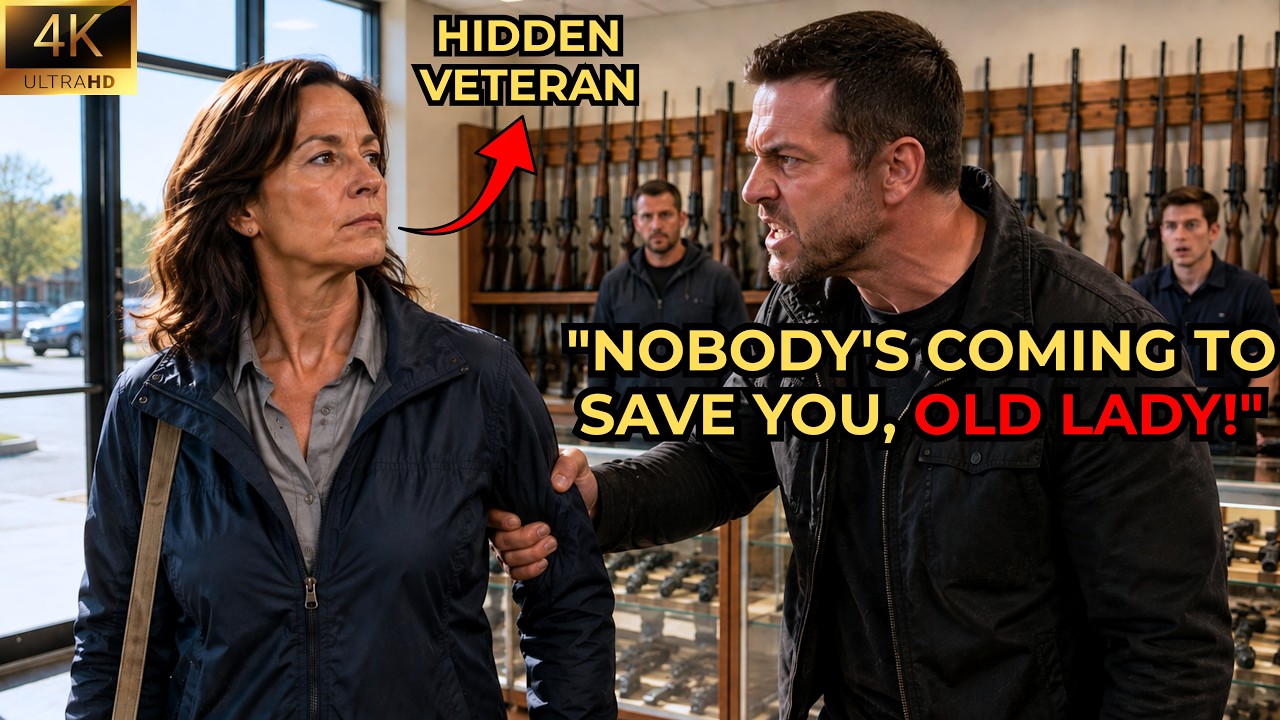
Her elbow finding his solar plexus with enough precision to drop him to his knees, gasping, his hands instinctively going to his midsection rather than continuing his attack. The third man, faster to react than his companions, pulled a knife from inside his jacket. Odalis closed the distance before he’d finished raising it.
Her hand redirecting his wrist while her other hand and hip combined into a technique that put him on his back hard enough to knock the weapon skittering across the floor, well out of reach before he’d even registered he was falling. The entire encounter took roughly 20 seconds. Perry stood frozen behind the counter, phone finally connected to 911 dispatch, unable to form coherent words for several seconds as he stared at three grown men groaning on the floor of his employer’s gun store.
Put there by a woman who looked, in every visible respect, like someone who’d wandered in to pick up a scope order. If something about this woman’s calm is already sitting with you the way it should, this is a good moment to send this video to a friend who needs to see what happens over the next hour. Odalis checked each of the three men briefly, the specific clinical efficiency of someone confirming injuries rather than gloating over them.
Then straightened her windbreaker and approached the counter with the same unhurried composure she’d carried since walking through the door. “I believe I have a scope on order,” she said, “under Marchetti.” Perry stared at her, phone still pressed to his ear, dispatch asking questions he’d entirely stopped processing.
“Ma’am,” he managed, “what did how did you dash?” “Training,” Odalis said, “a long time ago. It doesn’t fully go away, even when you’d prefer it to stay quiet.” Police arrived within 4 minutes, responding officers moving through the door with weapons drawn, finding a scene that took their sergeant, a broad man named Kessler, a long moment to properly process.
Three men restrained by their own injuries rather than any physical binding, a young clerk still holding a phone with a dead dispatch call, and a composed woman standing calmly at the counter as though she were simply waiting to complete an ordinary purchase. “Ma’am,” Kessler said, once his officers had secured all three suspects, “can you walk me through what happened here?” “They attacked me the moment I walked in,” Odalis said, “I defended myself.
That’s the entirety of what happened as far as I’m concerned.” Kessler studied the three groaning men, then looked back at Odalis with a specific measuring attention of an officer recognizing that something about this encounter didn’t match the ordinary shape of a random assault. “Three armed men attacked you, and you put all three of them down in what your clerk here is describing as under 30 seconds,” he said.
“That’s not ordinary self-defense, ma’am. I need you to be straight with me about your background.” Odalis considered the question the way she considered most questions now, weighing exactly how much of an honest answer the moment actually deserved. “I served for a number of years in a capacity I don’t discuss in detail,” she said.
“The training doesn’t disappear just because the service did.” Kessler didn’t press further immediately, though something in his expression suggested he wasn’t fully satisfied with that answer. And events over the following hour were going to make satisfaction considerably more complicated to achieve. Subscribe. Actually, forget the formalities.
Just stay with us, because what the detectives find in these three men’s records over the next hour is the reason this ordinary Wednesday afternoon turns into something considerably larger than anyone standing in that gun store expected. The three suspects were transported to the county precinct, and Detective Priya Kessing, assigned to process the incident, ran their identifications through the standard databases as a matter of routine procedure, expecting to find the ordinary criminal histories associated with an opportunistic assault
gone wrong. What she found instead set down her coffee and call her supervisor before she’d finished reading the third file. All three men had recent connections to a case her department had been quietly building for the past four months, an organized theft ring targeting firearms retailers across three counties, systematically identifying stores with predictable staffing patterns and weak security, then executing coordinated robberies during low-traffic hours.
The men arrested at Fenwick Arms weren’t opportunistic attackers. They were casing the store for exactly this kind of operation, and Odalis Marchetti had walked into the middle of what should have been routine reconnaissance rather than an act of robbery. Why grab a random customer during a casing operation? Priya’s supervisor asked, reviewing the file over her shoulder.
That doesn’t fit the pattern from the other locations. It doesn’t, Priya agreed. Unless she wasn’t actually random. She pulled Odalis Marchetti’s own background check, expecting the same routine information most citizens generated, and found instead almost nothing. A driver’s license issued 9 years earlier.
Property records for a modest home two counties over. No employment history before that point. No military service record accessible through any standard database her clearance allowed her to search. That’s not an ordinary civilian file, Priya said. That’s a constructed identity. If you’ve ever wondered what it costs to build an entirely new life around forgetting who you used to be, stay with us.
Because what Priya discovers next is going to reopen a chapter Odalis Marchetti believed had been permanently closed. Priya drove out to Odalis’s modest home that evening, and found her sitting on the front porch as though she’d been expecting exactly this visit since the moment police arrived at the gun store that afternoon. Detective Kessing, Odalis said before Priya had shown any identification.
I imagine you have questions. How did you know my name? Priya asked. I didn’t specifically, Odalis said. I know the particular way people who work investigations carry themselves when they’re about to ask questions they already suspect they know an uncomfortable version of the answer to. Sit down.
This conversation deserves more than a doorstep. They sat together on the porch, and Priya laid out what she’d found. The theft ring, the three men’s actual purpose at Fenwick Arms, the specific coincidence of Odalis’ walking into an active casing operation on the one day those particular men had chosen that particular store.
I don’t think it was entirely coincidence, Priya said. I think there’s a chance they specifically targeted you, and I think you might know why better than I do. Odalis was quiet for a long moment, her hands folded calmly in her lap. There’s a possibility, she said finally, that someone recognized me. Not as Odalis Marquette, as someone I used to be a long time ago.
In a professional context, this ring’s leadership might have crossed paths with under considerably different circumstances. What kind of circumstances? Priya asked. The kind that involved disrupting organized operations similar to the one you’re describing, Odalis said. Weapons trafficking, primarily, across several years, in a capacity that required me to be very good at recognizing exactly the kind of casing behavior your theft ring has apparently been running for months.
If someone from that world recognized me today, despite nine years of deliberately not being recognizable, that would explain why three men who should have been quietly casing a gun store instead decided to grab a customer they had no operational reason to touch. How does someone stay unrecognizable for nine years? Priya asked.
What does that actually involve practically? New name, new address, minimal contact with anyone from the previous life, Odalis said. No social media, no public records beyond the ordinary minimum required to function as a citizen. You learn to live small, deliberately. It costs you things, friendships you can’t safely maintain, a sense of continuity most people take entirely for granted.
But it works most of the time. Apparently not indefinitely. Priya absorbed this slowly. The pieces of an already unusual case rearranging themselves into a shape considerably more complicated than organized retail theft. “You’re saying this might not have been random?” she said. “You’re saying someone might have sent them specifically for you?” “I’m saying it’s a possibility I can’t rule out.
” Odalis said. “And if it’s true, three arrests today doesn’t end whatever this actually is. It just delays it.” Subscribe to Legendary Veterans because what happens over the following week is the reason Detective Kessing’s entire investigation changed shape. And the reason Odalis Marchetti’s carefully rebuilt quiet life got considerably more complicated before it got any safer.
Priya’s team spent the following week working two parallel threads, continuing to unravel the firearms theft ring’s broader operation, and quietly investigating whether the attempted grab at Fenwick Arms represented a targeted attempt against Odalis specifically. The second thread produced results faster than anyone expected.
Financial records recovered from one of the arrested men’s phones revealed a payment considerably larger than anything associated with routine casing work, transferred two days before the incident from an account traced, after considerable effort, to a shell company with connections to a weapons trafficking network Odalis had apparently helped dismantle years earlier in the professional capacity she declined to fully explain.
“Someone paid for this specifically.” Priya told Odalis meeting her again at the same porch four days later. “Not the casing operation. The attempt to grab you. It was folded into their existing plans at Fenwick Arms because it was convenient timing, but the payment predates any of their theft ring activity at that location.
” Odalis received this information with the same careful composure she’d carried through every conversation since the incident. “Then someone from that old life found me.” she said. “And decided I was still worth the expense of removing. What do you want to do about that? Priya asked. I want to find out exactly who authorized that payment, Odalis said, before they have the chance to try a second time with people considerably more competent than three men who couldn’t handle an unarmed woman in a gun store.
Over the following days, Odalis worked alongside Priya’s team in a capacity that remained carefully undefined on any official paperwork. Her knowledge of the trafficking network’s old operational structure accelerating an investigation that had stalled against exactly the kind of institutional firewall her own former service had once specialized in dismantling.
She identified financial patterns, recognized operational signatures in the shell company structure, and provided context that transformed vague suspicion into an actionable case within days rather than the months it would otherwise have required. The breakthrough came when Odalis recognized a specific coded reference in the shell company’s transaction history, a naming convention she recalled from a case nearly a decade old, connecting the payment authorization directly to a man named Dorsey Vance, a former associate of the original trafficking network who had
apparently rebuilt a smaller version of the same operation in the years since Odalis’s team had dismantled the original. He’d know your face, Priya said, once the connection was confirmed. If he was part of the original network, he’d know considerably more than my face, Odalis said. He’d know exactly what I was capable of, which explains why he sent three men with knives instead of coming himself.
Tell me about him, Priya said, whatever you’re comfortable sharing. It’ll help us build the case faster than starting from nothing. Odalis was quiet for a moment, weighing the request. Vance was mid-level in the original network, she said, not a leader, but someone with enough operational access to understand how the whole structure worked, which made him considerably more dangerous once the leadership above him was removed.
He was arrested during the original operation, served a reduced sentence for cooperation, and was supposed to have been out of the business entirely by the time he was released. I’m not surprised to learn that wasn’t true. Men like Vance rarely find anything else they’re as good at. Would he recognize you on site? After 9 years, Odalis said, “Probably not immediately, but if someone showed him a photograph, or if he encountered me in a context that jogged the right memory, yes.
I imagine that’s closer to what actually happened.” Someone saw me somewhere, recognized enough to make a call, and Vance decided the risk of me still being active in some capacity was worth the cost of removing it. Federal agents, brought in once the case’s scope became clear, executed a coordinated arrest 3 days later, taking Dorsey Vance into custody at a property two states away, alongside enough documentation to connect him not only to the payment authorizing the attempt on Odalis, but to a considerably larger reconstituted trafficking
operation that had been quietly rebuilding for the better part of 3 years. If this story is hitting you the way it’s hitting us, hit that like button, because what happens once Dorsey Vance is finally in custody is the reason Odalis Marchetti finally got to close a chapter she’d spent 9 years believing was already closed.
Odalis wasn’t present for the arrest, learning about its success the same way she’d learned about most developments over the preceding week and a half. A brief phone call from Priya delivering the essential facts without unnecessary elaboration. “We got him,” Priya said. “Full documentation, enough to connect him to everything.
This doesn’t happen without what you recognized in that shell company structure. It doesn’t happen without your team already doing the groundwork to notice the payment discrepancy in the first place, Odalis said. “I just recognized a pattern I’d seen before. That’s not the same as building an entire case around it. You could have said nothing,” Pria said after the attack.
“Let it stay a straightforward assault charge and gone back to being Odalis Marchetti, nobody in particular. Why help with any of this instead?” Odalis considered the question for a long moment. “Because I spent nine years building a life specifically designed to never matter to anyone in that particular way again,” she said.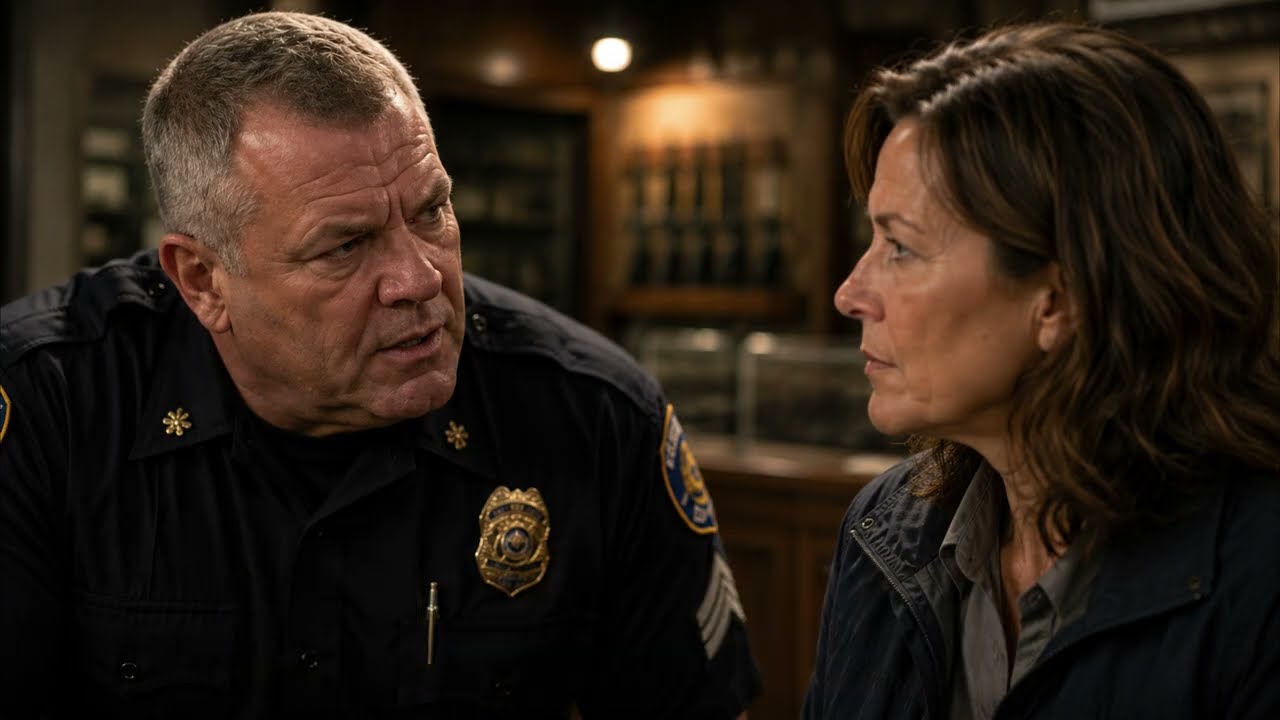
“And apparently, that life was never quite as invisible as I’d convinced myself it was. I’d rather know exactly who still remembers me and why than spend another nine years hoping nobody ever does.” Harry, the young clerk who’d watched the entire original encounter unfold from behind the Fenwick Arms counter, came by Odalis’s house unannounced two weeks later, awkwardly holding the scope she’d originally come in to collect, delivery of which had gotten entirely lost in the chaos of that Wednesday afternoon. “I
figured you probably still wanted this,” he said. “Also, I wanted to say” I froze, completely. “Three men attacked a customer in my store, and I couldn’t even dial a phone properly. I’ve been thinking about that a lot.” “You called for help,” Odalis said. “Eventually, and correctly. That’s what actually mattered.
Not everyone needs to be the person who intervenes physically. Someone needs to be the person who gets the right people there afterward.” “Doesn’t feel like enough,” Harry said. “It rarely does in the moment,” Odalis said. “It usually turns out to have been exactly enough once you look back at it properly.” Some people carry an entire previous life folded up behind an ordinary Wednesday afternoon.
And some ordinary Wednesdays turn out to be the exact moment that previous life decides it isn’t quite as thoroughly buried as as owner had hoped. Odalis Marchetti had spent nine years believing she’d successfully disappeared into an unremarkable, unnoticed existence. It took three men, 20 seconds, and one detective’s careful attention to remind her that some pasts and some skills never actually stop being findable, no matter how carefully the life built around hiding them has been constructed. If
this story kept you here until the very last word, share it with someone who needs a reminder that the quietest person in any room is sometimes the only one who actually knows exactly what to do when everything falls apart. >> [music]