They Mocked the Blind Sensei — Then He Dropped the Champion Without Ever Seeing Him – Ty
They Mocked the Blind Sensei — Then He Dropped the Champion Without Ever Seeing Him
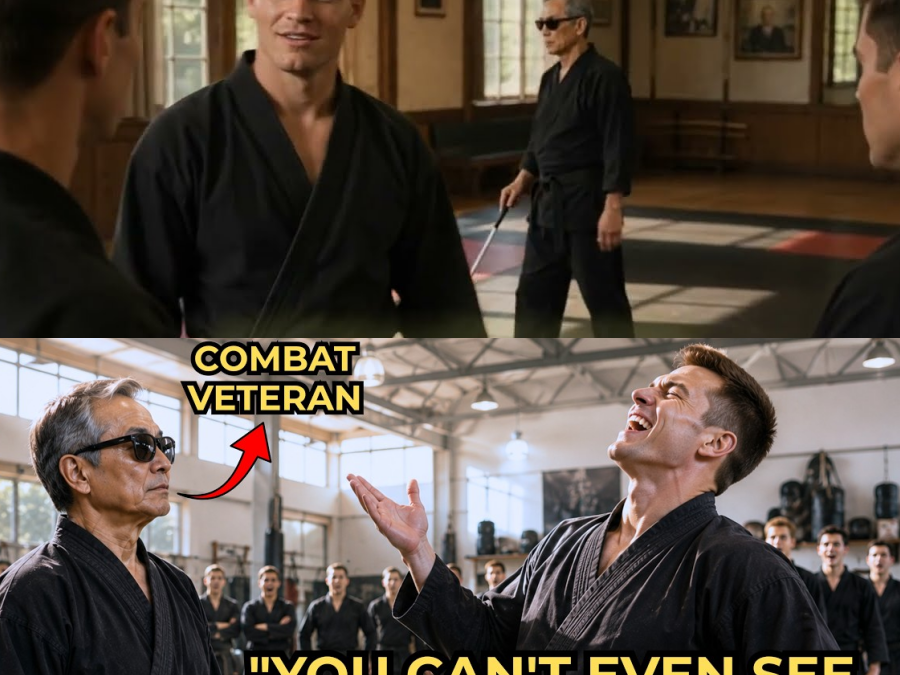
The new students always laughed the first time they saw him. An old man in dark tinted glasses feeling his way along the dojo wall with one hand, his cane tapping softly against the mat. How’s a blind man supposed to teach anyone to fight? One of them muttered. The old man didn’t turn toward the voice.
He simply asked for their best student to step onto the mat. For seconds later, that student was flat on his back, unable to explain how a man who couldn’t see him had read every movement before it happened. But the real shock came from a man standing near the entrance, a former army officer who recognized the technique. One used by a single unit that had officially stopped existing almost 20 years earlier, the same year its lead instructor was reported killed.
Ashefield Dojo occupied a converted warehouse on the edge of a midsize city. The kind of martial arts school that had built a modest but devoted following over 15 years under the quiet leadership of a sensei nobody in the current generation of students knew much about beyond his name. Training mats stretched across the main floor.
Heavy bags hung along one wall and a small shelf near the entrance held a handful of modest trophies from students who had gone on to compete regionally. None of them bearing Kenji’s own name anywhere on their inscriptions. Kenji Oay arrived at the dojo the same way he arrived every Tuesday afternoon. Wearing a simple black training uniform, dark tinted glasses covering eyes that had seen nothing at all for over two decades.
One hand tracing lightly along the wall as he made his way toward the mat. A thin white [music] came tapping a steady rhythm against the polished wood floor. Three new students enrolled only two weeks earlier watched him cross the room with the specific undisguised curiosity of people who hadn’t yet learned to keep their assumptions to themselves.
How’s a blind man supposed to teach anyone to fight? One of them, a broad young man named Tras, muttered to his [music] friends, not quietly enough for the words to stay contained to their small group. Kenji didn’t turn toward the voice. He continued his unhurrieded path to the center [music] of the mat. Set his cane aside with practiced precision and settled into a relaxed, grounded stance that betrayed nothing about the comment he’d clearly heard.
“You’re best student,” Kenji said, his voice calm and carrying easily across the training floor. “Step forward.” The room’s regular students, several years into their own training under Kenji, exchanged the specific knowing glances of people who had each at some point made a version of Tras’s mistake and learned better since. Nobody warned him.
Tras stepped onto the mat, grinning at his friends, clearly viewing the exchange as an easy demonstration rather than a genuine test. If something about this old man’s calm certainty is already sitting with you the way it should, this is a good moment to send this video to a friend who needs to see what happens in the next 4 seconds.
Tras moved first, a straightforward grab meant to establish quick control over an opponent he assumed couldn’t track his approach at all. He never got the chance to complete it. Kenji’s hand found his wrist before the grab fully closed, redirecting the momentum with an economy of motion that used Tras’s own forward energy against him.
His hip rotating into the technique with the specific fluidity of someone who had performed this exact sequence more times than conscious counting could track. Tras was airborne for a fraction of a second before he landed flat on his back, the wind driven from his lungs in a single sharp exhale. Kenji hadn’t turned his head to track the approach at any point.
His hand had simply been waiting exactly where Tras’s wrist arrived. The specific precision of someone reading air displacement, footstep weight, and breath rhythm with a fluency most cited people never developed even a fraction of. He lay there staring up at the ceiling trying and failing to reconstruct what had actually happened to him.
The room had gone completely silent. Near the entrance, a man in his 40s named Corvin Ash, who had walked in only minutes earlier, hoping to enroll his teenage daughter in a self-defense class, had gone very still. He was watching Kenji with an intensity that had nothing to do with the throw itself, and everything to do with the specific mechanical signature of how it had been executed, the angle of the redirect, the timing of the hip rotation, the precise economy of a technique he had only ever seen taught by one program in his entire career.
That’s not possible, Corin said quietly, mostly to himself. Kenji’s head turned slightly toward the sound of his voice. The specific subtle reorientation of someone listening rather than looking. “Say that again,” Kenji said. “I said that’s not possible,” Corin repeated, stepping closer.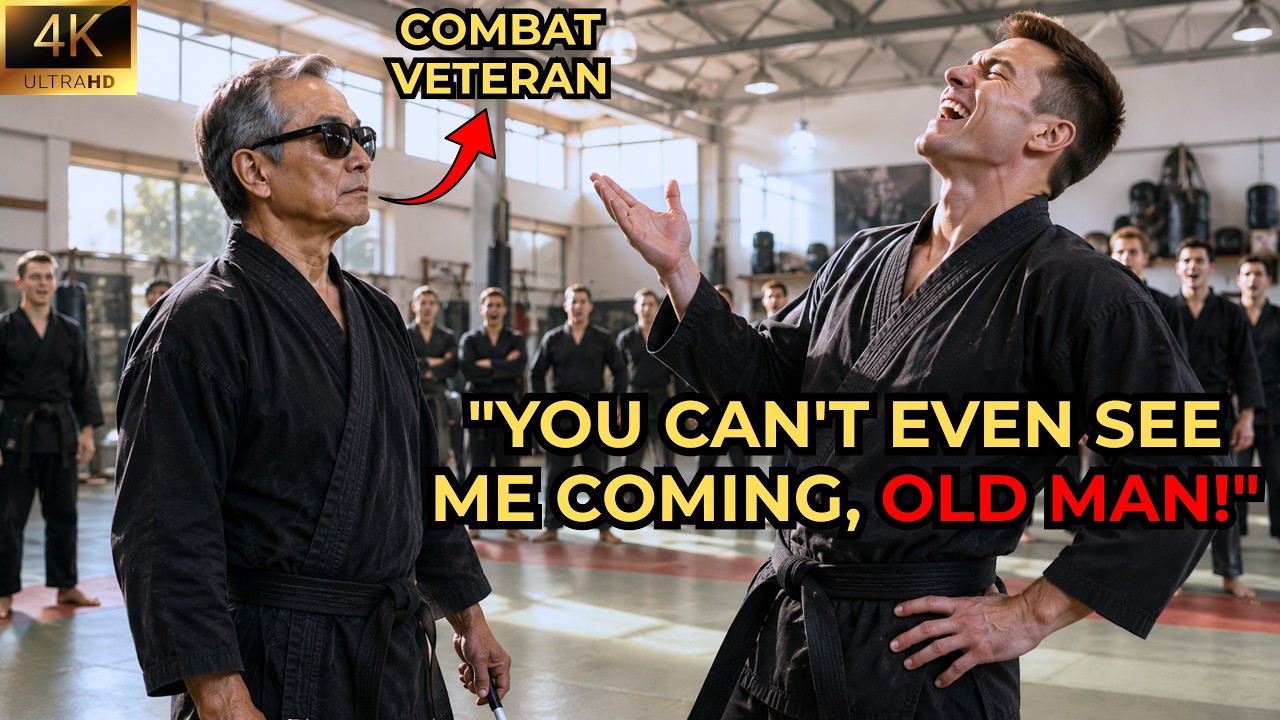
“That technique, the wrist redirect into a hip throw executed at that exact angle. I’ve only ever seen it taught one place. A program that doesn’t officially exist anymore. Kenji went very still. Subscribe to Legendary Veterans because what Corin says next is the reason nobody at this dojo has ever underestimated a stranger since.
Say your name, Kenji said, his voice carrying a careful weight it hadn’t carried a moment earlier. Corvanache. Former Army 12 years. I served two tours attached to a joint task force that occasionally trained alongside a specialized close quarters combat program. I only ever saw their techniques demonstrated once during a cross-raining exercise, but I never forgot the way their lead instructor moved. Everyone called him Ghost.
Command reported him killed during an extraction 18 years ago, an operation none of us were ever cleared to fully understand. Kenji was quiet for a long moment. The dojo around them holding its own breath along with him. Nobody has called me that name in 18 years, he said finally.
Corin’s composed, weathered face registered a level of shock that took him several seconds to fully process. You’re supposed to be dead, he said. I was there when command briefed us on the casualty report. The report was accurate about the operation going wrong, Kenji said. It was considerably less accurate about the specific outcome for me personally.
I lost my sight in that extraction. By the time I was stable enough to have the conversation, certain people found it considerably more convenient if the official record stood exactly as it had already been written. 18 years. Corin said, “You’ve just been here teaching, not just here.” Kenji said, “It took several years before I was ready to teach anyone anything.
The first years after the injury were mostly about relearning basic function and considerably more of relearning who I was without the version of myself that had defined most of my adult life. Teaching came later once I understood that everything I trained for still existed inside me. It just needed an entirely different set of senses to access it.
If you’ve ever wondered what it costs to let the world believe you’re gone, stay with us. Because what happens over the next several minutes is going to reopen a chapter Kenji believed had been permanently closed, the dojo’s regular students had drifted closer during this exchange. drawn by the specific weight of a conversation happening in a register none of them had ever heard their sensei use before.
Tras, finally sitting up on the mat, stared between Kenji and Corvin with an expression that had moved entirely past his own humiliation into genuine confusion about what he was witnessing. “You two know each other,” he said, mostly to fill the silence. “We served in overlapping circles a long time ago,” Corin said, not looking away from Kenji.
I never expected to find you again. I definitely never expected to find you teaching civilians in a converted warehouse. Teaching is what remained available to me. Kenji said after the injury, after the record closed the door on everything else, this was the version of usefulness I could still build. I’m not unhappy with what it became.
Corbin’s phone buzzed in his jacket pocket. He glanced at it and something in his expression shifted from stunned recognition into a different, more urgent kind of tension entirely. “I need to take this,” he said, stepping a few feet away. He returned less than 2 minutes later, his face considerably paler than the shock of recognizing Kenji had left it.
“That was my brother-in-law,” he said. He runs private security for a shipping executive two counties over. His client’s teenage son was supposed to be home from a private tutoring session an hour ago. Nobody’s heard from the tutor or the boy since. The family’s getting a ransom demand within the hour, and my brother-in-law’s entire team is stretched thin covering another assignment tonight.
What does this have to do with either of us? Tr still sitting on the mat. because whoever’s behind this used a specific approach to isolate the boy that matches operational patterns I haven’t seen outside of exactly the kind of program Kenji used to be part of. Corin said professional isolation timing communication blackout discipline the kind of methodical patience that doesn’t belong to an opportunistic kidnapping.
I need someone who can read this the way Kenji clearly still can faster than my brother-in-law’s team can manage alone tonight. Kenji considered this for exactly as long as it took Corvin to finish the sentence. Take me to the last confirmed location, he said. Subscribe. Actually, forget the formalities. Just stay with us because what Kenji does over the next several hours is the reason a frightened 17-year-old boy is going home tonight instead of becoming a headline nobody would have wanted to read. Corbin’s brother-in-law, a lean
tense man named Halloway, met them at the tutoring center 20 minutes later. his composure visibly strained under the weight of a situation escalating faster than his resources could contain. Reyes says you can help, Halloway said, looking at Kenji with the specific confusion of a man being introduced to someone he had every reason to believe he’d never actually need.
I don’t have time to process how a blind man is supposed to read a crime scene faster than my own train team. I don’t read scenes with my eyes, Kenji said. I never fully did, even before I lost them. Show me the last confirmed location and let me listen to what everyone else has already walked past without noticing. My team’s already processed the parking lot twice, Halloway said.
Standard search protocol, grid pattern. Nothing missed. Your team processed it the way a sighted search team always processes a scene, Kenji said. Visually, quickly, confident that anything worth noticing would be visible at a glance. I’m not criticizing the protocol. I’m telling you it has a specific blind spot.
And coincidentally, that blind spot happens to be exactly the kind of information I’ve spent 18 years learning to gather instead. Halloway hesitated only a moment before leading him toward the tutoring center’s parking area. The specific hesitation of a man weighing skepticism against the mounting evidence that skepticism hadn’t produced results fast enough on its own.
Holloway led him to the tutoring center’s parking area, where the boy’s abandoned backpack said exactly where it had been found. Undisturbed by the search team that had already processed the scene once, Kenji knelt beside the backpack, running his fingers lightly across the asphalt around it, tracing tire marks that hadn’t matched the family’s own vehicle, and listening.
with the specific trained attention of someone who had spent decades learning to extract information from a world most people processed almost entirely through sight. Two vehicles, Kenji said, not one. The tire spacing here is inconsistent with a single car making one stop. Someone was already waiting when the tutor’s car arrived, which means this wasn’t opportunistic.
It was planned around this exact schedule, which means whoever did this had access to information about the boy’s routine that isn’t publicly available. You’re saying someone close to the family, said, “I’m saying someone who could have obtained that schedule through professional reconnaissance rather than casual observation.
” Kenji said, “The kind of reconnaissance that takes considerable patience and considerable skill. This isn’t an amateur crime.” Kenji moved through the surrounding area methodically, listening for details the cited search team had walked past without registering. A faint chemical smell near a storm drained 200 yd from the pickup point that suggested a vehicle had idled there for an extended period.
The specific quality of gravel disturbance along a service road that matched a vehicle backing carefully into position rather than simply parking. Most searches fail because people trust their eyes to notice everything relevant. Kenji said, moving slowly along the road’s edge. One hand trailing lightly against a chainlink fence. Eyes are fast, but they’re lazy.
They notice what they expect to notice and skip past what doesn’t immediately register as significant. I don’t have that particular shortcut available to me. So, I never developed the habit of skipping. What are you actually listening for? Holloway asked, following a few steps behind. Right now, nothing specific, Kenji said.
I’m building a picture of what this stretch of road normally sounds and smells like, so anything that doesn’t belong stands out more clearly. A parking lot has its own baseline. A road that isn’t regularly used by search teams has a different one. You learn to notice the difference the same way you’d notice an unfamiliar word in a sentence you’d otherwise read without thinking.
They waited here, Kenji said, stopping at the service road for a while. long enough that whoever was driving got out at least once based on the shifting weight pattern in the gravel. This is where they took him. The service road led after a quarter mile to an abandoned equipment yard that Halloway’s team hadn’t yet fully searched, considering it too far from the pickup point to be an obvious hiding location.
If this story is hitting you the way it’s hitting us, hit that like button because what happens over the next 20 minutes is the reason this family got their son back instead of a ransom negotiation that could have ended considerably worse than it did. They found the boy and the tutor in a small maintenance shed at the edge of the equipment yard.
Both bound but unharmed. Guarded by a single man who startled badly at their approach, his hand moving toward a weapon he never fully raised before Kenji. moving with the same economical certainty he demonstrated on the dojo mat two hours earlier. Closed the distance and disarmed him with a technique that ended with the man face down on the ground before he’d fully processed what was happening.
How did you know exactly where he was? The managed disbelief cutting through his panic. You’re blind. You breathe loudly when you’re nervous, Kenji said, securing the man’s hands with a length of cord from his own bag. I heard you from the road. Halloway’s team arrived moments later to secure the scene, and the boy, shaking with relief, was reunited with a father who arrived at the equipment yard within minutes of the call going out.
The specific chaotic joy of a parent getting back a child he genuinely feared he might not see again. The tutor, an anxious young woman named Islaw, who had been bound alongside the boy for nearly 2 hours, approached Kenji once the immediate chaos had settled, her hands still trembling from the ordeal.
I don’t understand how you found us, she said. The search team walked right past that equipment yard twice. I heard them. They were looking with their eyes, Kenji said. Eyes are excellent at confirming what you already expect to find and considerably less reliable at noticing what doesn’t fit the picture you’ve already built in your head.
I don’t have that particular limitation available to me anymore. So, I had to develop a different one instead. Aren’t you afraid? Isa asked. doing something like this, walking into a situation like that without being able to see the threat coming. Kenji considered the question for a long moment. Fear is mostly a function of uncertainty, he said.
I’ve spent 18 years building considerable certainty about what my other senses can tell me in circumstances your search team would find genuinely terrifying to navigate blind. It isn’t fearlessness. It’s simply a different relationship with information than the one most people rely on. Kenji stood a short distance away, listening to the reunion unfold with the same quiet attention he’d carried through the entire evening, his cane resting lightly against his leg, entirely unbothered by the fact that he couldn’t see any of it directly.
Holloway approached him once the immediate chaos had settled. I don’t know how to thank you for this, he said. Any of it showing up tonight, finding him this fast. You don’t need to, Kenji said. Get him home. Let his father have this evening with him. That’s the part that actually matters. Subscribe to Legendary Veterans because the story of what happened after that equipment yard is the reason this entire city started asking questions about a blind sensei nobody had heard much about before that Tuesday. Corin drove Kenji back to the
dojo 2 hours later. Both of them quiet for most of the ride. the specific exhausted quiet of two people who had just lived through something considerably larger than either of them had expected an ordinary Tuesday evening to become. “You could have stayed retired,” Corin said as Kenji stepped out of the car.
“After the dojo, nobody would have known there was more to you than a blind instructor teaching civilians basic self-defense.” “I could have,” Kenji agreed. I spent 18 years building a life specifically designed to never matter to anyone in that particular way again. Tonight reminded me that mattering isn’t always something a person gets to fully choose to avoid, no matter how carefully the life around avoiding it has been constructed.
Are you going to disappear again now that this is over? Kenji considered the question, his head tilted slightly toward the sound of the dojo’s front door. I don’t know yet, he said. I think tonight changed the shape of that question, even if I don’t have the answer to it yet. He returned to the dojo the following Tuesday as always and found Tras already waiting near the mat.
His earlier confidence replaced by something considerably more careful. I owe you an apology, Tras said, for what I said about a blind man teaching anyone to fight. You made a judgment based on what you assumed my limitations meant. Kenji said, most people do. The mistake isn’t making it. It’s not staying curious enough to update it once the evidence changes right in front of you.
I’ve got better evidence now, Tras said. You do, Kenji agreed. Tras became over the following months one of Kenji’s most dedicated students, arriving early, staying late, absorbing every correction with the specific hunger of someone who had discovered on one memorable Tuesday afternoon exactly how much he still had to learn about a discipline he’d assumed he already understood.
“How do you actually do it?” Trask asked him one evening, months into his training, once he’d earned enough trust to ask the question directly. read someone’s movement without seeing them at all. The same way you read a sentence without sounding out every letter, Kenji said, “Once you’ve done it enough times, the individual pieces stop being separate information and start being one continuous signal.
Footstep weight, breath rhythm, the sound of fabric shifting, the displacement of air as someone closes distance. None of it is mysterious. It’s just attention applied for considerably longer than most people have the patience to sustain it. Could you teach me to read it that way? Even with my eyes working some of it, Kenji said, “The eyes get in the way more than people realize.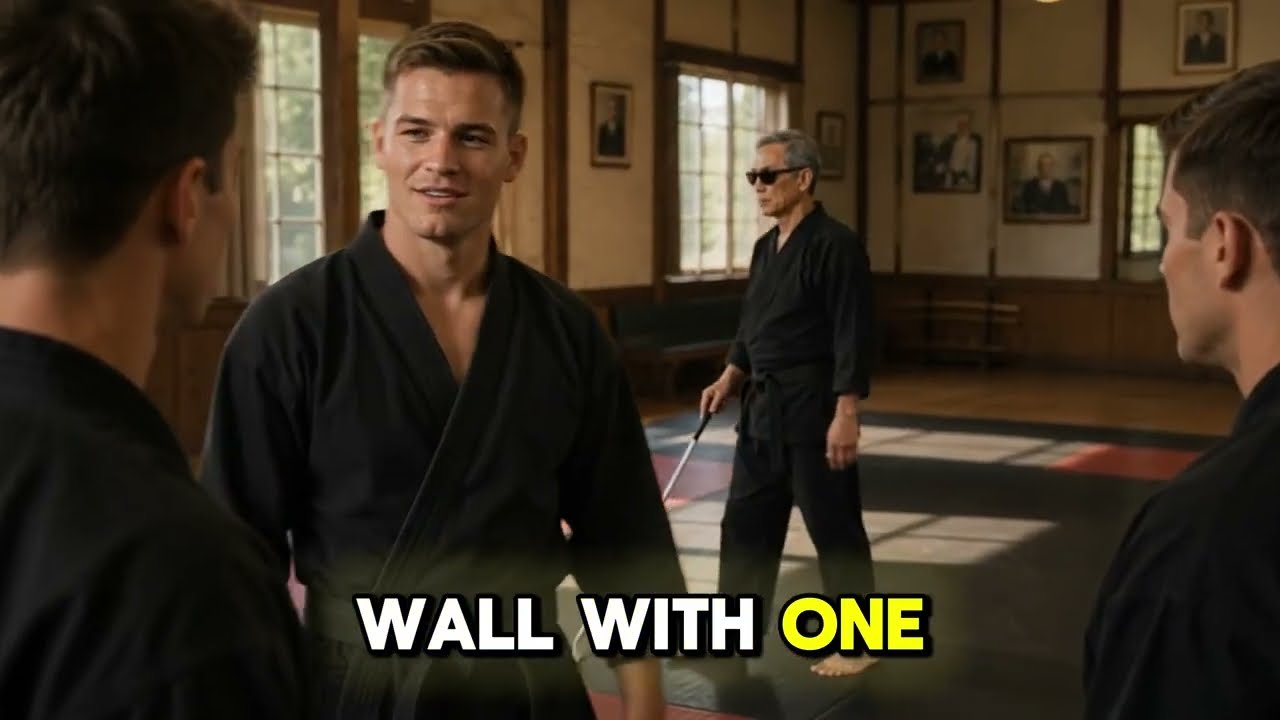
They give you information fast, but they also let you get lazy about everything else. Learning to listen the way I do means learning to distrust your eyes just enough to actually use your other senses properly. It’s a slower path than most students want to walk, but it makes you considerably harder to surprise. Would you ever consider training people the way you used to? Trasked.
Beyond this dojo, I mean, what you did that night with the boy, that’s not something you can teach in a normal class. Kenji was quiet for a long moment. Considering the question with the same careful weight, he gave most things now. Corin asked me something similar, he said. There’s apparently interest in what I could offer certain specialized teams.
people who need exactly the kind of non-visual awareness I’ve spent 18 years developing out of necessity rather than choice. I haven’t decided yet whether I’m ready to be that visible again. What’s stopping you? 18 years of very deliberately not being visible. Kenji said it’s not a habit that unwinds quickly, even when the reason for it no longer applies as clearly as it once did.
Some people carry an entire previous life folded up behind an ordinary Tuesday afternoon. and some ordinary afternoons turn out to be the exact moment that previous life decides it isn’t finished asking things of them yet. Kenji Oay had spent [music] 18 years letting the world believe a casualty report had gotten his story right.
It took one dismissive student, one old colleague’s recognition, [music] and one frightened teenager in an abandoned equipment yard to remind him that some skills and some people never actually stop matching, no matter how thoroughly they’ve been asked to disappear. If this story kept you here until the very last word, share it with someone who needs a reminder that the quietest person in any room is sometimes the only one who actually knows exactly what to do [music] when everything falls apart.