They Said The Pond Was Poisoned — Until Homeless Black Boy Scooped Something Shining From The Bottom – Ty
They Said The Pond Was Poisoned — Until Homeless Black Boy Scooped Something Shining From The Bottom –
That water’s poison, boy. 30 years and nothing living ever crawled out of it. You stay away from that pond. >> That was the first thing anyone in Ashburn said to Samuel. 20 years old, no home, no money, a duffel bag, and boots worn soft as cloth. And that poisoned pond was the one place in town nobody chased him away from.
But here’s what they didn’t know. On his second night, so hungry his hands shook, Samuel waded into that black mud reaching for a fish, anything at all. Then his fingers closed around something cold, hard, edged. He lifted it dripping into the moonlight and it caught the light like fire. Gold. The town was called Ashburn and it sat in a low fold of land in the western part of the state where the pines grew close and the roads ran out of names a few miles past the last [music] gas station.
Samuel came into it on foot in the last week of October, [music] the way he came into most places, walking the shoulder of the highway with a canvas duffel over one shoulder and the soles of his [music] boots gone soft as cloth. He had been moving for the better part of a year, >> [music] >> ever since the small apartment in Macon emptied out and there was no one left in it but him and no reason to pay rent on a room that held nothing but the smell of his mother’s hand lotion and a stack of unopened mail addressed to a woman
who was no longer alive to read it. He did not tell people that part. He learned quickly that a man with no people behind him is a man other people watch. His mother, Ruth, had been a private woman, private in a way he had never fully understood while she was alive. A woman who never once spoke about where she had come from or what her family had been before her, as though her own history were a door she had quietly closed and leaned against for the rest of her life.
He used to ask when he was younger. She used to change the subject. By the time he was old enough to ask in earnest, she was gone and the door stayed closed and he had carried his whole past in a single duffel bag ever since without ever quite knowing what was missing from it.
In the towns he passed through, his story shrank down to whatever they decided it was when they looked at him and what they decided was rarely kind. He had a way of standing very still when someone studied him too long, a stillness he had taught himself because the alternative was to feel the heat climb up the back of his neck and that helped nothing.
Ashburn studied him from the first hour. He stopped at the diner on the main strip to ask whether anyone needed a back for hauling or a pair of hands for the fall clean up and the woman behind the counter looked at his duffel and then at his boots and then somewhere past his left shoulder and told him there was no work in the flat voice of someone who had decided the answer before the question finished.
A man in a feed cap two stools down turned around slow to get a better look. Samuel thanked her and left before the looking could turn into anything else. He had eaten that morning, a gas station roll and a handful of water from a spigot behind a church and his stomach had been quiet about it for a few hours. But quiet was not the same as full and he could feel the afternoon stretching out ahead of him with nothing in it.
He found the pond the way a hungry person finds the edges of a place by walking until the houses thinned and the kept lawns gave way to a stretch of old fence and a field gone to broom sedge and brush. There was a tract of land out past the eastern edge of town that nobody seemed to use, an overgrown parcel with a collapsed shed listing at one corner and a stand of willows marking where the ground went soft.
Behind the willows sat the pond, maybe half an acre of dark water ringed with cattails, the surface so still and so brown it looked less like water than like something poured and left to set. He had not been at the fence 2 minutes before a voice came across it. “You don’t want to be back there.” the voice said.
Samuel turned. An older man stood on the near side of a gravel drive that ran up to a house a hundred yards off, a man in a quilted vest the color of dried tobacco, heavy set, holding a coffee mug he had clearly carried outside for the express purpose of being seen carrying it. He had the look of a man who watched the road for a living.
“That water’s poisoned.” the man went on, coming a few steps closer but not too close. “Has been since before you were born. Runoff got into it back in the ’90s, and nothing’s lived in it since. People around here know to leave it be.” He said it with a strange rehearsed patience, the way a person recites a thing they have said many times to many strangers, and never once had to defend.
“Estate’s tied up anyhow. Old man that held it passed last winter, and there’s no settling it yet, so the whole parcel just sits.” Samuel nodded the way he had learned to nod, slow and agreeable, a nod that ended conversations. “Appreciate it.” he said. The man stood there a moment longer to make sure the message had landed, then turned and went back up his drive, and Samuel watched him go and noted, the way he noted everything now, that the man had not once told him to get off the land.
He had only told him to stay out of the water. There is a difference between those two things, and a man with nowhere to sleep learns to hear it. He waited until the light went and the man’s porch lamp came on, and then he made a place for himself in the lee of the collapsed shed where the wind couldn’t find him, and he lay there with his coat over him and listened.
The thing about a poisoned pond, he thought, is that it should be silent. Dead water doesn’t sing. But all through that first night there was sound coming off it. The low creak of frogs and the slap of something breaking the surface and going under again. And once, near dawn, the clear two-note call of a bird that does not waste its breath on places where nothing lives.
He noticed. He was the kind of man who noticed. His mother had worked nights cleaning offices, and he had spent a great deal of his childhood being quiet and watching the world rearrange itself in her absence. And quiet watching had become the one skill he could carry from town to town without anyone able to take it from him.
By the second night, the hunger had stopped being a feeling and become a fact. A pressure behind his ribs that made his hands unsteady and his thinking narrow down to a single point. He had not eaten in a day and a half. He stood at the edge of the pond in the dark with the cold coming up off the water, and he thought about the frogs, about the thing that kept slapping the surface, about how a poisoned pond does not feed birds at dawn.
And he thought, with the clarity that real hunger brings, that the men of Ashburn had told him to stay out of that water with a little too much care for it to be only about his health. He rolled his pants to the knee, then gave up on keeping anything dry, and waded in to his waist. The bottom was soft, mud that gripped his boots and made him pull each step free.
And the smell that came up where he disturbed it was old and mineral and strange, but it was not the smell of poison. It was the smell of a thing that had been sealed a long time and was only now being opened. He bent and worked his hands down through the silt, feeling for the firm wiggle of a fish, the cold knot of a frog, anything.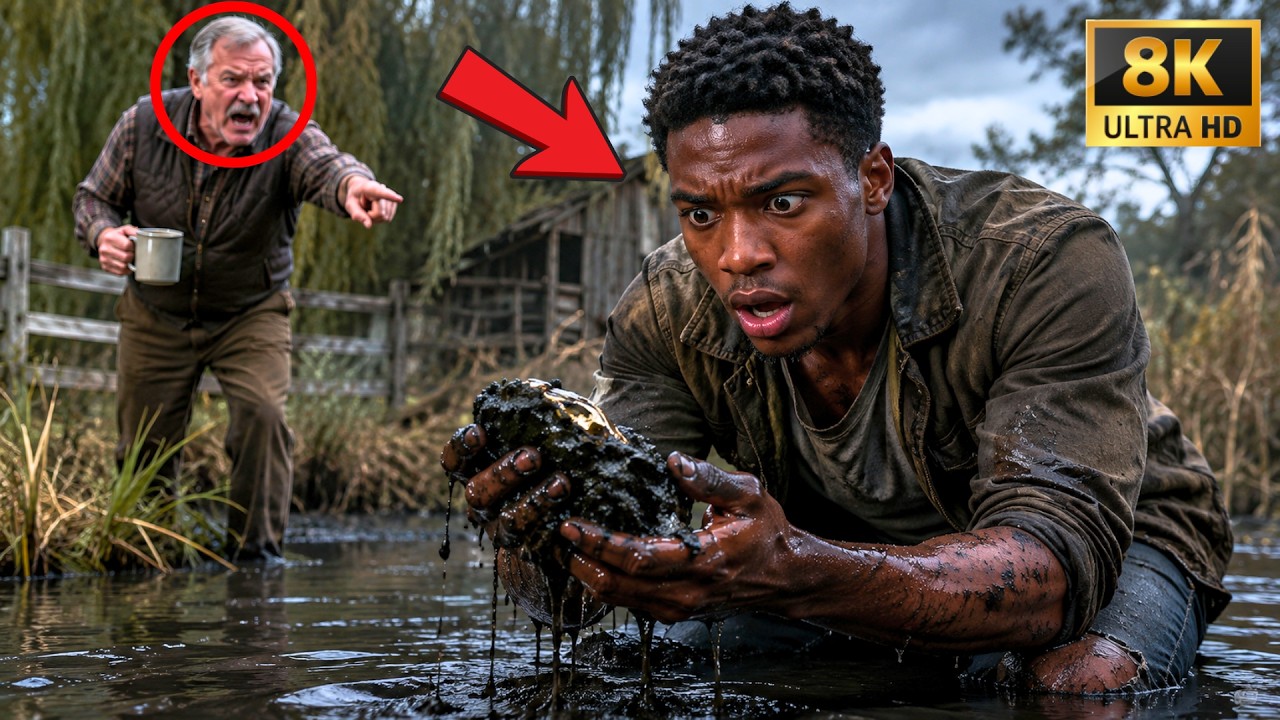
His fingers raked through leaf rot and clay, and then, a foot or so down, where the mud went dense and packed, his hand closed around something that was not soft and was not alive. It was hard. It had an edge to it, a worked edge, too regular to be stone. He pulled it up out of the mud and the water sheeted off it, and he held it into the thin moonlight that came through the willows, and his breath went out of him all at once.
It was a coin, heavier than any coin he had ever held, the size of a large button, and even caked with the pond’s filth, it threw back the moon with a deep, warm shine that no nickel or quarter had ever made. Gold. He knew it the way you know a thing your body has never touched, but your mind has always understood.
He stood there in the dark water with it pressed into his palm, and his heart was going so hard he could feel it in his teeth. He went back down. He couldn’t help it. He raked the same patch of bottom with both hands now, the hunger forgotten, and within a few minutes his fingers found a second thing, flat and rectangular and surprisingly large, the size of a small book and no thicker than two cards laid together.
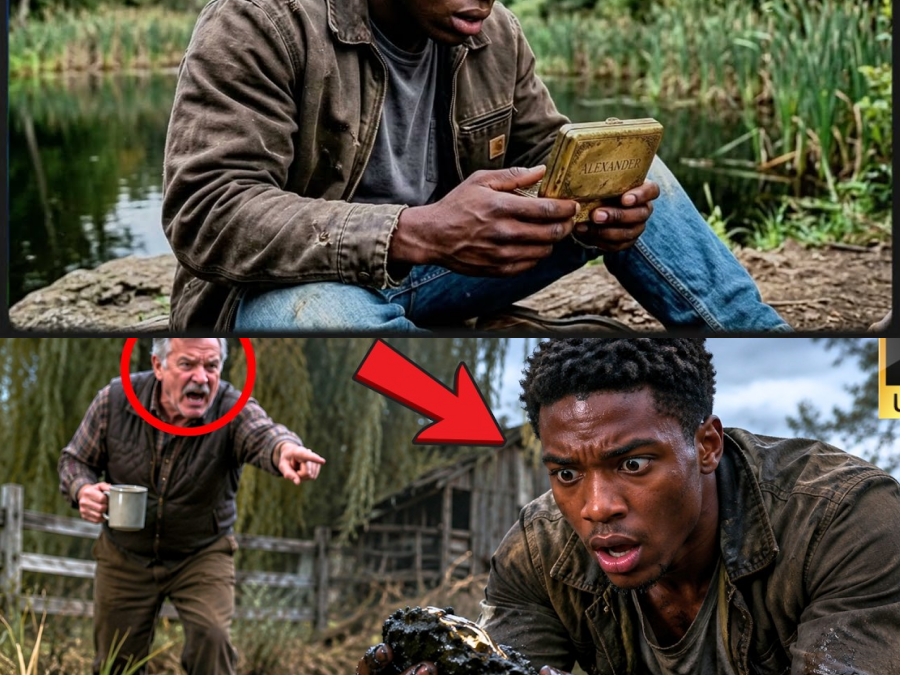
He brought it up, a case, gold gone dark at the seams, but unmistakable where he [music] rubbed it clean, hinged along one long edge like a book. The joint where the two halves met sealed so tight he could feel the swollen line of it under his thumb and worked into the face of it deep enough that the mud had not erased it in all the years it lay down there were letters.
A name. He waded out and sat on the bank with his back against the willow trunk, shaking now not from cold but from something larger, and turned the case over and over in his hands. The pond they all swore was dead had just handed him gold out of its bottom. And the more he sat with that, the colder and clearer it got in his mind.
Men do not stand at fences for 30 years guarding nothing. You do not invent a story careful enough to repeat word for word to every stranger who wanders past unless the story is doing a job. The poison was the fence. The water was the lie. And whatever was under it, somebody had gone to a great deal of trouble to make sure no one ever reached down and touched it.
He did not sleep at all that night. As the sky went gray, he held the case up into the strengthening light and turned it until the engraving caught. And he made out the letters one at a time, the way you sound out a word in a language you didn’t know you almost spoke. A surname cut deep and old into the gold, Calloway.
The name went through him in a way he could not account for, a small hard tug behind the breastbone like a hook setting. He could not have said why. It was a common enough name, a name that could have belonged to anyone, and he had no reason on earth to think his own family had ever set foot in a town like Ashburn.
And yet sitting there on the bank of a pond a whole town had lied about, holding a dead family’s gold in his cold hands, Samuel felt the name land in him as though it had been waiting in the mud all those years for the one person who would feel it. He understood that he was standing at the edge of two different lives and he had to choose which one to step into.
He could be gone by noon with enough in his two hands if it was real to ride a bus a long way from Ashburn and eat for a month and sleep somewhere with a door. That was the sane choice, the survivor’s choice, the one every hard mile of the last year had trained into him. But there was the name cut deep into old gold and a man who has spent a year being no one to anyone does not easily set down the first thing that ever felt like it was reaching back for him.
He should have run. Instead, as the first car of the morning came slow down the road and slowed further as it drew level with the willows, he closed his fist tight around the coin and the case and pushed himself up off the ground and he saw the face behind the windshield turn toward him and stop and he understood that the easy door had already shut.
He had been seen. A stranger soaked to the chest standing at the poisoned water with something gold catching the light in his hand. He slid the coin and the case deep into his coat pocket, pressed his hand flat over them and stood very still and waited for the car to stop. The car that stopped was a clean white pickup with a magnetic sign on the door and the man who climbed out of it wore a collared shirt with a small county seal stitched over the pocket.
He was somewhere past 50, silver at the temples with the smooth unhurried tan of a man who supervised work rather than did it. He looked at Samuel, then at the willows, then at the wet line up the front of Samuel’s coat and arrived at some private total that did not seem to please him. “You’re a long way from anywhere, son.
” The man said, leaving the truck door open behind him. “This here’s private land and that water will make you sick. I’d think they’d have told you that in town.” His eyes traveled down to the coat pocket where one hand was pressed flat against the fabric and stayed there a beat too long. “You find something in there worth getting sick over?” Samuel said nothing.
The stillness he had taught himself settled over him and he held the man’s gaze without offering it anything to work with. The man waited and when waiting got him nowhere, he changed his face the way a salesman changes a sample, smoothing it into something friendlier and somehow worse. “Tell you what,” the man went on, “whatever you pulled out of that mud, it’s not yours.
It belongs to the estate. You hand it over to me, I log it, and we forget a trespasser ever waded into a contaminated pond he was warned to stay out of. That’s the clean version. You want to know the other version?” “I can guess it,” Samuel said. The man smiled like that was the right answer and held out his hand, palm up, and the seal on his shirt caught the morning light and everything in his manner said this was a transaction that had already concluded in his mind and Samuel was simply slow to read the receipt.
Samuel looked at the open hand and thought about how it would go if he said no. A man with a county seal and a town behind him against a stranger with no name anyone here would speak for. Whatever he did in the next minute would not be judged on what was fair. It would be judged on which of the two of them Ashburn had already decided to believe and that question had been answered the day he walked in.
“It’s at the bottom of the pond,” Samuel said. “Whatever you think I found, I dropped it going back under. You want it? It’s in 4 ft of mud somewhere past the cattails. It was a lie and not a good one, but it did what he needed it to do, which was end the conversation before it became something he could not walk away from.
The man’s smile thinned. He weighed whether it was worth wading in himself and clearly decided it was not. Not in those clothes. You ought to move on, son. He said finally. The friendliness gone out of his voice like heat out of a stone. Today, that pond’s got a way of being more trouble than it’s worth to people who get curious about it.
He climbed back into the truck and before he pulled the door shut, he said one more thing, almost gently, which was the part that stayed with Samuel all the rest of that day. Nobody’s going to take your word for anything out here. Remember that. It’ll save you a lot of grief. Then he was gone.
Gravel ticking under the tires and Samuel stood alone at the fence with the gold against his ribs and the man’s words settling into him like the cold. The man had handed him the exit, had all but begged him to take it. But the name was in his pocket now and a man who has spent a year being no one does not easily set down the first thing that ever felt like it was reaching back for him.
He spent the morning learning, the hard way, exactly how right the county man had been. He walked back into Ashburn with the coin and tried to do the simplest, most honest thing he could think of, which was to find out what it was worth. There was a pawn shop wedged between a shuttered hardware store and a laundromat and he went in and set the coin on the glass counter, and asked the apron man behind it, reading glasses pushed up on his forehead, what he could tell him about it.
The man picked it up and his whole manner changed in the space of a breath. He turned it under the counter lamp, weighed it in his palm, and then looked up at Samuel over the top of the glasses. And what was in his face was not interest in a sale. It was suspicion, arriving fully grown. “Where’d you come by this?” the man said.
It was not a question. His other hand had drifted toward the phone on the wall behind him. “It’s mine.” Samuel said. “That’s not what I asked.” The man set the coin down, but kept two fingers on it, pinning it to the glass. “This is real old gold. A young man walks in off the street, no kind of identification, I’d bet, asking what something like this is worth.
” He shook his head. “Son, I’ve been doing this 30 years. I know what it looks like when something’s come from where it shouldn’t have.” “You don’t know anything about where it came from.” Samuel [music] said. And he heard his own voice go tight, and hated that it did, >> [music] >> because tightness was exactly what the man was waiting to see.
“I know enough to call somebody.” the man said. And his hand closed the last few inches toward the phone. Samuel took the coin back, slow and open-handed, no grab, just slid it off the glass into his fist, and the man let him, because taking it back was not the same as taking something that was the man’s.
And they both knew the difference, even if neither said it. Samuel walked out with the bell jangling behind him, and his face hot, and the certainty settling in his gut that the [music] county man had told him the truth about the one thing that mattered. Nobody here was going to take his word for anything. Not where he’d gotten the coin, not who he was, not whether he had any right to the only thing of value he’d ever held.
The honest road was closed to him. Not for anything he’d done, but for the shape of the man they saw when he walked in the door. He was standing on the curb outside the laundromat trying to think past the heat in his face when a voice spoke to him for the second time in 2 days from a place he hadn’t been watching.
“You’ve got something that doesn’t belong to this town.” The voice said, “and this town [music] knows it.” She was old, sitting on a bench in the narrow shade of the laundromat awning with a string bag of groceries at her feet. A black woman with close-cropped white hair and a cardigan buttoned to the throat against a cold she felt more than the day warranted.
Her eyes were the kind that had stopped being surprised by anything a long time ago. She was looking at his closed fist. “Ma’am.” Samuel said. “I watched you come out of that shop. I watched your face.” She said. “And I saw which way you came into town 2 days ago walking the eastern road.” “Which means you’ve been sleeping out by the Callaway parcel because there’s nowhere else out that way a man can lay his head.
” She gathered her string bag and stood, a small woman. But there was nothing small in the way she held the ground in front of him. “Open your hand, son.” “I’m not going to take it.” “I’m too old to want gold.” “I just need to see if it’s the one I think it is.” He did not know why he opened his hand. He had not opened it for the county man or the pawnbroker.
But there was something in her that did not feel like a hand reaching for what he had, and so he turned his fist over and let her see the coin lying in his palm. She looked at it a long moment. And when she lifted her eyes back to his face, something in her had gone soft and grieved. And certain all at once.
“Where’d you get this?” She asked. And it was the same question the pawnbroker had asked. But it came out of an entirely different place. The pond, Samuel said. The one everybody says is poisoned. He watched her closely. There’s more than the coin. There’s a case. Gold has a name cut into it. Calloway, she said before he could.
The hair stood up on his arms. How do you know that? She lowered herself back onto the bench the way a person sits when their knees have outlasted everything else and patted the seat beside her. And Samuel, who had not let himself sit easy beside anyone in a year, sat. Because that pond isn’t poisoned. And it never was, she said.
I’m old enough to remember when the water in it was clear enough to see your own face. I was a girl when they started telling people it would kill them. Same year the Calloways stopped being a family anybody in Ashburn would say out loud. 1958. She looked out at the street, at the shuttered hardware store, at the whole worn face of the town.
You want the truth, son? You’ve been sleeping on top of it. What she told him then rearranged everything he thought he had walked into. There had been a family named Calloway, she said, going back generations, all the way to a man who’d bought that eastern land outright in 1891, when nobody expected a black family to hold ground of that kind in this county.
They worked it and made it pay through her grandmother’s time and her mother’s and into her own. By the middle of the century, they were prosperous in a way that did not sit well with certain people in town, people who had decided that prosperity of that kind belonged to them by some arrangement they had never written down, but believed in absolutely.
And then in the space of a single hard season, the old woman said the Callaways were gone, driven off. The word she used was driven, plainly, without drama, the way a person states a fact they have carried so long it no longer needs decoration. Run out of the county under a cloud of accusations that everyone repeated and no one could ever find the bottom of.
The land changed hands through paperwork that appeared from nowhere and was never questioned. The fine house came down and the family scattered to wherever scattered families go and Ashburn closed over the place they’d been like water over a dropped stone. “But here’s the part you’ll want,” she said, turning to look at him.
“Before they ran, the Callaways knew it was coming. You can feel a thing like that coming the way you feel a storm. And whatever they couldn’t carry, whatever was small and heavy and worth keeping out of the hands reaching for it, they put where those hands wouldn’t think to look.” She nodded slowly. “They put it in the water.
And after they were gone, somebody started the story that the pond was bad. Poison. Whatever version they were telling that decade, runoff chemicals, all of it made up. Because a poisoned pond is a pond nobody drains. Nobody dredges. Nobody goes wading into looking for what a family left at the bottom on their way out the door.
” Samuel sat with the coin warming in his closed hand and felt the whole shape of it settle over him, so much larger and uglier than anything he had imagined when he reached down into that mud for a fish. The poison was not a warning. It was a lid. It had been a lid for nearly 70 years, kept screwed down tight over a family’s whole stolen life, and he had walked in off the highway with empty pockets and lifted the corner of it without even knowing what he was doing.
“Why would anybody still care?” he asked. “If it was that long ago, the people who did it are dead.” The old woman gave him a look that was almost pity. “The people who did it are dead,” she agreed. “But the people who have the land aren’t. The people whose fathers’ names are on that paperwork that appeared out of nowhere, they’re still right here.
They run things. That man with the county seal who came out to the pond this morning. You think he came out there for the water quality?” She shook her head. “There’s families in this town that have spent three generations making sure nobody ever has a reason to look hard at how they came by what they came by.
I’ve been one old woman saying it out loud for 40 years and 40 years of nobody listening. And you just walked out to that pond and pulled their reason up out of the mud with your bare hands.” The cold that went through Samuel then had nothing to do with the wet coat. He understood, all at once, the size of what he was standing in.
He was a stranger with no name anyone would speak for, no document to wave, no friend to call. He had a coin and a gold case that any one of them could swear he had stolen and a story that sounded, told plainly, exactly like the kind of story a desperate drifter would invent. Against the weight of a town that had kept its secret quiet for nearly 70 years, his word was worth precisely nothing. And he knew it.
“What do I do?” he said. It was not really a question. It was closer to the sound a man makes when he looks up and finally sees how high the walls are. The old woman got to her feet and looked down at him with those eyes that had stopped being surprised a long time ago. “You hold on to that case. Whatever else happens, you don’t let it out of your hands,” she said.
“There’s a name in it, and a name is the one thing they were never able to drain out of that water. My name’s Della Whitmore. I live in the greenhouse at the end of Pine Grove. You come find me when you’re ready to know the rest.” She started off, then turned back. “There’s a woman two towns over keeps the old land records, Lorraine.
She’s the only soul in this county besides me who ever believed there was something wrong with how that parcel changed hands. You may need her before this is over.” She went off down the sidewalk with her groceries, a small old woman in a buttoned cardigan, and Samuel sat alone with the coin in one fist and the case in his pocket, and the name Callaway going around and around in him like something trying to be remembered.
He did not get the chance to go to Pine Grove that day because the white pickup with the county seal was rolling slow up the far end of the street, and this time it was not alone. There was a town car behind it, and the man driving the first one was looking down the length of the street directly at the bench where Samuel sat, and Samuel understood, with the clarity that had served him all his life, that the easy door was not just shut now.
It was about to be locked behind him. The county man got out slow and easy, the way a man moves when he has decided he holds every card. The man who climbed out of the town car wore a sheriff’s jacket and a face that had clearly been told a story on the drive over and had already decided to believe it. They came down the sidewalk together, and the few people on the street found reasons to be elsewhere, doorways and parked cars, the way a town gets quiet around a thing it has agreed not to see.
“That’s him,” the county man said. “Pulled something gold out of the estate pond this morning, bold as you please, and the man at the pawn shop will tell you he came in trying to move it not an hour ago. He turned to the sheriff with the practiced regret of a man performing reluctance. There’s been items going missing off that property for years, and here he is, a stranger soaking wet, pockets full.
I think you better look in his coat. The sheriff looked at Samuel, and Samuel saw the whole arithmetic of it move behind the man’s eyes and come out exactly where the county man had set it up to. A drifter. No people. Wet to the chest. Gold he couldn’t account for. It was the easiest story in the world to sign your name to, and the hardest in the world to argue your way out of.
“Empty your pockets, son.” The sheriff said. There was no version of this where saying no helped him. Samuel brought out the coin and the case and held them in his open palm, and the morning light caught them, and the county man let out a small satisfied [music] breath. “There.” The county man said. “Estate property.
He’ll have a dozen stories about where it came from. They always do.” The sheriff took the coin, turned it over, and his face confirmed what the weight of it told him. Then he reached for the case, and Samuel’s hand closed. “That one’s not the estate’s.” “And it’s not Ashburn’s.” Samuel said. “There’s a name cut in it.” “If you’re going to take it, read it first.
Out loud. That’s all I’m asking.” It was the only move he had. And he did not even know if it was a move. He held it up by its hinge and turned the face of it toward the two men, and the sheriff, almost against his own intention, read it. “Callaway.” The word landed on the street like a dropped plate. The county man’s face changed, the smoothness going out of it all at once, and that change told Samuel more than any document could have [music] because a man does not flinch at a name that means nothing to him. But the
county man had a town behind him, and Samuel had only a wet coat. >> [music] >> The sheriff took the coin and the case into a manila envelope, wrote something on the outside, and told Samuel that until this got sorted, he’d be coming down to the county building to answer some questions. No one raised a hand to him.
No one needed to. >> [music] >> He walked to the back of the town car of his own accord because every road out of that moment ran straight through [music] it, and he sat in the small bright room they put him in and watched the afternoon drain out of the one window, >> [music] >> and he felt the bottom go out of everything.
The case was in an envelope he could no longer touch. The name was about to be filed away into a drawer where names like his went to be forgotten. He had reached down into the dark and pulled the truth up into the light, and the light had simply handed it back to the people who’d buried it. It was past dark when the door opened.
It opened on Della Whitmore moving as fast as her knees would carry her, and she was not alone. Beside her was a younger woman with a satchel and a visitor’s badge from the county records office two towns over. And the weight of the two of them coming through that door together made the sheriff straighten where he stood.
“This is Lorraine Mercer,” Della said, ignoring the county man entirely, who had risen halfway out of his chair. “She keeps the deed books. I called her the minute I left that boy on the bench this morning, and I told her it had finally surfaced. The thing I’ve been telling this county about for 40 years. She spent all afternoon in the books.
” Della looked at the sheriff. “You’re going to want to open that envelope, and you’re going to want to do it with people in the room to watch you.” Lorraine set her satchel on the table and drew out a thin file. And the sheriff, after a long moment in which the whole room seemed to tip on a point, slid the gold case out of the envelope and worked the hinge.
The catch had rusted nearly solid. For a terrible second, it seemed it would not give. Then it did, with a small, gritty click, and the case fell open in his hands like a book whose spine had only been waiting for someone to ask. Inside, behind a clouded oval of glass, was a photograph, small and water-stained and very old, but the seal had held against all those years of mud, and the faces were clear enough.
A man and a woman standing in front of a house, the woman holding the man’s arm, both of them in their Sunday best, both looking straight into the camera with the steadiness of people being photographed at the high point of their lives. And folded flat behind the photograph, pressed thin, was a square of paper gone amber with age.
Lorraine took it with the careful hands of someone who handled old paper for a living, and worked it loose and opened it on her palm, and her eyebrows went up, and she read it again. “This is a deed, a handwritten counterpart of one,” she said. “Land conveyance, 80-some acres on the eastern boundary of the township, recorded and witnessed.
The grantee is Thomas Calloway. The date is 1891.” She turned the paper so the sheriff could see it. “I pulled the chain of title on that parcel this afternoon. There’s a gap in it, a transfer in 1958 with no consideration listed, no signature on the grantor’s line that anybody ever verified, filed by hand into the book the same season the Calloway name disappears from every record in this county.
” She tapped the amber paper. “This is the title that gap was papered over. This is the deed they couldn’t make vanish because it was at the bottom of a pond they’d told everybody would kill them. The county man had gone very still. “Even if all that’s true,” he said, and his voice had lost its smoothness entirely now. “It’s got nothing to do with him.
He’s a stranger, some drifter who got lucky in the mud. The Callaways are gone. There’s no Calloway left in this county to claim a thing.” And that was when Della Whitmore turned and looked at Samuel, and there was something in her face he would carry for the rest of his life, a grief and a wonder so old and so deep that he felt it reach into him before she even spoke.
“What was your mother’s name, son?” she said quietly. “Her name before she married, before you?” Samuel heard himself answer from very far away. “Ruth.” And then the rest of it came up out of the place where it had been sealed his whole life. The maiden name he knew the way you know a thing you’ve simply never had reason to say out loud, the name his private quiet mother had carried out of a town she never once told him she was from.
“Ruth Calloway.” The room went silent in a way no one could have performed. Della’s eyes had filled, and she did not wipe them. “Ruth Calloway,” she said. “I knew your grandmother, son. We were girls together before they ran her family off. Your people are the ones that pond was keeping faith with all these years.
Every soul in this town told you that water would kill you. And the truth is it was the only thing in Ashburn that ever belonged to you. It held your family’s name down in the dark for nearly 70 years, safe from every hand that reached for it. And it waited. It waited for the one Calloway who’d come home with nothing but his own two hands and reach down far enough to take it back.
Samuel stood there with the open case in his palm and the faces of a man and a woman he had never met looking up at him out of all those years. And he understood at last the thing that had tugged at him on the bank the first morning. The reason the name had set into him like a hook. He had not stumbled onto a stranger’s gold. He had come home.
He had walked a year of highways with empty pockets straight back to the one piece of ground in the whole country that had been stolen from his own blood, and he had reached down into the water everyone swore was death, and pulled his family’s name back up into the light. The deed went where deeds go when they finally surface.
Lorraine took it into evidence with the care of someone who knew exactly what she was holding, and in the weeks that followed, the gap in the chain of title that three generations of Ashburn had counted on no one ever looking at became the only thing anyone in the county courthouse could talk about. The transfer of 1958, the one with no consideration and no verified signature, did not survive being looked at.
Things that have only ever worked in the dark rarely do. The county man with the silver temples did not come back out to the pond. His own family’s name, it turned out, was on more of the old paperwork than was comfortable for him. And a man who has spent his career making sure nobody looks hard at how his people came by their land does not do well when everybody starts looking at once.
He was gone from his county post by spring, and Ashburn, which had agreed for nearly 70 years not to see a thing, found it could no longer agree on anything at all. Samuel did not have to prove he was anyone. The case had done that, and Della Whitmore’s memory had done the rest, and the photograph behind the clouded glass turned out to match a wedding portrait in a church record that had survived in a box in Della’s own front room on Pine Grove, the greenhouse at the end of the street, where Samuel finally went and
sat at a kitchen table and was given for the first time in a year a plate of food by someone who knew his name and meant it kindly. She told him about his grandmother across that table and her grandmother and the family the pond had been keeping until the names stopped being strangers and became slowly his. The pond itself once people stopped being afraid of it turned clear within a season.
There had never been any poison in it to clear. The spring in the northeast corner ran cold and clean the way it always had and the frogs that had sung through Samuel’s first cold nights went right on singing and the birds came down to it at dawn the way they never did to water where nothing lived. He took to walking out to it in the evenings the way you walk back to a thing that changed your life and he would stand on the bank where he had once lain shivering under his coat and feel something in him that he did not
have a word for yet but recognized finally as belonging. The land came back to him not quickly and not without lawyers and not without the long grinding work the truth always takes once it has been let up into the air. But it came. The 80-some acres on the eastern boundary, the parcel with the collapsed shed and the willows and the clear cold pond went on to a deed with the name Callaway on the grantees line for the first time in nearly 70 years and the man who signed for it was a 20-year-old who had walked into town with nothing
but a duffel bag and the soles of his boots gone soft as cloth. He stood at the edge of the water on the evening it became truly his, with the gold case in his pocket where it had ridden every day since the night they finally gave it back, and he thought about the lie they had all told him at the fence. Poisoned.
Nothing’s lived in it for 30 years. Stay out of the water. He thought about how a lie like that one is told not to protect the people who hear it, but to bury the people it’s told about. And how it had so nearly worked for so long on so many. Because the world had trained a whole town to look at a young black man soaked to the chest and see a thief instead of an heir.
The thing that had shown up out of the mud at him that first cold night had never really been the gold. He understood that now. It was the name. It was the proof. It was the dignity of a family that had been driven into the dark and had refused, even from the bottom of a pond everyone called death, to stay buried.
They had set their faith on a person they would never live to meet, some Calloway somewhere down the long years, who would come home with empty hands and reach far enough down to take it back. They had been planning for someone, and that someone had turned out to be him. The drifter with no people.
The one the diner wouldn’t feed and the pawn shop wouldn’t trust and the town wanted gone by noon. The last of them walking back in off the highway to the one ground that had always, in spite of everything, been his. And maybe that’s the thing worth carrying out of this. The world is quick [music] to hand you a story about who you are and quicker still to hand you a story about what you should be afraid of.
People will tell you a place is poisoned. People will tell you, in a hundred small ways, that you don’t belong, that you have no people, that the door is closed and was never yours to open. But the lid somebody else screws down over a thing is not the same as the truth of what’s underneath it. Sometimes the water they swear will kill you is the one place in the world that’s been keeping [music] faith with you all along.
And the only way to ever know is to stop believing the fence and go see for yourself. Even cold, even alone, even when every voice you’ve met has already decided what you’ll find. So, here’s what I’d love from you if this one reached you. Have you ever found something in an old house, a drawer, a field, the bottom of some place everyone told you to leave alone that changed what you understood about where you came from? I really do read those and they’re my favorite part of doing this.
Tell me down in the comments. And if Samuel’s story moved something in you, pass it along to one person who needs to hear it tonight. The one you thought of just now while you were listening. They’ll know why you sent it. Take care of yourselves out there and I’ll see you in the next one.