Major Laughed at a Teen’s Classified Mom Claim — Then a Night Shift Nurse Walked In With 178 Mil… – Ty
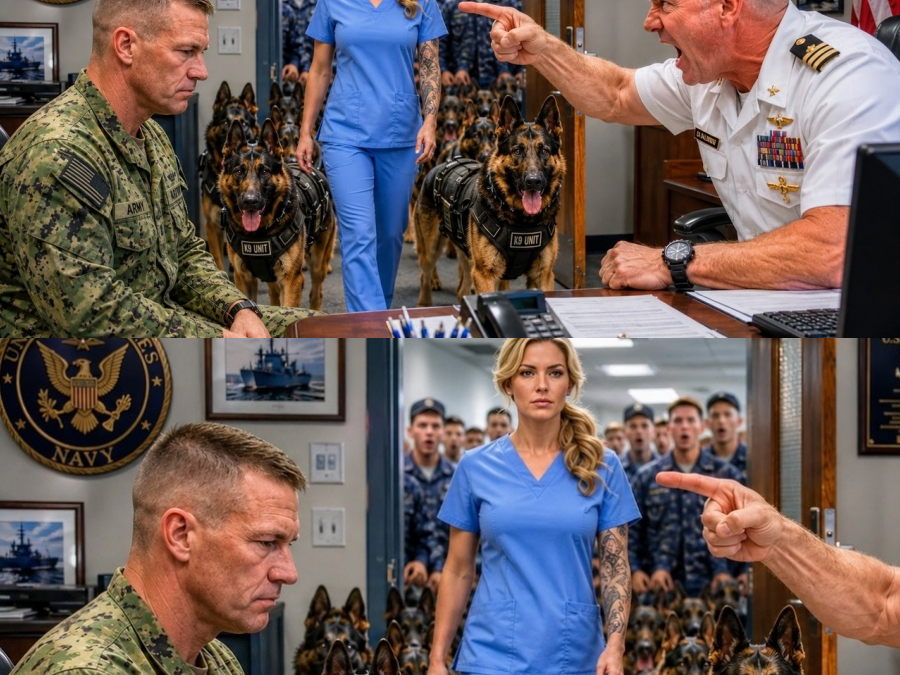
Major Laughed at a Teen’s Classified Mom Claim — Then a Night Shift Nurse Walked In With 178 Mil…
The floor shook before anyone could see what was coming down the corridor. It started as a low vibration, pens rolling to the edges of desks, a coffee mug walking itself toward the lip of a filing cabinet. Then the sound arrived, synchronized, rhythmic, the measured percussion of something moving in formation.
People in the outer offices of the Tidewater Army Education Center looked up from their screens the way people do when the body registers something before the mind has finished. categorizing it. Then the doors at the end of the main corridor swung open and they came through. Military working dogs two by two Belgian Malinoa and German shepherds in tactical harnesses filling the hallway from wall to wall.
They did not bark. They did not pull. Their eyes moved forward with the particular attention of animals that have been trained to a standard most humans never reach. Behind them, a woman in pale blue scrubs walked through the entrance of the Tidewater Army Education Center and stopped just inside the doors. She didn’t look around.
She had the posture of someone who already knew every room she was about to walk into. Major Brent Osland, who 25 minutes earlier had told a 17-year-old boy that his mother’s military record was, in his specific words, almost certainly fabricated, stood at the far end of the corridor and discovered he could not find a single thing to say.
If you’re watching this for the first time, stay with me until the very end. Drop a comment and tell me where you’re watching from. I want to see how far this story travels. The morning had started the way difficult mornings do without warning in an ordinary way. Caden Cavell woke at 6 because his internal clock had stopped trusting alarm settings sometime around age 14.
He was 17 now, tall in the awkward way of someone still catching up to a recent growth spurt, with his mother’s particular quality of watchfulness in his eyes, that specific stillness that didn’t look like absence, but like paying very close attention to something most people weren’t tracking. He got dressed, ate a bowl of cereal standing over the sink, and picked up the folder from the kitchen counter where his mother had left it the night before with a yellow sticky note on top that said in her neat, small handwriting, “Everything you need is in
here. You have this.” His mother, Jessica, had already been gone for 3 hours by then. She worked night shifts at Coastal Reach Regional Hospital, trauma nursing, and she’d left at 10:00 the previous evening in the same unhurried way she left for every shift. Keys, badge clipped to Scrub’s pocket, one look back at him from the doorway that wasn’t quite a smile, but carried the same information. Jessa was 32.
She had the kind of face that was calm in a way that felt earned rather than inherited, and hands that moved with a precision that seemed excessive for ordinary tasks. making a sandwich, folding laundry, rinsing a mug, as if some part of her was always operating at a higher standard of care than the moment actually required.
She had a scar along her left forearm that she called a climbing accident from her 20s. She took calls, sometimes in the backyard with the door pulled too, speaking in a low voice with someone she never named. She slept when she slept with the kind of alertness that wasn’t sleep at all. Caden had spent most of his life filing these observations somewhere he didn’t examine too closely. She was private.
Some people were. It was enough. What had brought him to the Tidewater Army Education Center that Tuesday morning was a dependent scholarship claim. Specifically, the verification of his mother’s military service, which triggered a tuition benefit he was applying for alongside an ORO program application.
It had been routine until 3 weeks ago when the system had flagged an error. His mother’s file had gone dormant under a clearance level the standard benefits database couldn’t access. A human being at a federal desk needed to look at the physical documentation and confirm what the paperwork already stated. His mother had told him she’d meet him there.
She had something to finish at the hospital first. Handoff at the end of her shift ran long sometimes. He had driven himself. The Tidewater Army Education Center sat at the edge of Grover’s Landing, Virginia, close enough to the shipyard district, that the air carried the particular smell of brine and industrial heat.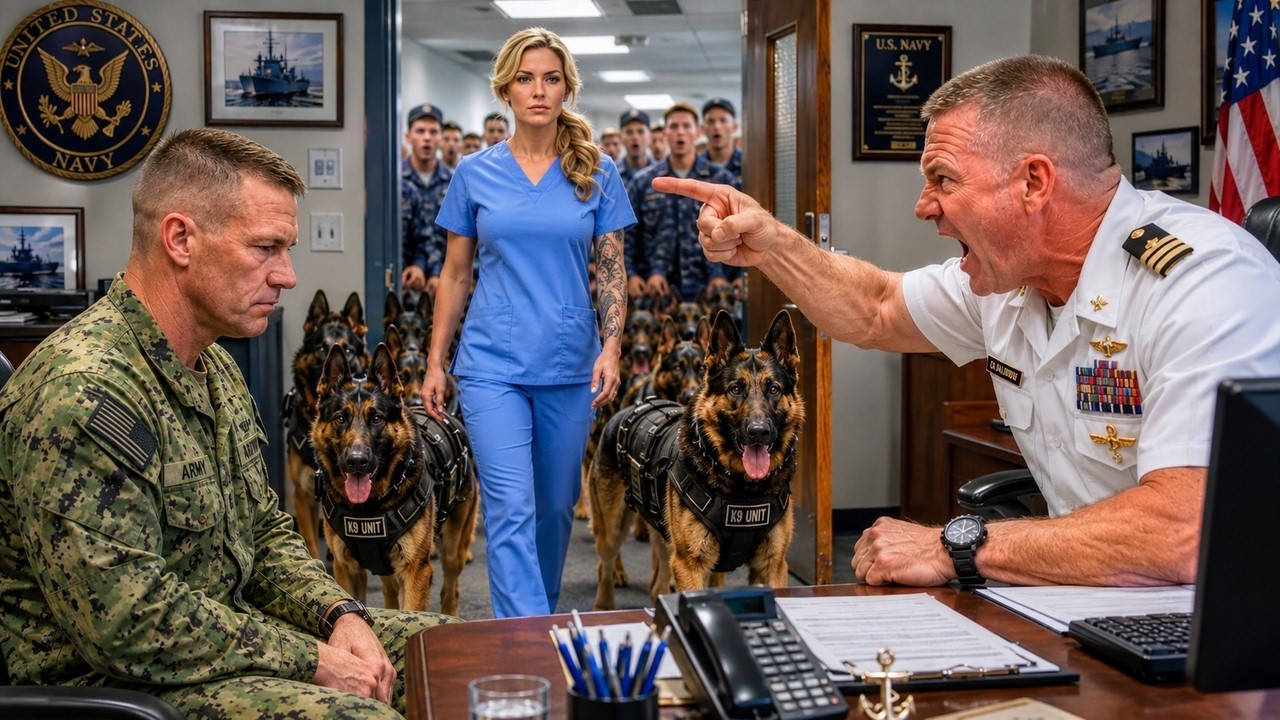
It was the kind of federal facility that existed to process paperwork rather than inspire anything. Fluorescent lighting, plastic chairs, forms that asked for the same information in slightly different formats across multiple pages. Caden checked in, received a number, waited 14 minutes, and was directed to a processing officer.
Major Brent Osland was in his mid-40s with the build of a man who had once passed physical assessments and was now primarily a desk presence. His uniform was impeccable. His desk held a name plate, a computer monitor angled slightly toward visitors, and a framed citation on the wall positioned so that a person sitting across from him would have difficulty avoiding it. He looked at the folder.
He looked at Caden. He looked back at the folder. Jessica Vel, he said. Your mother. Yes, sir. It says here, “She served under a joint special operations designation.” He tilted his head slightly. Tier classification redacted. Authorization chain not visible in my system. I know. You know, he repeated it with the particular inflection of someone setting down a word to examine it.
She’s listed here as currently employed at Coastal Reach Regional as a trauma nurse. Night shift. Yes, sir. Osland looked up. His expression was not neutral. A trauma nurse with a tier level redaction on a special operations file that I, as a federal education benefits officer, am not authorized to view. He closed the folder with a deliberate quiet snap.
I imagine you understand how that sounds. Caden felt the first pull of something behind his breast bone. Not anger yet. Awareness. The awareness that this was going to take longer than it should. The file is unusual because of how it’s classified, not because it’s inaccurate. Oseland leaned back. Son, I’ve processed thousands of dependent benefit claims.
I’ve seen records stretched, dates adjusted, service periods inflated to reach eligibility thresholds. It happens. A pause. What does not happen is a redacted tier designation on a file with no supporting chain I can access in any system available to me. Maybe you’re not cleared for those systems.
Something crossed Oslin’s face. Not anger. Not quite. I’m going to ask you to be very careful right now. I’m not trying to be disrespectful. You’re presenting documentation that doesn’t hold up. Oseland said, his voice dropping to a register that was deliberate and controlled. I’m going to need to flag this application for review, which suspends your scholarship claim pending a fraud investigation.
He reached for a pen. This conversation is going to take considerably longer than you planned for. The word fraud registered in Caden’s chest the way cold air does, abrupt and total. He thought about the folder, the way his mother had organized every page, the labeled dividers, the fact that she’d laid it on the kitchen counter with a sticky note rather than leaving it to chance.
He thought about her, looking at him across the table the previous evening, saying only that the documentation was complete and the truth was on his side. “Can I call her?” he asked. “You’re not under arrest,” Osceland said standing. “Do what you need to do.” Caden called his mother three times.
The first went to voicemail. The second rang twice and cut off. The third was answered on the first ring by a voice that wasn’t hers. A man brief and professional who said only, “She’s coming. 20 minutes and ended the call.” Cadence stared at his phone. Around him, the office ran its ordinary operations. Printers hummed.
Someone in a hallway laughed at something. A specialist carried a stack of folders past the glass partition without looking in. He’d grown up in a specific kind of quiet that wasn’t peaceful. The kind that accumulates in a house where certain questions never get asked because some part of you understands the asking would change the shape of everything.
He’d learned early that his mother checked the locks twice, that she sat with her back to walls and restaurants, that she returned missed calls only from numbers she already knew, and that she sometimes went very still in a way that had nothing to do with the room she was physically in. He had built his childhood around the frame of her, not the contents.
Now he sat in a plastic chair in a federal office and held the phone on his knee and waited. Major Osland returned 11 minutes later with a second officer, a young sergeant named Peele, who had the expression of someone positioned to witness something they would rather not see. “We’re initiating the fraud referral,” Oselyn said. “I need a formal statement.
” The building shook. Not violently, no lateral roll, no disorientation, just a deep low vibration that traveled through the floor and up through the chair legs. The kind produced by something massive moving in for information just beyond a wall. Osland stopped mid-sentence. Peele looked at the ceiling.
Through the glass partition, Caden watched people in the outer office turn from their screens. Then the sound arrived. synchronized footfalls, not boots, not human, rhythmic and precise, advancing down the main corridor. Dozens of them, then more than dozens. Osceland moved to the door and opened it. The hallway was full of dogs.
Belgian Malininoa and German Shepherds in tactical harnesses, moving two by two with their handlers from wall to wall. They covered the corridor in both directions as far as Caden could see through the partition glass. They did not bark. Their handlers moved with them using only hand signals, a raised fist, a flat palm, and the animals responded with a precision that made the whole mass of them feel like a single organism, deliberate and unhurried.
The sound of it, 178 dogs on government tile, was something between a drum roll and a warning. People stepped back, not because anyone asked them to. The formation slowed. The handlers brought it to a halt by gesture, and the dog sat in unison, filling the hallway. And then the doors at the far end opened one more time, and she walked through.
Jessica was still in her scrubs. She had the kind of face that cameras never capture correctly because what it communicated wasn’t a single expression. It was a quality of attention, focused and total, that reduced the space around it to context. She was 32, medium height, with a stillness in the way she moved that covered ground without appearing to hurry.
She walked through the formation, and every dog she passed turned its head to follow her with the recognition of animals, marking the location of someone they already knew. She stopped at the doorway of Oseland’s office. Mrs. Cavlland had found his voice, though it was doing something different now, operating below its usual register.
I was just explaining to your son. I know what you were explaining. She looked past him to Caden for one second, the particular look she gave him from doorways, carrying more than it showed. Then she looked back at Osland and stepped into the office without being invited and sat in the empty chair beside her son. And the effect of that, a woman in blue hospital scrubs sitting down across from a uniformed major in a federal building surrounded by over a hundred military working dogs was more authoritative than anything Osland had managed in the
previous 40 minutes. The records you can access are incomplete because your clearance level doesn’t reach the classification tier covering my service history, she said. That’s not a flaw in my documentation. That’s the architecture functioning as intended. Oseland found some of his composure. Anyone can claim their records are classified. That’s not verification.
That’s She said a phone on his desk. Matte black, compact, no visible carrier branding. A handset that did not look like anything he had seen before in a civilian context. When it rings, she said, “Answer it.” He looked at the phone. He looked at her. “I’m not going to.” The phone rang. One flat tone, then silence, then a second flat tone.
Osland picked it up. He listened. The color left his face in stages, not all at once. In the specific way a tide goes out, receding from his jaw first, then his throat. His posture underwent a different kind of change, an incremental compression, a man growing smaller inside his uniform. He said, “Yes, sir.” twice, and then a third time, very quietly, and put the phone down on the desk and did not touch it again.
He did not look at Jessa. Approve the application, she said. Clear the fraud referral. Process the full scholarship benefit and the rot verification package. Yes, Osceland said. Cadence sat in his chair and watched his mother and the ordinary woman who had made his school lunches and sat with him through chemistry finals and answered his calls from the hospital parking lot at midnight quietly became someone else entirely without moving a single muscle to make it happen.
The reversal took 8 minutes. Oseland processed it in silence, printed the confirmation, slid it to the edge of his desk facing Caden without meeting either of their eyes. The referral has been cleared. The application is approved. ROC verification is processed. He cleared his throat. There’s nothing outstanding. Jessa looked at the printed form for a moment.
You told my son his family’s documentation was almost certainly fabricated, she said in front of a witness. You used the word fraud in reference to his application. You threatened a formal investigation against a 17-year-old who came in here with properly assembled paperwork and told you the truth. She let that sit for a moment. He did everything correctly.
You made it harder than it needed to be because you made an assumption and the assumption was wrong. Osland looked at Caden, actually looked at him perhaps for the first time. “I apologize,” he said, “for how I handled this.” That was He stopped, started differently. “I’m sorry.” Caden didn’t say it was fine.
He picked up the printed form from the edge of the desk and nodded once. In the hallway, the K-9 formation registered the change in status with the subtle collective attention of animals that had been waiting. Handlers looked toward the doorway. Dogs turned their heads. Osland watched from behind his desk and looked for the first time in the interaction like someone measuring the full dimensions of a mistake.
Outside in the parking lot in the cold of a Virginia November morning, Caden walked beside his mother through air that smelled of salt and distance and tried to organize what he now knew into something with edges. “How many are there?” he asked. She considered for a beat, 178, including handlers. “How long did it take you to arrange that?” She looked straight ahead.
I made some calls before my shift ended. He understood what that meant. She’d known. She’d anticipated exactly what Oslin would do, and she had moved accordingly. And what he’d walked into that morning as a routine documentation meeting had already been prepared for by someone who did not walk into rooms unprepared. You filed a report, he said. It wasn’t a question.
Last night, when I received confirmation the claim had been flagged before you even knew how bad it would get, I knew enough. She unlocked the car. Get in. I’ll explain what I can. She explained in the way she always did things. Carefully with precision, leaving certain doors closed and others open wider than she had before.
19 years of service. Conventional military first. Then a recruitment process she described as thorough and unusual and lasting almost a year. Then operational work across locations she named in geography and duration, but not in what happened there. He had 17 years of questions. He chose them carefully.
The scar, he said, on your forearm. A pause, not a climbing accident. I know. She turned onto the highway. The shipyard cranes were visible to the east, enormous and still against the gray sky. There’s something else, she said, and the quality of her voice shifted in a way he had never heard from her before.
Not loss of composure, she didn’t lose composure. a change in density, as if she was carrying something that had been held under her other words for a long time and was now moving it into view. Something from seven years ago that I thought was resolved, closed, archived permanently. What kind of something? She kept her eyes on the road, the kind that doesn’t stay buried even when you bury it correctly.
The file had been dormant for 7 years. A cross- reference audit in a routine system maintenance cycle had flagged a documentation anomaly in an operation designated ridge line. The analyst who pulled it ran a background check on all personnel listed and found a name that had come up 72 hours earlier in an unrelated education benefits incident at a federal center in Virginia.
The call from Admiral Silven Price reached Jessa at 4 that afternoon while she was in the car with Kaden on the westbound highway. the light going low and copper over the bay. She took it on speaker. She had decided during the 40-minute drive that some doors were going to open today, whether she directed them or not. Admiral Price’s voice was measured and specific.
The anomaly flagged in the Ridgeline audit was a discrepancy between the casualty record of Sergeant Drew Hollyy and the field report Jessa had submitted from the extraction point 7 years ago. The casualty record listed cause of death as operational environment hazard indirect fire.
Jessa’s original field report, superseded within 48 hours by her commanding officer’s documentation, listed the cause differently. Friendly coordination failure. The commanding officer at the time, Major Conrad Feller, now Brigadier General Conrad Feller, currently assigned to the Pentagon’s joint planning directorate. I need you to come in, Price said.
today if possible. There’s a second element. I’ll come in, she said. I’m bringing my son as far as the lobby. A brief pause. Understood. At the facility, Cadence sat in a waiting room with a paper cup of bad vending machine coffee and his rot scholarship confirmation folded in his jacket pocket, and he thought about Drew Hollyy, a name he had only just heard and was already beginning to understand the weight of.
He thought about his mother’s voice when she’d said there was something from seven years ago. The specific texture of something carried a long time without being set down. He thought about the winter he was 10 when she’d been away for 9 days and had come back with her left shoulder wrapped and an explanation about a fender bender that didn’t quite fit the way she moved.
He thought about the locked door, the 3:00 in the morning kitchen, the way she checked the car before she got in every single time, even in their own driveway, even when they’d been home all day. He’d been building the same picture for years. He just hadn’t let himself look at it directly.
Inside, Jessa sat across from Admiral Price and spoke on the record for the first time about what she had written in her original field report. Drew Hollyy had been her teammate. He’d intercepted secondary channel traffic during a reconnaissance position on day nine of operation Ridgeline. Traffic that did not match their operational net, carrying information that should not have existed on that frequency.
He’d logged it immediately, flagged it through the correct chain, and was dead within 6 hours. Her field report said what she’d assessed that the coordination failure enabling the hostile contact that killed him was internal, that someone above the field level had passed their position to people who should not have had it.
Feller had superseded her report inside 48 hours of submission. He had attributed the channel traffic to equipment malfunction and the contact that killed Hollyy to environmental hazard. She had been a sergeant. He had been her commanding officer. The operation was classified. Hollyy was already gone.
“Why did you accept the super session at the time?” Price asked. Jessa looked at the small recording device on the table between them. “Because I’d been awake for 60 hours.” “Because I had an injury I hadn’t yet reported. Because a formal challenge against a superior officer on a classified operation would have taken everything I had left.
and I had a 10-year-old at home and I needed to survive the year. She kept her voice level. Both reasons were true simultaneously. I’m not able to separate them and I’ve stopped trying. Price nodded slowly. We found something in the audit beyond the field report discrepancy. He opened the file to a flagged page.
Financial transfers connected to accounts linked to Feller beginning 14 months before Ridgeline ending 6 months after. They connect to a foreign intelligence adjacent network active in the operational region during that period. The room was very quiet. He wasn’t covering a bad call, Jessa said. No, he wasn’t. She looked at the table.
Drew Hollyy had been 31 years old. He had a daughter named Sophie who was four when he died and was 11 now, living in Tucson with her mother. He had died because he found something he was supposed to find and reported it exactly the way he was supposed to report it. And the person who should have acted on that information had instead used it to end him.
I want the investigation to center on Drew’s casualty record, she said, not on my report being validated or my service record being acknowledged, on his death being documented accurately. He has a daughter who deserves the right version of who her father was. Price looked at her for a long moment. That’s all you want. That’s the first thing I want.
The second is that this goes where the evidence goes, regardless of where Feller sits now. He closed the file. I’ll need you for further testimony. I’ll be available. She stood and there was something in the rising that was not triumphant and was not easy. the particular sensation of a person who has put down something heavy and is still surprised by the lightness that follows.
Caden was in the waiting room where she’d left him, but he was not alone. Sitting across from him in the corridor chairs was a man she had not seen in 7 years, though she had thought about him on a rotating basis for all of them. Corporal Tomas Valz medically separated from service 4 years after Ridgeline last known address a PO box in Richmond that had been closed for 3 years.
He was 41 now thinner than she remembered with a steadiness in his eyes that had been hard one and cost more than it should have. He looked at her from across the waiting room and said simply, “I’ve been waiting for someone to open that file.” He had been with Hollyy at the secondary channel position on day 9. He had heard the traffic.
He had been in the debrief when Feller attributed it to equipment malfunction, and he had not had the rank or the record to contest it. He’d requested a voluntary meeting with the investigative team and had been living 30 minutes from Grover’s Landing for 2 years. Close enough to move when the file opened.
You knew it would open eventually, she said. I knew the math didn’t hold forever. He looked at Caden, then back at her. Your son the one who started this? He needed his paperwork processed. She said everything follows from there. The almost smiled. Usually does. The investigation moved with the particular momentum of federal proceedings that carry strong evidence and high-profile subjects.
Feller was notified, retained counsel, and 2 days later was found to have accessed a secure archive at his Pentagon office after hours, removing physical documentation. He was detained at Dulles airport the following morning with a flight plan already filed. He had not gone quietly which told everyone watching what the physical files almost certainly contained.
The charges when filed were specific and extensive conspiracy to commit espionage, falsification of official military records, conduct resulting in the death of a service member. The financial documentation connected him to a foreign intelligence network across four years of his command. Ridgeline was not the first.
The audit established two prior operations with anomalous casualty records, two prior investigations now reopened. Additional families who would receive calls about their loved ones death records being formally reviewed. Osland’s disciplinary proceedings were quieter. The formal findings came 3 weeks after the original incident. Abuse of processing authority conduct unbecoming, deliberate obstruction of a legitimate education benefit claim.
His authorization was permanently revoked. 21 additional cases from his processing record were identified, each one corrected individually. Cadence was first on the correction list. He received the formal notification in the mail and sat with it at the kitchen table for a long time before he opened it.
Inside three pages of institutional language that stripped down to one thing. You were right. He was wrong. We know it now. He looked up at his mother who was sitting across from him with both hands wrapped around a mug she wasn’t drinking from. It doesn’t feel like as much as I expected, he said.
The paperwork is the record of what already happened. She said the actual thing that happened on Tuesday. The form is just the proof that it was real. He thought about that. Drew Hollyy’s file. Revised last week. Cause of death corrected in the official record. Hostile action facilitated by command level compromise. She set down the mug.
His daughter was notified before the formal change was filed. I ask that she hear it from a person first, not a document. How old is she? 11. Caden was quiet for a while. The November afternoon light was doing something specific through the kitchen window. That low latefall slant that made everything look slightly more consequential than it was.
You’d been carrying this for 7 years, he said. Yes. And you didn’t say anything because because you were 10 when it happened and then you were 12 and then 14. And every time I thought about telling you, I imagined what your face would look like, and I wasn’t ready to watch you carry it, too.
She looked at the table between them. That was cowardice, not protection. Both things can be true at once. I was afraid anyway, he said, “The whole time. Whatever you were protecting me from, I was afraid of the shape of it, even without knowing the shape.” I know. Quietly. I know you were. He turned the printed notification over. The back was blank.
“When you brought all those dogs,” he said, “How did you know what Osland would do?” She looked at him with something in her face that was not quite a smile. I’ve been in enough rooms to know what a certain kind of person does when they’re unchecked, and someone ordinary is sitting across from them.
She picked up her mug again, and I know what stops them. It’s not a quiet call. It’s not a favor. It’s visibility making the thing be seen. She looked at the window. I learned that 7 years ago and then I forgot it for a while and Tuesday reminded me. Because I went in alone. Because you went in period. You had the paperwork. You told the truth.
Everything that followed came from that. She met his eyes. The chain was already there. You just walked into it. He held the notification form for a while longer. Outside the evening was coming in off the bay. that particular darkening that happened fast in November. And the house was warm and smelled like the coffee she’d made and the dinner she’d started before they sat down.
And it was as ordinary as it had ever been. And it was also not at all the same. Drew Hollyy’s casualty record was formally corrected 41 days after the initial audit flag. Sophie Hollyy, 11 years old, living in Tucson, would grow up knowing that her father had found something important and reported it correctly and been killed because of what he’d found, not because of bad luck, not because of an environment, because he had been good at his job at a cost that was real and documented and finally permanently on the record.
Jessa read the revision notification the morning it arrived and sat on the back porch in the November cold for a long time, letting the bay air come in off the water, not thinking about anything in particular, just sitting with the specific weight of something that has been set down after a very long time and the way the body doesn’t quite know what to do without it.
Tomas VeZ called her three weeks later from a military working dog training program in Northern Virginia where he’d just been hired as a lead handler. His medical discharge had been reviewed and reclassified. The board found that the separation evaluation had been influenced by a commanding officer recommendation that overstated his condition and understated his capacity.
His voice on the phone carried something she hadn’t heard in it in 7 years, possibly ever. the specific ease of a person who is exactly where their skills belong. Feller entered a guilty plea in December. His attorney’s statement cited the weight of evidence. It did not include an apology which Jessa read as its own kind of admission.
A man who had nothing nothing useful to say and understood that. Caden passed his wrote TC application review. The same week he came home from the confirmation meeting and set the letter on the kitchen table next to the original benefits notification from November, the two forms side by side and stood looking at them with his mother.
You said something to me in the car, he said on the way back from the facility that first day. You said the kind of thing that doesn’t stay buried even when you bury it correctly. He looked at her sideways. I’ve been thinking about that. She waited. I think you were talking about more than the file, he said.
She was quiet for a long moment. Yes. He straightened the two forms against the table edge, lining them up with the particular care of someone organizing something they intend to keep. I used to think the way you operated, never explaining yourself, always handling things alone. I thought that was what strength looked like, that being self-contained was the goal.
I thought so too, she said for a long time. But Tuesday wasn’t that. No, Tuesday was the opposite. She looked at the forms. The only thing that actually changed anything was putting the accurate version in a room where it would be written down. The dogs, the phone, the report I filed the night before, the testimony, all of it visible, all of it documented. She paused.
Strength that nobody sees is just loneliness with better posture. It doesn’t stop Osland. It doesn’t give Sophie Hollyy the right record about her father. It doesn’t give Tomas VeZ his discharge back. She touched the edge of the November notification. Visibility was the thing, the willingness to be the person who says the true thing in the room where it gets written down.
Caden looked at her, the woman who had made his school lunches and helped him through chemistry finals and answered his midnight calls from hospital parking lots and checked the car locks every single time, even in their own driveway. and the woman who had walked through 178 dogs in blue scrubs and placed a satellite phone on a major’s desk like like a quiet detonation.
He was only now old enough to hold both of those people in one frame at the same time without one of them canceling out the other. I should have asked more, he said earlier. You asked what I was ready for, she said. That’s not a failure. That’s patience. She looked at him directly.
I’m the one who needed to be readier sooner. She touched his shoulder, that specific contact she gave him from doorways, carrying the same information it always had. I’m here and so are you, and that is enough. And then she went to finish dinner. He stood at the kitchen table with the two forms and listened to the ordinary sounds of a house running and thought about chains.
The chain that ran from a Tuesday morning benefits appointment through a major who would never process another claim through a general in federal custody through a file sealed for 7 years and opened by a routine audit. through 178 dogs on government tile, through a woman in scrubs who had walked through all of it without appearing to hurry, and all the way to an 11-year-old in Tucson with the correct version of who her father was.
He had gone in with a folder and a sticky note that said, “You have this.” It turned out that was exactly